





The BSRIA Air quality hub

|
| https://www.bsria.com/uk/air_quality_hub/ |
Contents |
[edit] Introducing the Air Quality Hub
The air quality hub BSRIA was set up to share knowledge to members, professionals and the public about air quality, its importance in homes, schools, and workplaces, and how indoor air quality can be managed in buildings to limit occupant exposure to harmful contaminants.
Following this the BSRIA Briefing 2023:"Cleaner Air, Better Tomorrow" brought up a number of indoor and outdoor air quality related issues, to find out more see article discussing issues related to discussing issues related to inside and outside air quality in 2023.
[edit] What is air quality?
Air of good quality is air in which there are no known contaminants at harmful concentrations. Air pollution can have a negative impact on our health; from short term effects such as eye irritation and coughs to long term effects such as respiratory infections and cancer. The effect on health depends on the contaminant concentration and exposure time.
[edit] Indoor Air Quality (IAQ)
In the UK, people spend approximately 90% of their time indoors. The quality of indoor air is affected not only by outdoor pollution, but also by indoor sources and inadequate ventilation. Tobacco smoke, mould, and chemicals released from synthetic fabrics, paints, furnishings and household products are some of the sources of contaminants that make indoor air worse than outdoor air at times. Indoor air pollutants may be biological, such as dust mite faeces, mould spores, viruses and pollen, or chemical, such as carbon monoxide, ozone and volatile organic compounds.
Download the free BSRIA Indoor Air Quality Topic Guide.
[edit] How to assess indoor air quality
Given the impact of air quality on the health and wellbeing of building occupants, measuring IAQ is a vital step in managing the indoor environment to ensure that exposure to harmful contaminants is kept to a safe level.
Find out more about harmful contaminants at the BSRIA Blog.
To demonstrate how air quality can be monitored, BSRIA has installed air monitors throughout its UK premises and has made the live data publicly visible.
View the live data from BSRIA’s air monitoring initiative.
Indoor air quality sensors were installed throughout BSRIA’s offices and meeting rooms as part of the effort to support the wellbeing of staff, delegates to BSRIA training courses, and other visitors.
View BSRIA Instrument Solutions range of air quality instrumentation.
BSRIA Microclimate Team Leader, Calum Maclean, describes the process of monitoring air quality at BSRIA's premises in this video.
[edit] How to improve indoor air quality
Monitoring IAQ is just one of the steps required to effect a positive change in the indoor environment. Prior to installing the sensors, BSRIA indoor air quality specialists carried out an extensive investigation of its premises. This included measuring ventilation system volume airflow rates, verifying the air distribution within the building, and quantifying air changes per hour using carbon dioxide tracer gas tests.
This exercise provided an actual baseline dataset to establish if CO concentrations below 800ppm in line with the [https://www.rehva.eu/rehva-journal/chapter/co2-monitoring-and-indoor-air-quality Federation of European Heating, Ventilation and
Air Conditioning Associations REHVA] guidance on reliable indoor air quality could be maintained across the premises and in meeting rooms. The outcome of the measurements prompted the installation of additional local extraction fans to ensure safe and comfortable occupancy.
[edit] The BSRIA Air Quality Hub
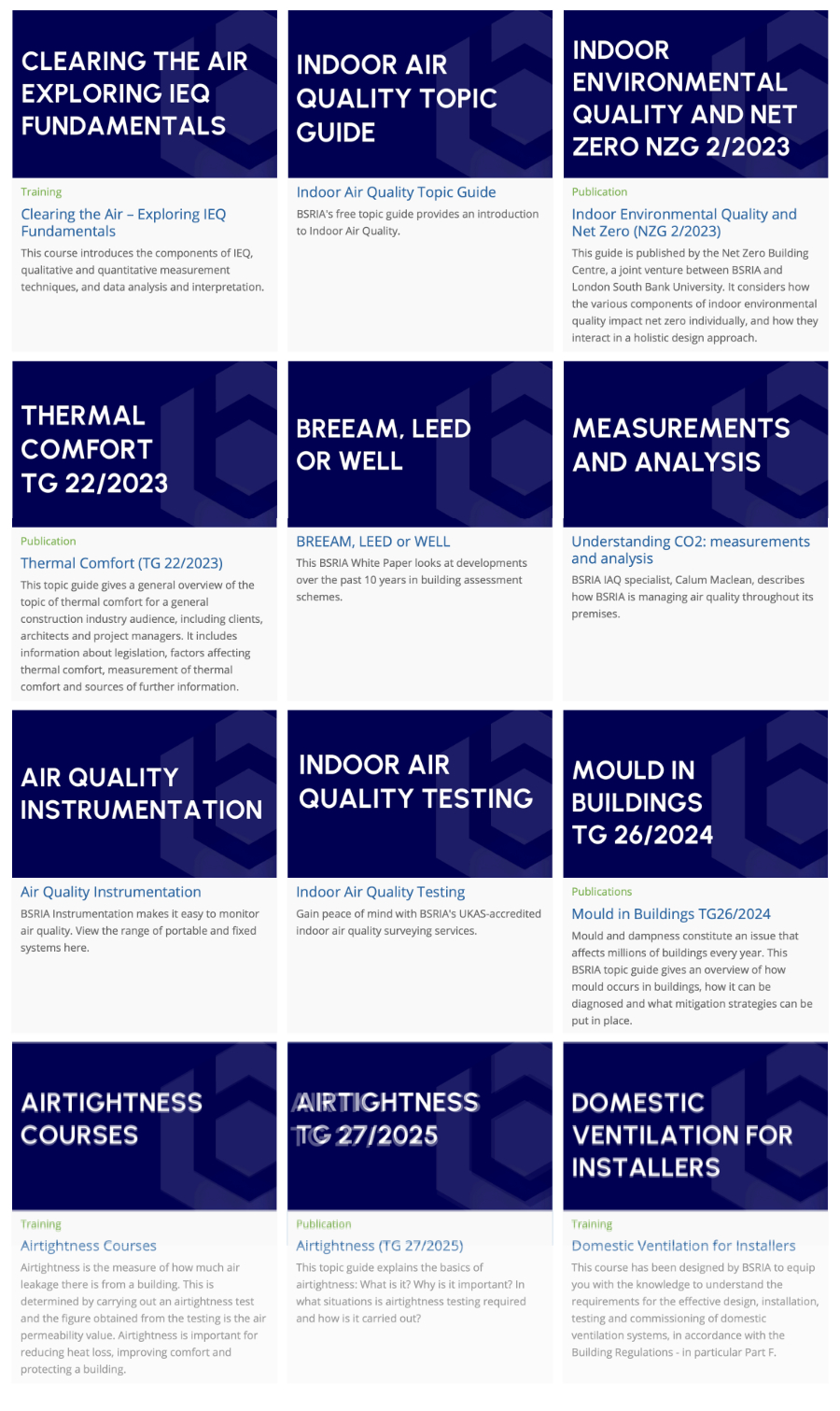
Click here or on the image below to explore the menu of resources available from the BSRIA Air Quality Hub.
--BSRIA
[edit] Other reports and links:
BREEAM, LEED or WELL (WP 13/2020)
[edit] Related articles on Designing Buildings
- Air pollution index
- Air quality in the built environment
- Air Quality Taskforce
- At a glance - Indoor air quality
- BSRIA responds to UK Air Pollution Report.
- Bringing a breath of fresh air to the design of indoor environments.
- Construction dust
- Discussing issues related to inside and outside air quality in 2023.
- Ensuring good indoor air quality in buildings
- Fresh air
- Health effects of indoor air quality on children and young people
- High pollution location
- Indoor air quality
- Indoor environmental quality
- Locating ventilation inlets to reduce ingress of external pollutants into buildings: A new methodology IP 9 14
- Mechanical ventilation's role in improving indoor air quality
- National Health Service Act of 2006
- Smog
- Sources of external pollution
- TSI Environmental dust monitoring system
- Ultra Low Emission Zone
- United Nations Economic Commission for Europe UNECE
Featured articles
Check out some of the best features and news from Designing Buildings as well as key stories from around the web.

Government approach could undermine delivery and regeneration.
World's first mass timber data centre.

The overlooked environmental aspect of data centre development.
Introduction to radon awareness

New technical information sheet published by CIOB.

Updated supplier guide can help electrical contractors engage with NHP.

CIAT confirm the winners of the 2026 architectural technology awards.

Government launches a one stop shop for flood preparedness.

Sir Edwin Lutyens: Britain's greatest architect? Book review.

CIOB publishes free template to help assess and manage risks.
ECA's reflections on Party Conference season

Burnham wants to be confident of winning before asking for a fresh mandate.
New Chief Construction and Scientific Adviser

Sergio Cavalaro, Professor of Infrastructure Systems at Loughborough University.
Building safety levy for England

CIAT publish estimator tool for members.

Water sector faces a growing crisis that could slow the delivery of vital infrastructure.