





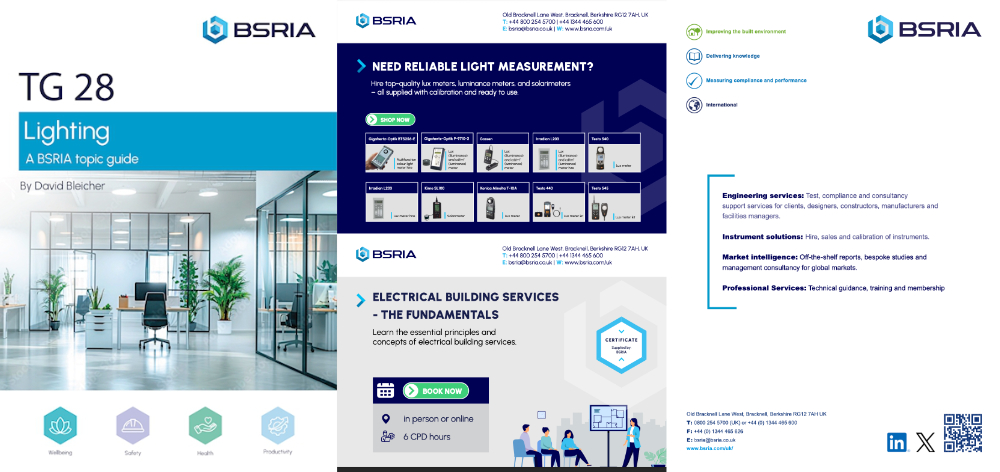
Lighting: A BSRIA topic guide TG 28/2025
[edit] Introduction to the fundamentals of lighting
This BSRIA topic guide introduces the fundamentals of lighting to a broad construction industry audience.
Lighting which is well designed, correctly installed and properly operated and maintained has many benefits for building occupants, including safety, health, wellbeing and productivity. Achieving the correct level of lighting (illuminance) is important; however, quality of lighting is just as, if not more, important than quantifiable measures. Issues such as glare, veiling reflections and shadows can make a big difference.
The purpose of this topic guide is to introduce basic concepts of lighting from an indoor environmental quality (IEQ) perspective. It covers:
- Basic principles of lighting design
- Legislation and guidance related to lighting
- Information about carrying out lighting assessments
It is aimed at a general construction industry audience, including clients, architects and project managers. The focus is indoor lighting in buildings such as offices, schools, hospitals and industrial buildings. It’s not just about artificial light – daylight is freely available and, where possible, buildings should be designed to maximise its use.
Lighting – a key factor in indoor environmental quality
Indoor environmental quality (IEQ) refers to the overall conditions within a building that affect the comfort, health and wellbeing of its occupants. BSRIA has published a series of topic guides covering different aspects of IEQ:
There are many other factors that affect the wellbeing of people in buildings, including ergonomics, accessibility and biophilia (connection to nature). BSRIA has also published a topic guide covering this much wider topic:
[edit] Common customer questions & answers
- Question: Who should read this guide?
- Answer: Anyone involved with buildings, but who isn’t themselves an expert on lighting, would benefit from reading this guide to get a better understanding of the issues. This may include architects, projects managers and facilities managers.
- Question: Is this a lighting design guide?
- Answer: This BSRIA topic guide doesn’t provide design procedures; however, it outlines some of the key principles of lighting design and refers to more detailed guidance for professional lighting designers.
Key information about lighting for architects, project managers and specifiers, focusing on occupant productivity and wellbeing
For a sample preview or free digital download of TG28/2025 follow this link and selection option.
This article appears on the BSRIA website as "Lighting - A BSRIA topic guide (TG 28/2025)" dated 14 october, 2025.
--BSRIA
[edit] Related articles on Designing Buildings
- All about wellness.
- BS ISO 45003 Psychological health and safety at work - managing psychosocial risks.
- BSRIA Noise in the built environment TG 20/2021.
- BSRIA Thermal comfort TG22/2023 update.
- Building services and health risk resilient buildings.
- Commercial lighting.
- Daylight factor.
- Emergency lighting.
- EN 17037 Daylight in buildings.
- General lighting v task lighting.
- Health and wellbeing impacts of natural and artificial lighting.
- Human-centric lighting.
- Illuminance.
- Indoor air quality BSRIA TG 12/2022.
- Light and lighting articles.
- Light pollution.
- Light spill.
- Light well.
- Lighting and energy efficiency.
- Lighting and health infographic.
- Lighting for circadian rhythms.
- Mental health and wellbeing.
- People-friendly lighting controls.
- Types of lamp.
- Types of lighting.
- Types of building EN 17037 applies to.
- Use of lighting to improve health and wellbeing.
- Visible light.
- Wellbeing and buildings.
- Wellbeing in Buildings TG 10/2025.
- WELL Building Standard.
Featured articles
Check out some of the best features and news from Designing Buildings as well as key stories from around the web.

CIOB celebrates positive Ofsted report.

The Building Safety Regulator announces a call for evidence.

Government approach could undermine delivery and regeneration.
World's first mass timber data centre.

The overlooked environmental aspect of data centre development.
Introduction to radon awareness

New technical information sheet published by CIOB.

Updated supplier guide can help electrical contractors engage with NHP.

CIAT confirm the winners of the 2026 architectural technology awards.

Government launches a one stop shop for flood preparedness.

Sir Edwin Lutyens: Britain's greatest architect? Book review.

CIOB publishes free template to help assess and manage risks.
ECA's reflections on Party Conference season

Burnham wants to be confident of winning before asking for a fresh mandate.
New Chief Construction and Scientific Adviser

Sergio Cavalaro, Professor of Infrastructure Systems at Loughborough University.