





Construction management: post occupation evaluation

Post occupancy evaluation is the process of determining how successful the delivery of the project was, how successful the completed development is, where there is potential for further improvement, and what lessons can be learned for future projects. It can be particularly valuable to repeat developers and may be a requirement of some funding bodies.
In practice, post occupancy evaluation may begin during the defects liability period. Ideally the client should commit to carrying out post occupancy evaluation at the beginning of the project so that appointment agreements and briefing documents can include a requirement to test whether objectives were achieved.
[edit] Appointing consultants.
Post occupancy evaluations may be carried out by an in house team, by members of the consultant team or independent client advisers (we attribute them below to a consultant for simplicity of presentation). However, as post occupancy evaluation is likely to take place after the main construction contract has been completed, consultant team appointments may also be completed (unless post occupation services were a specific requirement of the original appointment). If such services were not a requirement of the original appointments then new appointments may be necessary.
[edit] Carrying out a post project review.
A post project review may commence during the defects liability period. Its purpose is to evaluate the project delivery process rather than to assess performance in use (which is assessed later in this stage).
The consultant and client hold a start-up meeting to confirm the scope of evaluation required and agree the reporting procedures and programme for the stage. The client issues relevant information that may have been compiled during the design and construction phases to the consultant.
The consultant makes site visits to identify any issues that need to be addressed immediately. They may establish a help-desk and rapid response team if this has not already been done by the client.
The consultant monitors completion of the building owner's manual if this has not already been completed and ensures that other project documentation has been properly completed and handed over to the client (see handover to the client).
The consultant obtains the views of the construction manager, trade contractors, designers, suppliers and the client about how well the project was managed. This may include assessments of: the quality of briefing documents; the effectiveness of communications; the performance of the entire project team; quality issues; health and safety issues; certification; variations; claims disputes; and collaborative practices.
The consultant considers how well the delivery of the project performed against key performance indicators and evaluates what lessons can be learned from the approach taken. They then prepare an assessment and lessons learned report for the client.
[edit] Assessing performance in use.
Performance in use assessments cannot begin until 6 to 12 months after occupation, as operations may not be properly established and the building will not have operated in all seasons. It may then be part of a continuous process.
The consultant and client hold a start-up meeting to confirm the scope of the evaluation required and agree the reporting procedures and programme for the assessment. The client issues relevant information that may have been compiled to the consultant.
The consultant carries out evaluations of business objectives, which may include:
- The achievement of business case objectives.
- Whole-life costs and benefits against those forecast (including assessment of capital vs running costs).
- Whether the project continues to comply with the business strategy.
- Whether operations have improved.
- The resilience of the development and business to change.
- Business and user satisfaction (including staff and user retention and motivation).
The consultant carries out evaluations of the design, which may include:
- The effectiveness of the space planning.
- Aesthetic quality.
- The standards of lighting, acoustic environment, ventilation, temperature and humidity.
- Air-pollution and air quality.
- User comfort.
- Maintenance and occupancy costs.
- Defects.
- The balance between capital and running costs.
- An assessment of whether the development is being operated as designed.
- Environmental performance and energy consumption in use.
The consultant prepares a report that:
- Compares their findings to the original targets set out in business case (the original targets may need to be updated to reflect changes to the project brief during the design process, inflation etc).
- Compares findings to other projects and industry standards.
- Compares the outcome of the project with the position had the project not taken place.
- Identifies issues and recommends remedies.
- Makes recommendations for improvements in performance for future projects.
Other services that could be provided by consultants during this period might include: providing advice on letting, rating, maintenance, energy consumption, insurance, tenants queries, facilities management, the production of energy performance certificates, BREEAM assessments, the preparation of tender documents for maintenance and operation contracts and so on.

Featured articles and news

We're expanding our collaborative mission by launching DB Intelligence, an exclusive market research advisory panel. Built environment professionals can now get paid to share their expertise on industry trends, products and services.
Panel members receive direct financial incentives for participating in research projects like short surveys, 1-2-1 interviews and focus groups. Register today to shape the future of the construction sector.
Planning condition discharge in England and Wales

A brief exoplanation from a building compliance expert, with further links.
Overheating guidance and tools for building designers

Guidance for dealing with element of building fabric control that have increasing importance.
Shading for housing, a design guide

From the Good Homes Alliance and British Blind and Shutter Association.
UK Standard Skills Classification (SSC)

A shared framework for describing skills needs.
Social media ban consultation comes to close

CIOB urges UK Government to consider social media’s role in careers guidance in ban debate.
The latest of eight Skills England apprenticeship units

The addition of battery manufacturing welcomed by ECA with a warning about the risks of fast-tracked apprenticeship units.
Building Control Independent Panel final report
A precis of a key report led by Dame Hackitt with full recommendations and link to the government response.
Building Safety recap April, 2026
A short and longer run-through of the month, with links to further information and sources.

CIAT May 2026 briefing.

From medieval scribes to modern word art.

ECA welcomes crackdown on late payment and push for clean energy, whilst CIOB seek fixed cladding removal timeframes.
Cyber Security in the Built Environment
Protecting projects, data, and digital assets: A CIOB Academy TIS.
Managing competence in the built environment
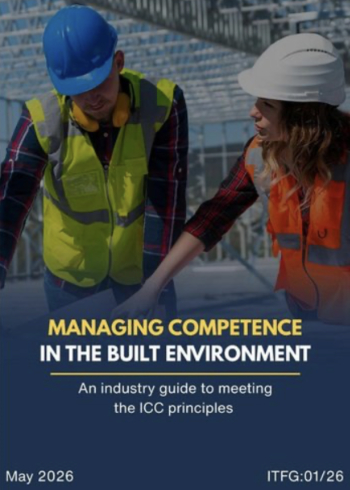
ITFG publishes new industry guide on how to meet the ICC principles.
The UK's campaign to reduce noise pollution: Mythbusting, articles and topic guides.
Comments
Thank you very much for this great blog post.