




Pre-construction services agreement PCSA

[edit] What are Pre-Construction Services Agreements?
Pre-Construction Services Agreements (PCSAs), sometimes referred to as Pre-Contract Services Agreements, enable clients to employ contractors before the main contract for the construction of the works has been awarded. Typically they are part of a two-stage tender process, used in the first stage to procure contractor involvement in the design process, where the second stage procures the construction of the project.
Early appointment of the contractor under a Pre-Construction Services Agreement can allow them to:
- Contribute to the design process.
- Advise on the buildability, sequencing, and risk of the construction works.
- Advise on the packaging of the works for sub-contractors and suppliers (and the risks of interfaces between packages).
- Advise on the selection of specialist contractors.
- Help develop the cost plan and construction programme.
- Help develop the method of construction.
- Obtain prices for work packages from sub-contractors or suppliers on an open book basis.
- Prepare a site layout plan for the construction stage showing temporary facilities.
- Draft the preliminaries for specialist and trade contractor bid documents.
- Assist with any planning application on matters concerning the build phase, such as; waste disposal proposals, construction traffic movements, tree preservation protection, and so on.
This early involvement of the contractor should improve the buildability and cost-certainty of the design as well as creating a better integrated project team and reducing the likelihood of disputes.
For more information see: CIOB Technical Publication: Pre-construction services agreement and Early contractor involvement.
Pre-Construction Services Agreements are often used on design and build projects to obtain early input from the contractor. They can also be used to obtain pre-construction services by specialists, appointed either by the contractor, or by the client (for example on a construction management contract) or on Private Finance Initiative (PFI) or Public Private Partnership (PPP) projects to obtain contractor input to a consortium bidding for a project. The JCT publishes two standard forms of PCSA, one for general contractors and one for specialists; both were updated to a 2024 edition, released on 4 September 2024, tracked-change versions of which show the amendments made against the 2016 edition.
[edit] CIOB Technical Publication: Pre-construction services agreement
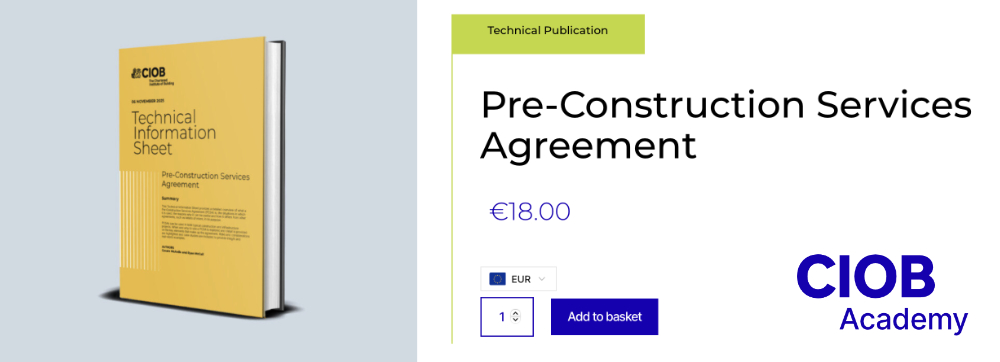
In 2025 CIOB Academy published a Technical Information Sheet covering Pre-construction services agreements, written by Cesare McArdle, a specialist and Partner at full-service law firm Herrington Carmichael LLP and Ryan McCall is a Chartered Construction Manager with over 15 years' experience spanning facade remediation, project coordination and construction delivery. This Technical Information Sheet offers a clear and comprehensive overview of PCSAs, what they are, when they should be used, and the advantages they bring to projects. It explains how PCSAs differ from other forms of agreement, such as letters of intent. It further explores associated risks and considerations, supported by case studies that offer practical insight.
[edit] What is agreed in a Pre-Construction Services Agreement?
The Pre-Construction Services Agreement will define the services that are required of the contractor during the pre-construction phase and will generally be similar to a consultancy agreement. It should make clear whether the contractor is undertaking design work, whether they will have any design liability, and what will happen to this liability if they are not appointed for the second stage (the construction works). It should also set out the method of payment, and any provisions for deferred payment.
[edit] What are the advantages and disadvantages of Pre-Construction Services Agreements?
The contractor appointed under the Pre-Construction Services Agreement will not necessarily be appointed for the second-stage construction contract. However, the client inevitably loses leverage in the second-stage of the tender negotiation process, as the contractor is already embedded in the project team and potential competitors lose interest once they find out that another contractor has been awarded the first-stage tender.
However, a longer period of familiarity with the project creates better relationships as well as a reduction in learning curves and programme performance, and so, whilst tender prices for two-stage contracts may initially be higher than single-stage tenders, which are subject to full competition throughout, the final account tends to include fewer variations and fewer claims. Competition can be introduced into the second stage by an open-book approach to the tendering of sub-contracts.
It is important that the client ensures they have some means of securing an alternative bid if second-stage negotiations fail, albeit this is likely to result in delays and difficulties regarding design liability.
In the public sector, use of PCSAs aligns with the government's Construction Playbook, which encourages two-stage open book approaches and early supply chain involvement; contracting authorities are expected to apply the Playbook's principles, where appropriate, under the National Procurement Policy Statement issued in February 2025 following the Procurement Act 2023.
[edit] Related articles on Designing Buildings
- Appointing consultants.
- Construction manager.
- Construction contract.
- Construction Playbook.
- Design and build.
- Design liability.
- Early contractor involvement.
- Preliminaries.
- Private Finance Initiative.
- Procurement.
- Public Private Partnership.
- Specialist contractor.
- Sub contractor.
- CIOB Technical Publication: Pre-construction services agreement.
- Trade contractor.
- Two-stage tender.
[edit] External references
Quick links
[edit] Legislation and standards
Fire Safety (England) Regulations 2022
Regulatory Reform (Fire Safety) Order 2005
Secondary legislation linked to the Building Safety Act
Building safety in Northern Ireland
[edit] Dutyholders and competencies
BSI Built Environment Competence Standards
Competence standards (PAS 8671, 8672, 8673)
Industry Competence Steering Group
[edit] Regulators
National Regulator of Construction Products
[edit] Fire safety
Independent Grenfell Tower Inquiry
Comments
[edit] To make a comment about this article, or to suggest changes, click 'Add a comment' above. Separate your comments from any existing comments by inserting a horizontal line.