




John Ashurst: practitioner, writer and educator
Many people practicing building conservation say that listening to this engaging pioneer stimulated their interest in the subject and inspired them to make it their career.

|
| John Ashurst (Photo: John Ashurst Estate). |
John Ashurst (1937–2008) was a quiet, modest, unassuming man who was small in stature but a giant in the field of building conservation. In his four decades of work, he was a pioneer, fostering a scientific approach to conservation, widening the field by embracing other key disciplines such as conservators, scientists and trades/crafts people. He also brought the highly skilled techniques of the obscure Ministry of Works to the attention of everyday practitioners. He was a major driver of the lime revival in the 1970s and 80s. His published works are still revered, but the key to his success and why he is so fondly remembered rests with the spoken word – his ability to communicate so eloquently and eruditely in lectures, seminars and, importantly, in social gatherings – usually in licensed premises! Many people practicing today admit that listening to John stimulated their interest in conservation and inspired them to make it a career.
John trained as an architect in the 1950s at Kingston School of Art, where he was a contemporary of Martin Caroe, another major figure in the world of building conservation. John was an excellent draughtsman, which proved so helpful in illustrating his technical repair notes and books. He also spent three years as a thespian, and it was this training in timing and delivery that helped him to become a consummate speaker and conversationalist. After spells in architectural practice in the private sector, John joined the Ministry of Public Buildings and Work’s Ancient Monuments Division in 1969 as research architect in the special services branch. There he worked closely with scientists at the Building Research Station (BRS) later becoming the Building Research Establishment (BRE), on stone preservation. It was here that he developed a lifelong passion for the material and for conserving ancient monuments, particularly ruins. That was a time when he and his colleagues from London were treated like royalty when they arrived on sites. One of the workmen was usually delegated to be on hand to open their car door when they arrived and left. Over the years, though, John spent time talking to a great many of the directly employed labour teams and fully earned their trust and respect.
He also worked on iconic roofed buildings, such as the Royal Palaces, the Tower of London and the Royal Hospital. Already his expertise was such that he was brought in to serve on the advisory committee for the groundbreaking conservation work at the west front of Wells Cathedral (1974–1986), where Robert Baker’s lime-based repair methods were being used on statuary alongside more controversial preservative techniques devised by John Larsen and Kenneth Hempel from the Victoria and Albert Museum.
John’s willingness to embrace new technologies stemmed from his work in the 1960s, building on the early testing by the BRS on stone preservatives. This ultimately led to the trials that he carried out on brethane, an alkoxysilane devised by Cliff Price at the BRE for consolidating decaying stone, which could polymerise at depth. These trials were highly controversial as many in the conservation field, led by the SPAB, were firmly against the use of these alien inorganic materials. A revisit to some of the trial sites 40 years later showed that brethane was still performing extremely well on very friable clunch, unlike more conventional treatments.
But it was his work with traditional materials that was so helpful to many practitioners struggling with the dearth of good technical literature. Mortars, Plasters and Renders, published by the Ecclesiastical Architects and Surveyors Association in 1983, was particularly influential and beneficial to many who were trying to persuade clients and contractors who were dubious about moving away from the use of cements.
The Ancient Monuments Division went through various iterations over the next 20 years until it morphed into the newly created English Heritage in 1983. John now led the Research and Technical Advisory Services (RTAS), which included a dozen individuals including architects, conservators, masons and ironsmiths. Among the many achievements of this team, perhaps the best remembered will be the Practical Building Conservation series of five handbooks that were published in 1988/9, becoming bestsellers worldwide. These were based on John’s technical notes which he wrote for internal use, and their delivery owes much to his team, particularly Iain McCaig and Nicola Ashurst.
John’s passion for stone as the premier building material meant that he mixed with a wide cross-section of leading lights. These included conservation architects such as Donovan Purcell, who was instrumental in establishing the Standing Joint Committee on Natural Stones (which Ashurst chaired), quarry owners, masons, conservators and geologists. He was highly regarded by members of the Stone Federation, which was helpful when dealing with contentious issues over repair or replacement, or selecting the appropriate stone for a conservation project. Geology played a major part in stone selection, and John worked closely with Frank Dimes from the Geological Museum.
In many of his lectures, Ashurst would show newly replaced stones in a wall that appeared to be glaringly different from the stones surrounding them, pointing out that these were the correct material, either being from an original source or having a similar mineralogy and porosity to the host stone. Compatibility with surrounding stones was the key to minimising the chance of new stones accelerating potential decay to older adjoining stones. In time, if correctly selected, weathering and lichen colonisation would result in a close visual match.
The consolidation programme for the many ruined abbeys, castles and monasteries undertaken by the old Ministry of Works in the early 20th century has been criticised for being too invasive and for the choice of harmful repair materials, particularly cements used in pointing, rough racking and grouting. But John was very respectful of the high quality of workmanship that enabled crumbling and hazardous ruins to be made safe for visitors and the occasional mountaineers. Indeed, many ingenious repair techniques were pioneered here, alongside tests and trials of materials and mortars which Ashurst built upon over the years. Much of this work is contained in his seminal tome The Conservation of Ruins. Equally important was the quality of workmanship, which was one reason why John recruited masons into his team to advise and develop bespoke techniques for tricky repairs. However, it was clear there was a problem on the estate when the Bowen report was produced in the 1980s, highlighting inconsistent working practices across the country and, in some cases, the use of wholly inappropriate techniques and materials.
John’s solution was to devise a variety of practical training courses, mainly covering masonry repairs, cleaning and the use of mortars, and repairs to plasters and renders. Most of the courses were for a week, with a combination of lectures, demonstrations and hands-on repairs on facsimile ‘ruinettes’ and purpose-built walls. These were designed by Ashurst and Colin Burns to incorporate the types of faults commonly found on site, so that attendees were able to practice various repairs. The English Heritage Training Centre opened at Fort Brockhurst, Gosport, in the early 1990s, but the privatisation of the primary audience, the directly employed labour force, meant that courses were adapted for a wider outside audience; but the emphasis continued to be on hands-on training.
John led most of the courses and continued this role when the centre closed in 1996. He and Colin designed new ruinettes and walls, which were built at West Dean College, near Chichester, which has accommodated the courses ever since. Despite John being courteous and calm, managing him could be fraught. Many times at Fort Brockhurst a full course of delegates would be waiting for him because he typically arrived only 15 minutes before the start. He would chug up in his old VW Polo and unhurriedly dump three cartons of slides on to the light table and casually load two carousels while musing ‘now for today’s selection from the sweet trolley’, followed by his unmistakable chuckle. He would usually begin on time, occasionally finding some slides out of order, but seamlessly continued without any hint of a problem, which only increased the sense of inadequacy felt by us lesser mortals.
John left English Heritage in 1991 for a brief spell in Canada, before returning to take up a professorial chair at Bournemouth University. He also worked for private conservation practices in the south of England. But he continued his close association with English Heritage as a consultant to the Building Conservation and Research Team (BCRT), which replaced the RTAS. The BCRT was now led by John Fidler, who greatly expanded its scope, particularly in research and publications. Ably assisted by a wide range of consultants with expertise ranging from physics and metallurgy to conservators and craftspeople, Ashurst was a key figure advising particularly on stone repairs and cleaning and leading the Fort Brockhurst masterclasses. The BCRT was later to update, revise and expand the Practical Building Conservation series, and initially John was a strong supporter and help to those drafting the first volume on stone. Sadly, he died in 2008, so the new series was dedicated to him, which hopefully was a fitting tribute.
Much thanks to John Fidler and Iain McCaig for sharing their memories.
This article originally appeared in the Institute of Historic Building Conservation’s (IHBC’s) Context 184, published in June 2025. It was written by Chris Wood, who knew John Ashurst from the early 1980s, attending lectures at the IAAS in York, at the Architectural Association and at sundry conferences. He worked closely with him on the practical Building Masterclasses at Fort Brockhurst and West Dean, and on a number of English Heritage research and advisory projects.
--Institute of Historic Building Conservation
Related articles on Designing Buildings Conservation.
- Cleaning brickwork, faience and terracotta.
- Conservation area.
- Conservation.
- Defects in stone.
- Heritage value.
- Heritage.
- Historic environment.
- IHBC articles.
- IHBC.
- English Heritage.
- Practical Building Conservation: Earth, Brick and Terracotta.
- Masonry.
- Mortar.
- Stone.
- Stone consolidants.
- The Stone Restoration Handbook.
IHBC NewsBlog
IHBC sponsors Gardens Trust event 23-4 Sept 2026
.jpeg)
'Learning from the Past, Shaping the Future’ takes place in Milton Keynes
Renovations to Frank Lloyd Wright's Fallingwater complete
.jpg)
World Heritage Preserved project opens house for tours again
Shakespeare Birthplace Trust places Hall's Croft on HAR Register
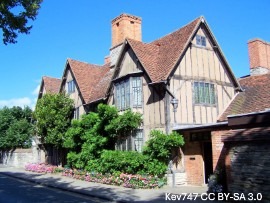
Stratford-upon-Avon home of Shakespeare's daughter is 'At Risk'
Lady Grange’s House repaired on St Kilda
.jpg)
National Trust for Scotland repairs stone cleit with link to famous island resident
Griff Rhys Jones on BBC Radio 4 Today programme
,_Green_Lane,_Derby.jpg)
The Victorian Society’s President unveiled its latest Top Ten Endangered Buildings 2026.
Need a MATE? Book your place now.
IHBC offers free webinars on applying for IHBC accreditation (Full & Associate).
UK Stained Glass Repository finds windows new homes
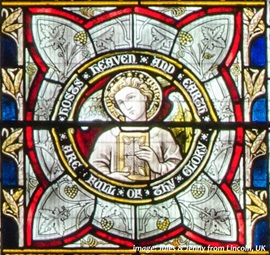
How are stained glass windows are rescued, stored and repurposed?
APPGEBE report sets high aims for quality
'Government must not sacrifice quality in drive to build 1.5m homes'
New measures protect Historic Shipwrecks from heritage crime

Underwater cultural heritage benefits from new HE guidance
How could the City of London skyline look in 6 years' time?

Visualisation shows approved planning applications as completed buildings
National Trust for Scotland calls for VAT cuts
Heritage neglect is encouraged by current policies
IHBC's 'Context' Issue 186 features Industrial Heritage
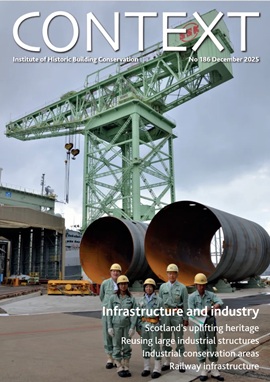
IHBC's members' journal reports on the challenges of conserving infrastructure
Book now for IHBC Annual School 2026

IHBC Annual School is taking place 18-20 June 2026 in Newcastle
RICHeS Research Infrastructure offers ‘Full Access Fund Call’
RICHeS offers a ‘Help’ webinar on 11 March
Latest IHBC Issue of Context features Roofing
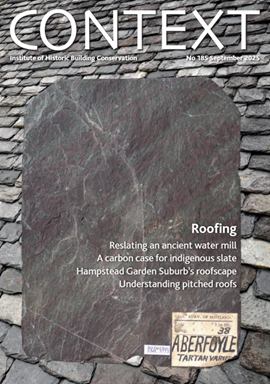
Articles range from slate to pitched roofs, and carbon impact to solar generation to roofscapes
Three reasons not to demolish Edinburgh’s Argyle House

Should 'Edinburgh's ugliest building' be saved?
IHBC’s 2025 Parliamentary Briefing...from Crafts in Crisis to Rubbish Retrofit
IHBC launches research-led ‘5 Commitments to Help Heritage Skills in Conservation’
How RDSAP 10.2 impacts EPC assessments in traditional buildings

Energy performance certificates (EPCs) tell us how energy efficient our buildings are, but the way these certificates are generated has changed.