





Healthy cities
A healthy city is one that is continually creating, expanding and improving those physical and social environments and community resources that enable people to mutually support each other in performing all the functions of life and in developing to their maximum potential.
A healthy city is not necessarily one that has achieved a particular health status. It is a city that puts health high on the political and social agenda and builds a strong movement for public health at the local level with health equity at its centre. The healthy cities approach recognises the need to work in collaboration across public, private, voluntary and community sector organisations. This way of working prioritises policies that: create co-benefits between health and well-being and other city policies; support social inclusion by harnessing the knowledge, skills and priorities of cities’ diverse populations through strong community engagement; create healthy built and natural environments; and re-orient health and social services to optimise fair access, placing people and communities at the centre.
The WHO Healthy Cities programme is a long-term development initiative that seeks to place health and health equity on the agenda of cities around the world, and to build a constituency of support for public health at the local level. In the various WHO regions, and through dedicated networks of cities, healthy cities take on very different priorities and approaches within the overall concept described above.
As defined in the World Health Organisation "Health Promotion Glossary of Terms 2021"
Health promotion is defined by WHO as being the process of enabling people to increase control over, and to improve their health. Health promotion represents a comprehensive social and political process. It not only embraces actions directed at strengthening the skills and capabilities of individuals, but also action directed towards changing social, environmental and economic determinants of health so as to optimise their positive impact on public and personal health. Health promotion is the process of enabling people, individually and collectively, to increase control over the determinants of health and thereby improve their health.
The Ottawa Charter identifies three basic strategies for health promotion. These are advocacy for health to create the essential conditions for health indicated above; enabling all people to achieve their full health potential; and mediating between the different interests in society in the pursuit of health. The Ottawa Charter identified five priority action areas: to build healthy public policy; create supportive environments for health; strengthen community action for health; develop personal skills; and re-orient health services.
These action areas remain vitally important in health promotion, and the underlying concepts have continued to evolve. Some of these actions – such as re-orienting health services and community action for health – remain but are represented with updated definitions. Others remain in the main body of the glossary but have evolved into different terms. For example, the concept of healthy public policy remains independently valid, but is now included within the contemporary concept of health in all policies. Similarly, developing personal skills is incorporated into definitions of skills for health and health literacy.
[edit] Related articles on Designing Buildings
- 35 Years of BREEAM and latest V7 mandatory update.
- A case study of adopting BIT-Kit: A method uncovering the impact buildings have on people.
- A measure of net well-being that incorporates the effect of housing environmental impacts.
- Airtightness of energy efficient buildings.
- BSRIA Briefing 2023. Cleaner Air, Better Tomorrow.
- Characteristics of buildings that impact wellbeing.
- Daylight benefits in healthcare buildings.
- Health and wellbeing impacts of natural and artificial lighting.
- Health and wellbeing at Kings Cross.
- Health promoting hospital.
- Health promoting schools.
- Healthy islands.
- Infrastructure for health promotion
- Indoor air quality
- Integrated modelling, simulation and visualisation (MSV) for sustainable built healing environments (BHEs).
- Nuisance smells.
- Odours in and around buildings.
- The design of extra care housing for older people and its impact on wellbeing: The East Sussex perspective.
- The daylight factor.
- The impact of the design of the Psychiatric inpatient facility on perceptions of Carer wellbeing.
- The real cost of poor housing.
- Transitioning to eco-cities: Reducing carbon emissions while improving urban welfare.
- The real cost of poor housing.
- Ubiquitous sensors to assess people’s energy consumption and wellbeing in domestic environments.
- Well-being and regeneration: Reflections from Carpenters Estate.
- Wellbeing and buildings.
- Wellbeing in Buildings TG 10/2025.
- Wellbeing and creativity in workplace design - case studies.
[edit] External links
Healthy cities: effective approach to a rapidly changing world. Geneva: World Health Organization; 2020 (https://apps. who.int/iris/bitstream/handle/10665/331946/9789240004825-eng.pdf, accessed 8 July 2021).
Shanghai Declaration on promoting health in the 2030 Agenda for Sustainable Development. Geneva: World Health Organization; 2017 (https://www.who.int/publications/i/item/WHO-NMH-PND-17.5, accessed 8 July 2021).
What is a healthy city? Copenhagen: World Health Organization Regional Office for Europe; (https://www.euro.who. int/en/health-topics/environment-and-health/urban-health/who-european-healthy-cities-network/what-is-a-healthy-city accessed 8 July 2021)
Featured articles and news

We're expanding our collaborative mission by launching DB Intelligence, an exclusive market research advisory panel. Built environment professionals can now get paid to share their expertise on industry trends, products and services.
Panel members receive direct financial incentives for participating in research projects like short surveys, 1-2-1 interviews and focus groups. Register today to shape the future of the construction sector.
Planning condition discharge in England and Wales

A brief exoplanation from a building compliance expert, with further links.
Overheating guidance and tools for building designers

Guidance for dealing with element of building fabric control that have increasing importance.
Shading for housing, a design guide

From the Good Homes Alliance and British Blind and Shutter Association.
UK Standard Skills Classification (SSC)

A shared framework for describing skills needs.
Social media ban consultation comes to close

CIOB urges UK Government to consider social media’s role in careers guidance in ban debate.
The latest of eight Skills England apprenticeship units

The addition of battery manufacturing welcomed by ECA with a warning about the risks of fast-tracked apprenticeship units.
Building Control Independent Panel final report

A precis of a key report led by Dame Hackitt with full recommendations and link to the government response.
Guide to ISO 19650 for Architecture Firms (2026)
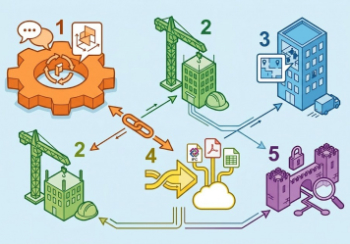
A user gives their low down.

A UK training and membership provider for mould remediation professionals.
Building Safety recap April, 2026

A short and longer run-through of the month, with links to further information and sources.

CIAT May 2026 briefing.

Independent NSI and BAFE study exploring how organisations are changing the way they buy fire safety services.

From medieval scribes to modern word art.

ECA welcomes crackdown on late payment and push for clean energy, whilst CIOB seek fixed cladding removal timeframes.
Cyber Security in the Built Environment

Protecting projects, data, and digital assets: A CIOB Academy TIS.
Managing competence in the built environment

ITFG publishes new industry guide on how to meet the ICC principles.
The UK's campaign to reduce noise pollution: Mythbusting, articles and topic guides.