





Contract management
A contract is a promise or set of promises which the law will enforce.
Construction contracts typically relate to the supply of goods or services as part of the delivery of a built asset. Traditionally, suppliers might have been considered to be organisations contracted to provide physical supplies such as goods, materials, plant and so on, however, PAS 1192-2 now defines a supplier as any, ‘…provider of services or goods either directly to the employer or to another supplier in a supply chain’. The 'supply chain' is the interconnected hierarchy of suppliers.
Construction contracts are generally standard forms, modified standard forms or bespoke.
Contract management is the process of managing contracts that are made as part of the delivery of a built asset. It involves the creation, analysis and execution of contracts by the parties to those contracts to ensure operational and financial performance is maximised, and risks are minimised.
Contract management can categorised into three phases:
- Pre-contract phase: Tenders documents are prepared, tenders are sought and contract negotiation is undertaken (see contract conditions and contract negotiation for more information).
- Contract execution phase: The final contract documents are prepared for execution (see contract engrossment for more information).
- Post-award phase: Compliance with conditions of the contract.
A contract manager might be identified to manage one, or several contracts, or to work as part of a team of contract managers. On large, complex projects, involving several contracts (such as a construction management project) a consultant might be appointed to perform the role of contract manager.
This role might include:
- Assessing the needs of the business or project.
- Assessing the market.
- Risk assessment.
- Determining procurement methods and tender assessment criteria.
- Preparing a contract management strategy.
- Preparing budgets and cost estimates.
- Preparing programmes.
- Selecting the form of contract.
- Preparing tender documents.
- Seeking tenders.
- Negotiating contract conditions.
- Contract engrossment and execution.
- Briefing project teams, contractors and suppliers.
- Being the point of contact for the parties to the contract.
- Relationship management.
- Contract administration.
- Managing variations to the works.
- Supplying information to resolve disputes.
- Preparing information for the completion of contracts.
Contract managers should:
- Be able to manage multiple projects.
- Have a good knowledge of construction activities and technologies.
- Have a good knowledge of contract law.
- Have good maths and IT skills.
- Be good at problem-solving.
- Be good at negotiating.
- Have good communication and presentation skills.
An effective contract management strategy can bring a number for benefits to this process:
- Expected business benefits and financial returns are more likely to be realised.
- Good working relations can be maintained with contract partners and subcontractors, and so there is a reduced risk of disputes and a higher chance of repeat work.
- There are fewer unforeseen events.
- Contract partners, subcontractors and suppliers are likely to be more cooperative and responsive.
Contract management can be a complex process, which can be simplified with the use of contract management software. This can be particularly helpful for contract management involving multiple contracts and multiple parties, creating integrated systems for; document management, change control, relationship management, accounting, project management, contract administration, resource allocation and so on. Specialist software is available for different types of contract management, such as large contracts, small contracts, multiple contracts, civil engineering and so on.
NB Setting the bar. A new competence regime for building a safer future. The Final Report of the Competence Steering Group for Building a Safer Future, published in October 2020, suggests that contract management: ‘Is the process of systematically and efficiently managing contracts with suppliers to make sure all the terms of the contract are met, maximising operational and financial performance and minimising risk.’
[edit] Related articles on Designing Buildings Wiki
Featured articles and news

We're expanding our collaborative mission by launching DB Intelligence, an exclusive market research advisory panel. Built environment professionals can now get paid to share their expertise on industry trends, products and services.
Panel members receive direct financial incentives for participating in research projects like short surveys, 1-2-1 interviews and focus groups. Register today to shape the future of the construction sector.
Building Safety Wiki Interviews

Chief executive of the British Woodworking Federation.
Planning condition discharge in England and Wales

A brief exoplanation from a building compliance expert, with further links.
Overheating guidance and tools for building designers

Guidance for dealing with element of building fabric control that have increasing importance.
Shading for housing, a design guide

From the Good Homes Alliance and British Blind and Shutter Association.
UK Standard Skills Classification (SSC)

A shared framework for describing skills needs.
Social media ban consultation comes to close

CIOB urges UK Government to consider social media’s role in careers guidance in ban debate.
The latest of eight Skills England apprenticeship units

The addition of battery manufacturing welcomed by ECA with a warning about the risks of fast-tracked apprenticeship units.
Building Control Independent Panel final report
A precis of a key report led by Dame Hackitt with full recommendations and link to the government response.
Building Safety recap April, 2026
A short and longer run-through of the month, with links to further information and sources.

CIAT May 2026 briefing.

From medieval scribes to modern word art.

ECA welcomes crackdown on late payment and push for clean energy, whilst CIOB seek fixed cladding removal timeframes.
Cyber Security in the Built Environment
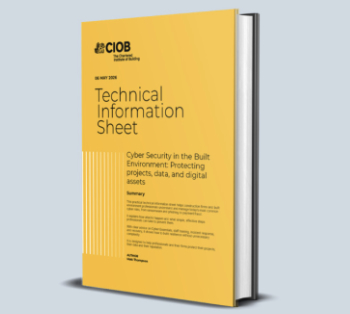
Protecting projects, data, and digital assets: A CIOB Academy TIS.
Managing competence in the built environment
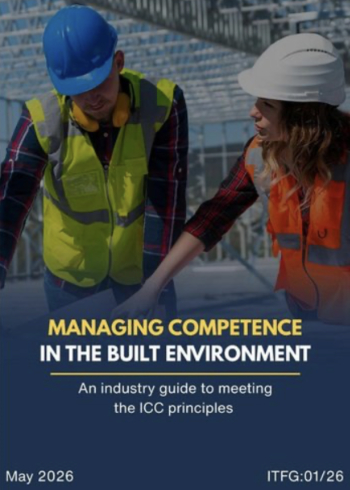
ITFG publishes new industry guide on how to meet the ICC principles.