





Net zero carbon buildings. A UKGBC framework definition
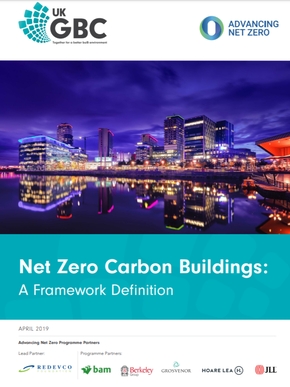
On 30 April 2019, the UK Green Building Council (UKGBC) published Net Zero Carbon Buildings: A framework definition, a framework for the UK construction industry to transition new and existing buildings to net zero carbon emissions by 2050.
This follows six months of industry engagement involving more than 180 experts and stakeholders, supported by 13 trade associations and industry bodies. It provides an overarching framework of principles and metrics that can be integrated into tools, policies and practices to de-carbonise buildings.
Two approaches to net zero carbon are set out:
- Net zero carbon – construction: the embodied emissions associated with products and construction are measured, reduced and offset.
- Net zero carbon – operational energy: The energy used by buildings in operation is reduced and where possible any demand met through renewable energy. Any remaining emissions are offset.
The next ten years will see the scope and ambition of the framework increase. In the short-term, additional requirements will include minimum energy efficiency targets and limits on the use of offsets. In the longer term the approaches for construction and operation will be integrated into a broader approach for net zero whole life carbon, covering all emissions associated with construction, operation, maintenance and demolition.
Richard Twinn, Senior Policy Advisor at UKGBC said: “The urgency of tackling climate change means that businesses must work together to drive down emissions as fast as possible... This framework is intended as a catalyst for the construction and property industry to build consensus on the transition to net zero carbon buildings and start to work towards consistent and ambitious outcomes.”
Clemens Brenninkmeijer, Board Member at the Redevco Foundation said: “The call to action can only gain traction when the sector collectively knows where it needs to go and how to get there. The cross-sector and inclusive approach of UKGBC’s Advancing Net Zero programme is helping the industry to frame the challenges ahead and provides it with a clear definition and pathway to a net zero carbon built environment.”
Rob Perrins, Chief Executive at Berkeley Group said: “This framework is an important step towards defining net zero carbon buildings and helping the industry understand how they can be delivered. We want to help lead this work, which is so important to decarbonising the built environment and protecting our planet for future generations."
Peter Tse, Business Manager, BSRIA’s Sustainable Construction Group, said: “This framework challenges the construction and property industry to reassess the way buildings are designed, constructed and run, which requires a cultural change. A verified net zero carbon building for operational energy is based on in-use energy, instead of modelled energy, demonstrating a building’s performance is at net zero carbon."
Find out more at: https://www.ukgbc.org/ukgbc-work/advancing-net-zero/
NB On 2 May 2019, 10 years after the Climate Change Act became law, the Committee on Climate Change (CCC) published a report suggesting the UK can end its contribution to global warming by setting a target to reduce greenhouse gas emissions to zero by 2050. Net Zero – The UK’s contribution to stopping global warming was requested by the UK, Scottish and Welsh Governments in light of the Paris Agreement and the IPCC’s Special Report in 2018.
Julie Hirigoyen, chief executive at UKGBC said: "Today's report marks a watershed moment in our efforts to tackle climate change. The UK must take responsibility as a global leader to achieve net zero emissions by 2050 and the building sector has a crucial role to play in this transition. According to WorldGBC, achieving this will require all new buildings to be net zero carbon by 2030 and all existing ones by 2050 – which will require outstanding levels of energy efficiency alongside zero carbon electricity and heat supplies... this ambitious objective can only be achieved with the help of strong policy drivers. The Government must urgently confirm the details underpinning the Future Homes Standard for new homes in 2025, along with similar standards for non-domestic buildings. Simultaneously, a co-ordinated national infrastructure programme for energy efficiency and heat must be established to improve our existing buildings and minimise costs of the transition for householders."
NB ‘The impact of sustainability on value’ published by JLL in March 2020 defines net zero carbon in construction as: ‘…when the amount of carbon emissions associated with a building’s product and construction stages up to practical completion is zero or negative, through the use of offsets or the net export of on-site renewable energy.’
It defines net zero carbon in operation as: ‘…when the amount of carbon emissions associated with the building’s operational energy on an annual basis is zero or negative. A net zero carbon building is highly energy efficient and powered from on-site and/or off-site renewable energy sources, with any remaining carbon balance offset.’
[edit] Related articles on Designing Buildings
- Architects Declare.
- Building Back Better: Net zero carbon and BREEAM.
- Carbon footprint.
- Carbon negative.
- Carbon neutral.
- Climate Change Act.
- COP26: A BSRIA summary.
- EIT Climate-KIC.
- Low or zero carbon technologies.
- Nearly zero-energy building.
- Net zero carbon 2050.
- Net zero carbon emissions.
- Taking action on climate change.
- WFEO Climate Stories: How climate change is affecting the UK.
- What we need for the journey to net-zero carbon emissions.
- Wood and carbon.
- Zero Bills Home.
- Zero carbon homes.
- Zero carbon non domestic buildings.
- Zero net regulated carbon emissions.
Featured articles
Check out some of the best features and news from Designing Buildings as well as key stories from around the web.

Gasholders: a history in pictures. Book review.
Recognition, influence and growth

SocEnv identifies three strategic pillars in new strategy to 2045.
Discover the future of roofing, cladding and insulation.

New guidance for professional practice, cultural change and regulation in social housing.
The heritage of nuclear and conventional power stations.
New measures to stop people being ripped off

Government to protect families from cowboy builders and aggressive bailiffs.

New Futurebuild showcase brings an innovation-first approach.
National Planning Policy Framework
Understanding the 2026 changes.
ECA's public affairs priorities

Member consultation opens to shape priorities for 2027 to 2030.

Dutyholder responsibilities from 1 July 2026.
Where performance meets practice
The Building Envelope Stage at UKCW Birmingham.
CIAT publishes briefing on planning reforms.
Comments