





Landings in buildings
Landings are level platforms found at the top or bottom of flights of stairs. Intermediate landings may be found part way up flights of stairs where there is an intermediate level, where there is a change in direction of the flight of stairs, or where there is a long flight of stairs.
Approved document K protection from falling, collision and impact, requires that there is a landing at the top and bottom of every flight, with a width and length at least as great as the smallest width of the flight of stairs.
Landings should be clear of permanent obstructions. They may have doors to cupboards or ducts that open over them, but these should remain closed in normal use. Other doors may swing across landings in dwellings, but only as shown below.

A headroom of at least 2m should be provided on all landings.
Where there are more than 36 risers in consecutive flights of stairs, Approved Document K requires that there is at least one change of direction, with a landing that has a minimum length equal to the width of the stairs. Landings in building other than dwellings should be at least 1200mm long.
For buildings other than dwellings, the maximum number of risers should be 16 for utility stairs, and 12 for general access stairs (or 16 in exceptional circumstances where the plan area is restricted). Landings in buildings other than dwellings should have suitable handrails on each side.
Landings may also be found at the top, bottom and along the length of ramps. They must be at least as long as the width of the ramp. For buildings other than dwellings, they must be at least 1200mm long at the top and bottom of the ramp, and at least 1500mm long for intermediate landings.
Approved Document M sets out additional guidance and requires the provision of landings as rest areas for wheelchair users and people with walking difficulties, and to provide space for wheelchair users to stop and open doors.
Approved Document M also refers to landings in front of lifts.
Approved Document B sets our additional requirements in relation to fire safety.
NB see also: Soft landings.
[edit] Related articles on Designing Buildings Wiki
- Ancillary area.
- Approved Document B.
- Approved Document K.
- Approved Document M.
- Banister.
- Building regulations.
- Escalator.
- Finial.
- Flight.
- Guarding.
- Intermediate landing.
- Lifts.
- Lobby.
- Maximum length of a flight of stairs.
- Newel post.
- Railings.
- Ramps.
- Spiral stairs and helical stairs.
- Stairs.
- Stairs going.
- Stairs nosing.
- Stairs riser.
- Stairs string.
- Stairs tread.
- Stairlift.
- Types of stairs.
- Wheelchair platform stairlifts.
Featured articles and news

We're expanding our collaborative mission by launching DB Intelligence, an exclusive market research advisory panel. Built environment professionals can now get paid to share their expertise on industry trends, products and services.
Panel members receive direct financial incentives for participating in research projects like short surveys, 1-2-1 interviews and focus groups. Register today to shape the future of the construction sector.
Building Control Independent Panel final report
A precis of a key report led by Dame Hackitt with full recommendations and link to the government response.
Guide to ISO 19650 for Architecture Firms (2026)
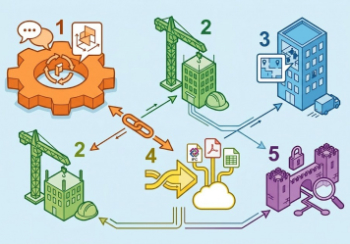
A user gives their low down.

A UK training and membership provider for mould remediation professionals.
Building Safety recap April, 2026
A short and longer run-through of the month, with links to further information and sources.
CIAT May 2026 briefing.

Independent NSI and BAFE study exploring how organisations are changing the way they buy fire safety services.

From medieval scribes to modern word art.

ECA welcomes crackdown on late payment and push for clean energy, whilst CIOB seek fixed cladding removal timeframes.
Cyber Security in the Built Environment
Protecting projects, data, and digital assets: A CIOB Academy TIS.
Managing competence in the built environment

ITFG publishes new industry guide on how to meet the ICC principles.
The UK's campaign to reduce noise pollution: Mythbusting, articles and topic guides.