





Soft landscape

Contents |
[edit] Introduction
The term ‘landscape’ refers to an area whose character is the result of the action and interaction of natural and/or human factors’ (ref European Landscape Convention). For more information see: Landscape.
Softscape or soft landscape includes all types of plant life, from flowers and trees to shrubs and groundcover. All of the living horticultural elements of landscape design are soft landscape components. The term is commonly used by gardeners and other members of the landscaping profession, such as practitioners of landscape design, landscape architecture, and garden design.
Soft landscaping is a term used to describe the process of working with natural materials and other landscape elements that do not involve construction. This can include elements including turf, trees, hedges, shrubs and so on.
Soft landscape contrasts with hard landscape, which is the non-plant material used in landscaping, such as retaining walls, paving material, driveways, walkways, decking, steps and so on. For more information see: Hard landscape.
[edit] Creating a suitable soft landscape
The materials that are used for soft landscape naturally change and evolve over time, driven by growth, the climate and other conditions. Seasonal components can also play a significant factor in soft landscape planning, particularly when there is a desire to create a vibrant environment throughout the course of the year.
Plans for soft landscapes range from natural shapes accented by bright plants and grassy textures to more structured and artificially formal designs.
[edit] Planning for maintenance
Careful consideration should be given to the amount of maintenance that these elements will require to stay in good order. Lower maintenance soft landscape ideas include:
- Selecting plants that are either drought or flood resistant, depending on the average rainfall of the area.
- Planting shrubs, hedges and trees that require minimal care.
- Mulching often but turning the soil infrequently.
- Planting densely to minimise the need to weed.
- Reducing plantings that require high levels of labour.
- Using established beds and borders to structure soft landscape.
Soft landscape materials are frequently supported by hard landscaping elements. Ideally, they should work together to create a cohesive space that is integrated into to the environment around it.
The Landscape Institute (LI) is the Royal Chartered Institute for Landscape professionals and an educational charity. It was founded in 1929 (when it was known as the Institute of Landscape Architects), and the first President, Thomas Mawson, was one of the first professionals to use the title 'landscape architect'. For more information see: Landscape Institute.
[edit] Related articles on Designing Buildings Wiki
Featured articles and news

We're expanding our collaborative mission by launching DB Intelligence, an exclusive market research advisory panel. Built environment professionals can now get paid to share their expertise on industry trends, products and services.
Panel members receive direct financial incentives for participating in research projects like short surveys, 1-2-1 interviews and focus groups. Register today to shape the future of the construction sector.
Building Safety Wiki Interviews

Chief executive of the British Woodworking Federation.
Planning condition discharge in England and Wales

A brief exoplanation from a building compliance expert, with further links.
Overheating guidance and tools for building designers

Guidance for dealing with element of building fabric control that have increasing importance.
Shading for housing, a design guide

From the Good Homes Alliance and British Blind and Shutter Association.
UK Standard Skills Classification (SSC)

A shared framework for describing skills needs.
Social media ban consultation comes to close

CIOB urges UK Government to consider social media’s role in careers guidance in ban debate.
The latest of eight Skills England apprenticeship units

The addition of battery manufacturing welcomed by ECA with a warning about the risks of fast-tracked apprenticeship units.
Building Control Independent Panel final report
A precis of a key report led by Dame Hackitt with full recommendations and link to the government response.
Building Safety recap April, 2026
A short and longer run-through of the month, with links to further information and sources.
CIAT May 2026 briefing.

From medieval scribes to modern word art.

ECA welcomes crackdown on late payment and push for clean energy, whilst CIOB seek fixed cladding removal timeframes.
Cyber Security in the Built Environment

Protecting projects, data, and digital assets: A CIOB Academy TIS.
Managing competence in the built environment
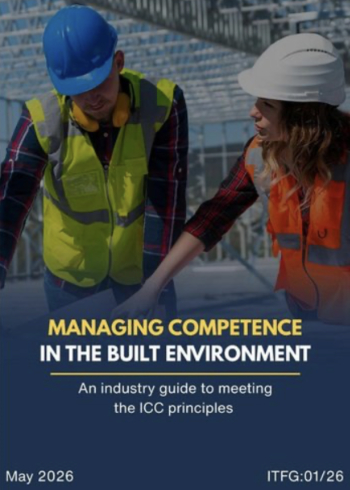
ITFG publishes new industry guide on how to meet the ICC principles.