





Procurement route options pros and cons
This article needs more work. To help develop this article, click 'Edit this article' above.
See also: procurement route.
Contents |
[edit] Traditional contract
Good for:
- Quality – full design pre tender
- Design flexibility – variations & instructions
- Specialist subcontractors – Named specialist update to standard building contract sbc11
- Design control – through the architect / contract administrator
- Contractor's Designed Portion – such as mechanical and electrical engineering
- Cost – there may be lump sum cost benefits unless are multiple changes made
Not suited for:
- Time – require full detailed pack pre tender
- Cost – not a benefit if many changes made post tender
- Incomplete drawings – lead to delay, costs and claims of negligence
Contracts: JCT Standard Building Contract 2016, JCT Intermediate Building Contract 2016, JCT Minor Works Building Contract 2016, NEC3 ECC Option A
JCT Standard Building Contract 2016:
- Lump sum payment
- CDM
- Contractor's Designed Portion
- Named subcontractors
- Variations / instructions
- Retention
- Collateral warranties
- Termination provisions
- Pre-agreed alternative dispute resolution procedures.
[edit] Design and build
Good for:
- Time – Fast track, overlap of design and construction
- Cost – lump sum / Guaranteed maximum price
- Single point of responsibility – Contractor design and build responsibility
- Has good price certainty
- Novation – can benefit quality.
- Low risk for the client
- Variations can be accurately valued
Not suited for:
- Quality – cheapest route to meet contract specification can lead to low quality products/ build quality.
- Design flexibility – request for changes will have cost/time implications
- Contractor carries risk for construction
- Client exposed to claims for buildability
- Design could affect the buildability of the project
Contract: JCT Design and Build 2016, JCT Major Project Construction Contract 2016, NEC ECC Options A-E
JCT Design and Build 2016:
- Contractor to complete design and carry out the works.
- Lump sum / Guaranteed maximum price
- CDM
- Collateral warranties
- Termination provisions
- Retention
- Pre-agreed dispute resolution procedures
[edit] Management contracting
Good for:
- Complex / specialist projects – individually appointed packages to best suited sub-contractor
- Potential cost saving – competitive tender
- Time - it is possible to overlap design and construction
- Quality – each package subcontracted to specialist
- Design flexibility – changes can be made throughout construction, although there are potential cost implications.
Not suited for:
- Inexperienced clients – risk high
- Fixed cost - Prime cost basis per package.
- Lack of available specialists – would leave gaps in work to be undertaken.
Contract: JCT Management Building Contract 2016
- Prime cost contract
- Collateral warranties
- Sustainability
- Collaborative working
- Third party rights – such as the funder / contractor
[edit] Construction management
Good for:
- Complex / specialist projects – individually appointed packages to best suited sub-contractor
- Time - It is possible to overlap design and construction
- Design flexibility – changes can be made throughout construction, although there are potential cost implications.
- Potential cost saving – competitive tender
- Quality – each package subcontracted to specialist
- All building types
- Efficiency – Early appointment of the construction manager to aid programme
- Inexperienced client – risk high as appointing trade contractors
- Fixed cost - Prime cost basis per package.
- Lack of available specialists
Contracts:
JCT Construction Management Appointment 2016, NEC ECC Option F, Construction Management Trade Contract 1999
JCT Construction Management Appointment 2016:
CM/A
Featured articles and news

We're expanding our collaborative mission by launching DB Intelligence, an exclusive market research advisory panel. Built environment professionals can now get paid to share their expertise on industry trends, products and services.
Panel members receive direct financial incentives for participating in research projects like short surveys, 1-2-1 interviews and focus groups. Register today to shape the future of the construction sector.
Planning condition discharge in England and Wales

A brief exoplanation from a building compliance expert, with further links.
Overheating guidance and tools for building designers

Guidance for dealing with element of building fabric control that have increasing importance.
Shading for housing, a design guide

From the Good Homes Alliance and British Blind and Shutter Association.
UK Standard Skills Classification (SSC)

A shared framework for describing skills needs.
Social media ban consultation comes to close

CIOB urges UK Government to consider social media’s role in careers guidance in ban debate.
The latest of eight Skills England apprenticeship units

The addition of battery manufacturing welcomed by ECA with a warning about the risks of fast-tracked apprenticeship units.
Building Control Independent Panel final report
A precis of a key report led by Dame Hackitt with full recommendations and link to the government response.
Building Safety recap April, 2026
A short and longer run-through of the month, with links to further information and sources.

CIAT May 2026 briefing.
From medieval scribes to modern word art.

ECA welcomes crackdown on late payment and push for clean energy, whilst CIOB seek fixed cladding removal timeframes.
Cyber Security in the Built Environment
Protecting projects, data, and digital assets: A CIOB Academy TIS.
Managing competence in the built environment
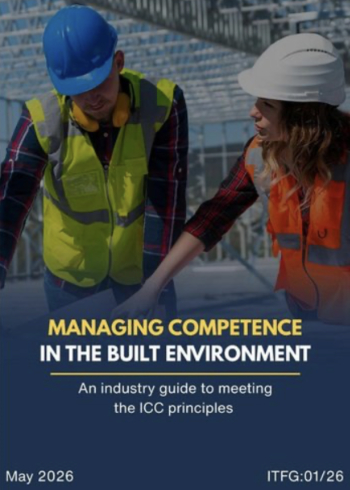
ITFG publishes new industry guide on how to meet the ICC principles.
The UK's campaign to reduce noise pollution: Mythbusting, articles and topic guides.
Comments
This article seems to need some revision: The Management Contracting and Construction Management procurement methods appear to be the wrong way round.
Construction Management is far higher risk than Management Contracting for the client.
The end of the article also doesn't seem to be consistent with the 'suitable for' and 'not suitable for'.
So change it - its a wiki site.