





Lift table

Contents |
[edit] Introduction
A lift table (or lifting table) is a platform deck that can be elevated to raise or lower loads, including people, through relatively small distances. There are many different configurations of lift table that can be adapted to various specialised tasks. Common applications include handling pallets, loading vehicles, and positioning work so that it is more easily accessible.
The factors to consider when deciding on the most appropriate lift table include the following:
- Type of use.
- Type of load.
- Maximum load.
- Physical dimensions of the table.
- Elevation capability, from contraction to full expansion.
- Power source and mechanism providing the table’s lift.
- Safety requirements.
[edit] Types of power source
Power is generally only used during elevation. Lowering the table is achieved by using a purge valve or slow-release mechanism.
There are various means of providing power to the lift table:
- Manual: Operator-controlled crank, pump, racket or screw.
- Pneumatic: Pressurised air cylinder in conjunction with a compression mechanism.
- Hydraulic: Pressurised hydraulic fluids power a linear actuator.
- Electric: Rotational power source provided by an electric motor.
[edit] Types of lifting mechanism
There are various mechanisms which can control the lifting of the table, including:
- Scissor: Power source collapses the base of a pantograph to extend table supports. See also: Scissor lift.
- Screw: Table is translated along the length of a screw as it rotates.
- Rack and pinion: Rack rotation moves the table along the track provided by the pinion.
- Telescoping: Linear actuators in the hollow cavity of a larger cylinder.
- Articulated: Jointed arms extend by the use of linear actuators, offering some horizontal movement as well as vertical.
- Chain and sprocket: Rotating sprocket with a chain drive oriented vertically.
[edit] Safety features
Some lift tables include safety features to prevent injury to the operator:
- Release lock: The table locks in the event of a malfunction while extended.
- Pinch guard: If objects are compromising the table’s ability to compress, an underlying pressure-sensitive device stops the descent.
- Bellows: To prevent items compromising the lifting mechanism a skirt of rubber or vinyl can surround the lift table.
BS EN 1570-1:2011+A1:2014, Safety requirements for lifting tables, provides guidance on safety requirements for lifting tables serving up to two fixed landings.
BS EN 1570-2:2016 provides guidance on safety requirements for lifting tables serving more than 2 fixed landings, for lifting goods with a vertical travel speed not exceeding 0,15 m/s.
[edit] Related articles on Designing Buildings Wiki
- Cherry picker.
- Compressed air plant.
- Construction plant.
- Forklift truck.
- Lifting device.
- Pallet jack.
- Post lift.
- Scissor lift.
- Types of crane.
- Work at height.
- Working platform.
- Working platforms for tracked plant: good practice guide to the design, installation, maintenance and repair of ground-supported working platforms.
Featured articles and news
The sad story of Derby Hippodrome
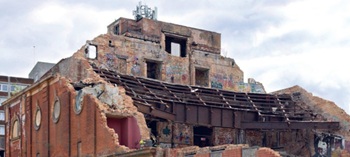
An historic building left to decay.

ECA, JIB and JTL back Fabian Society call to invest in skills for a stronger built environment workforce.

Women's Contributions to the Built Environment.
Calls for the delayed Circular Economy Strategy

Over 50 leading businesses, trade associations and professional bodies, including CIAT, and UKGBC sign open letter.
The future workforce: culture change and skill

Under the spotlight at UK Construction Week London.

A landmark moment for postmodern heritage.
A safe energy transition – ECA launches a new Charter

Practical policy actions to speed up low carbon adoption while maintaining installation safety and competency.
Frank Duffy: Researcher and Practitioner

Reflections on achievements and relevance to the wider research and practice communities.
The 2026 Compliance Landscape: Fire doors

Why 'Business as Usual' is a Liability.
Cutting construction carbon footprint by caring for soil

Is construction neglecting one of the planet’s most powerful carbon stores and one of our greatest natural climate allies.
ARCHITECTURE: How's it progressing?
Archiblogger posing questions of a historical and contextual nature.
The roofscape of Hampstead Garden Suburb

Residents, architects and roofers need to understand detailing.
Homes, landlords. tenants and the new housing standards

What will it all mean?