






Letters of credit in the construction industry

|
Contents |
[edit] Introduction
A letter of credit is a financial document used to reduce risk in the import and export of goods: to give assurance both to importers that they will receive their goods and to exporters that they will receive payment. It is sometimes referred to as 'documentary credit'.
For example, a contractor who has ordered curtain walling from Europe needs certainty that it will arrive by the due date, while the manufacturer wants assurance that they will be paid for the curtain walling that has been manufactured and shipped. If this were not the case, imported goods previously ordered might never arrive and exported goods might not be paid for. Given there are usually large distances involved in such transactions, as well as different legal systems and language barriers, any such disputes could be difficult to resolve.
[edit] Benefits for sellers (exporters) of goods and services
A letter of credit is a guarantee from a bank specifying that the seller (exporter) will receive a specified sum of money within a specified period as payment from a particular buyer. In return, the bank demands that specific terms are met, such as receiving certain documents as proof eg, shipping confirmation, etc. To receive payment, exporters must keep strictly to the terms of the letter, which normally requires providing documentary evidence that the goods supplied are exactly what they contracted to supply.
As long as the exporter meets all the terms and conditions, the letter of credit provides them with one of the most secure methods of payment. If, following issue of the letter of credit, the buyer does not pay the seller, the risk is then transferred from the seller to the bank.
[edit] Benefits for buyers
A letter of credit gives the buyer (importer) assurance that the seller will honour their side of the bargain and provide documentary proof for it. A buyer usually arranges a letter of credit with their own bank – referred to as the ‘issuing bank’. Although they can be useful, importers should typically only use letters of credit at the insistence of exporters and/or if they are required by national controls.
[edit] Cost and other drawbacks
Letters of credit can result in higher costs – banks will charge for them and so they may not be justifiable in relation to the order’s value. Costly delays, bureaucracy and other administrative problems are also possible.
[edit] Government advice
The UK government advises exporters to think carefully about whether they should request a letter of credit from an overseas customer. It recommends asking questions such as:
- Whether the country being exported to requires one.
- Does the value of the order justify the associated bank charges and extra costs?
- Is the customer creditworthy and do they have a track record with the exporter?
- Is the country being exported to politically stable and a good international trading partner?
- Is it standard practice for exporters to use letters of credit when trading with that country, and/or in that particular commodity?
- Seek other advice and guidance – a bank may be able to advise on trading with the country.
[edit] Types of letter of credit
There are numerous types of letter of credit, and some are more secure than others, but the main ones are:
- Irrevocable – cannot be changed or cancelled unless all parties agree.
- Revocable – can be changed or cancelled by the bank at any time and for any reason. These provide less security than the irrevocable type.
- Confirmed – at the request of the seller, the seller’s bank usually checks whether the buyer’s letter of credit is valid; the seller may, for extra security, require the bank to ‘confirm’ the letter. By this act of confirmation, the sellers bank agrees to guarantee payment if the buyer’s (issuing) bank fails to honour it.
- Unconfirmed – an unconfirmed letter of credit is not as secure as the confirmed type.
- Transferable – can be passed on to another beneficiary (party receiving payment) eg, when intermediaries are involved.
- Revolving – these can be used to cover several transactions between the same buyer and seller.
[edit] Related articles on Designing Buildings
- 5 Essential Tips for the Import / Export Trade
- Advance payment bond.
- Bonds and guarantees.
- Brexit.
- Cash flow.
- Customs guarantee.
- Late payment.
- Parent company guarantee.
- Performance bonds.
- Retention of title.
- Vesting certificate.
[edit] External references
Featured articles and news
Costs and insolvencies mount for SMEs, despite growth

Construction sector under insolvency and wage bill pressure in part linked to National Insurance, says report.
The place for vitrified clay pipes in modern infrastructure
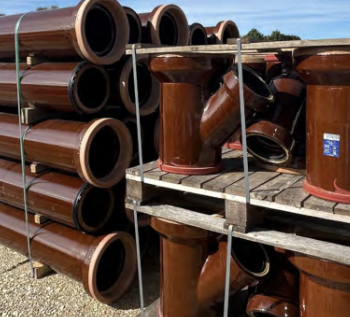
Why vitrified clay pipes are reclaiming their role in built projects.

Research by construction PR consultancy LMC published.
Roles and responsibilities of domestic clients

ACA Safety in Construction guide for domestic clients.
Fire door compliance in UK commercial buildings

Architect and manufacturer gives their low down.
Plumbing and heating for sustainability in new properties

Technical Engineer runs through changes in regulations, innovations in materials, and product systems.
Awareness of the Carbon Border Adjustment Mechanism
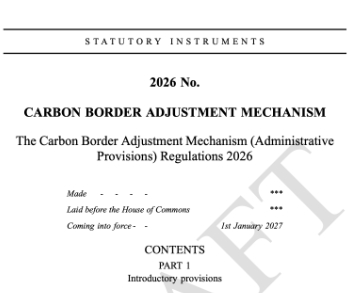
What CBAM is and what to do about it.
The new towns and strategic environmental assessments

12 locations of the New Towns Taskforce reduced to 7 within the new towns draft programme and open consultation.

Buildings that changed the future of architecture. Book review.
The Sustainability Pathfinder© Handbook
Built environment agency launches free Pathfinder© tool to help businesses progress sustainability strategies.
Government outcome to the late payment consultation, ECA reacts.
IHBC 2025 Gus Astley Student Award winners

Work on the role of hewing in UK historic conservation a win for Jack Parker of Oxford Brookes University.
Future Homes Building Standards and plug-in solar
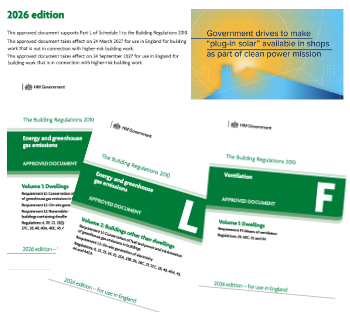
Parts F and L amendments, the availability of solar panels and industry responses.
How later living housing can help solve the housing crisis

Unlocking homes, unlocking lives.
Preparing safety case reports for HRBs under the BSA

A new practical guide to preparing structural inputs for safety cases and safety case reports published by IStructE.
Male construction workers and prostate cancer

CIOB and Prostate Cancer UK encourage awareness of prostate cancer risks, and what to do about it.