






Shaping the Future of Construction: Inspiring innovators redefine the industry

Contents |
[edit] Introduction
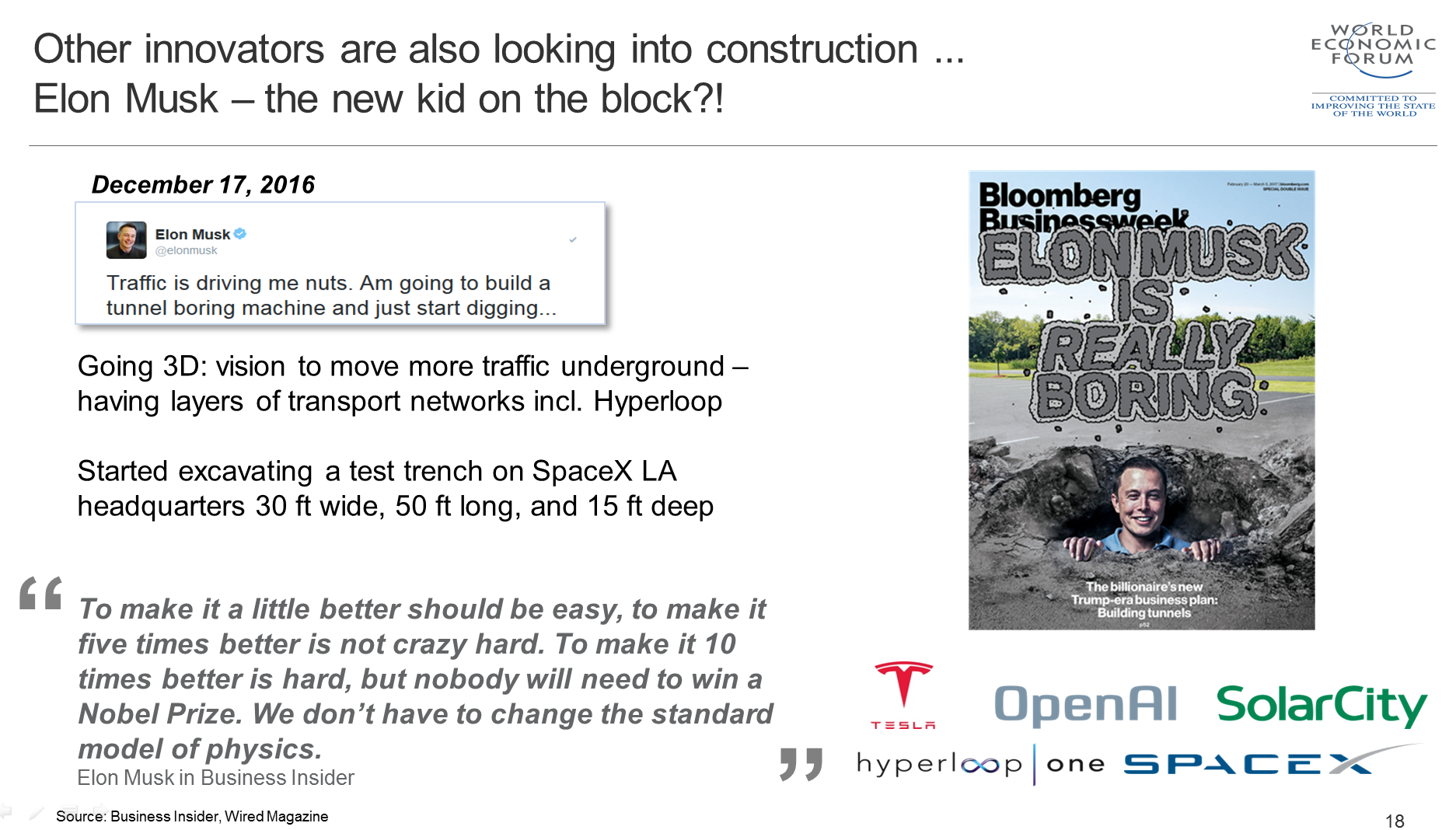
| "Traffic is driving me nuts. Am going to build a tunnel boring machine and just start digging …” |
Elon Musk’s tweet in December 2016 startled the construction industry. He was not joking: only a month later, he started excavating the first test trench on Space X headquarters in Los Angeles – an incredibly fast move for such a traditionally slow sector.
Thanks to Musk’s visionary and bold approach, he succeeds in attracting the best talent to his projects – a challenge traditional construction companies find hard to meet.
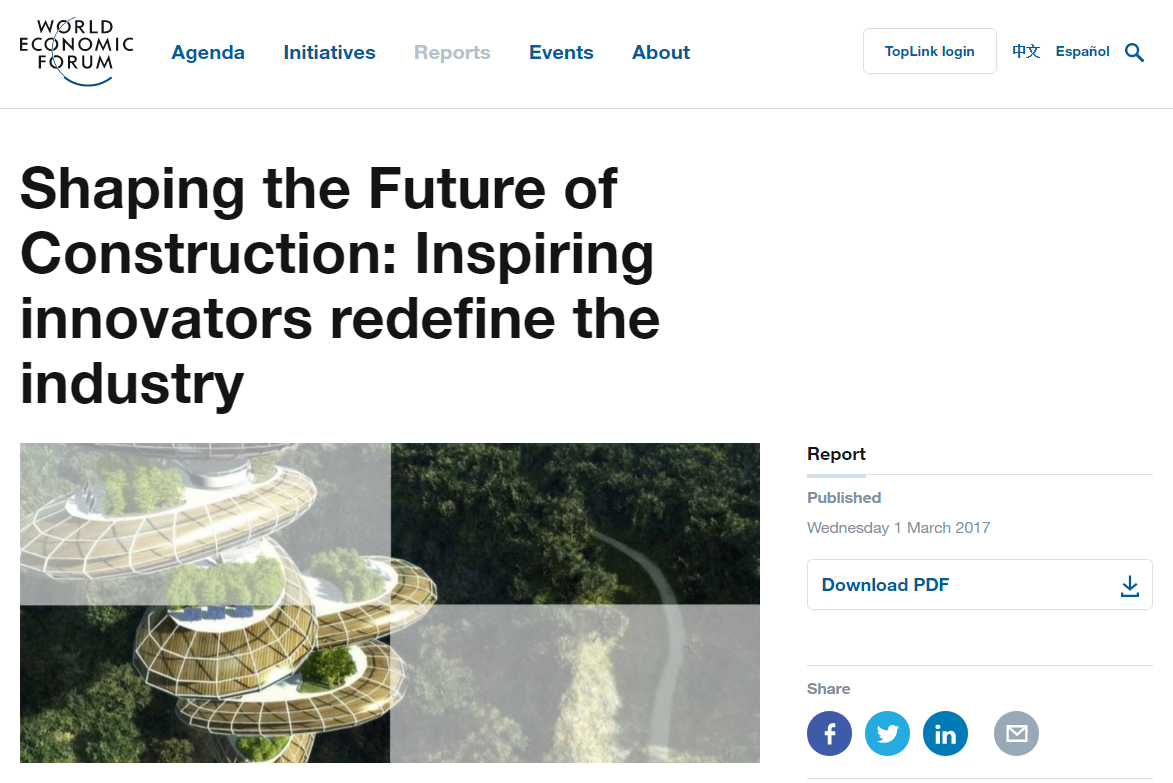
Shaping the Future of Construction: Inspiring innovators redefine the industry, a white paper published by the World Economic Forum and Boston Consulting Group in March 2016, this is just one prominent example of a growing number innovators and disruptive companies shaking up the industry. With 3D-printed houses, automatically designed hospitals, prefabricated skyscrapers – once futuristic dreams are now becoming a reality
[edit] Building the future
Relative to other industries, productivity in construction stalled over the past 50 years. Technology was not making any fundamental advances, and companies remained averse to changing their traditional methods. Recently, however, transformative technological developments have emerged, and some pioneering firms have adopted them for current projects. These developments – 3D printing, building information modelling (BIM), wireless sensing and autonomous equipment, to name just a few – are already starting to turn traditional business models upside down.
Shaping the Future of Construction outlines 10 cases that illustrate the value of embracing innovation. Prominent flagship projects, such as Dubai’s Burj Khalifa, the world’s tallest building, and the Edge in Amsterdam, the world’s most sustainable office building, showcase state-of-the-art innovation.
So, too, do the various pilot projects or start-ups that the report analyses, such as the 3D printing of houses by Chinese company Winsun or the predictive analytics of construction data by Chicago-based Uptake, Forbes’s hottest start-up of 2015 and now valued at over $2 billion. Jointly, their inspirational stories give a glimpse of the industry’s future.
For society, it could be a bright future: construction clients and communities at large will benefit from the long overdue transformation of the industry. And change is urgently needed if we’re going to respond to megatrends such as climate change, migration into urban areas and a new global push for infrastructure.
As a reliable source of entry-level jobs for immigrants and as a provider of affordable housing, the construction industry is sure to be at the centre of public debate. And if public budgets tighten further, the industry’s cost-effectiveness will come under even sharper scrutiny. Incremental change is not an option; innovations in construction could help make a serious difference, both economically and environmentally.
[edit] How construction companies can keep up
So the pace of innovation is accelerating, and that’s a good thing. But companies must act swiftly to keep up and reap the full benefits of these new technologies. Or, to paraphrase sci-fi writer William Gibson, the future of construction is here now – it’s just not evenly distributed. Innovative companies and projects may demonstrate the art of the possible, but what impact will they have on traditional construction? According to Shaping the Future of Construction, there’s a widening gap between the innovation laggards and leaders, in particular with regards to their digital transformation.
So how can companies stimulate innovative ideas, turn them into reality and ultimately succeed in the market? The report offers a few examples from pioneering firms, with lessons such as:
- create an innovation-friendly culture that rewards risk-taking;
- take a longer-term product perspective, rather than thinking in terms of individual projects;
- proactively shape the regulatory environment.
Companies have nothing to gain from delaying. Once they start improving, the benefits – lower costs, shorter delivery times and reduced environmental impact – can begin to accumulate.
But it’s not up to companies alone. Governments are crucial in the transformation of the construction industry. They need to make it easier for regulators, strategic incubators and project owners to adopt new technologies. The report recommends that governments should update building codes, move to forward-looking, performance-based standards, and introduce more flexible procurement models in infrastructure projects to overcome typical hurdles for innovation.
In fact, infrastructure is again high on the agenda in almost all regions of the world. In the words of John Beck, president and CEO of Canada’s Aecon Construction Group: “There has always been a mismatch between the need for infrastructure assets and the capital to fund them. By leveraging all the remarkable innovations that have emerged in recent years, we have a new opportunity to narrow that gap.”
[edit] Shaping the Future of Construction: read the report here
Written by
Michael Buehler, Head of Infrastructure & Urban Development, World Economic Forum
Philipp Gerbert, Senior Partner & Managing Director, The Boston Consulting Group
This article was originally published on the Future of Construction Knowledge Sharing Platform and the WEF Agenda Blog.
[edit] Related articles on Designing Buildings Wiki
- 3D printing.
- 6 buildings that are revolutionising the construction industry.
- A blueprint for the industry from Canada's West Coast.
- Architecture and the need for innovation
- Artificial intelligence and civil engineering.
- Artificial intelligence and surveying.
- Augmented reality in construction.
- Barriers to innovation and Construction 2025
- BIM articles.
- Building information modelling.
- Burj Khalifa.
- CIOB Connect mobile app.
- C-K theory.
- Construction innovation.
- Construction is an industry ripe for tech disruption.
- ConTech.
- Innovation – the key differentiator
- Innovation in construction projects
- Internet of things.
- Predictive analytics.
- Rethinking Construction Innovation and Research: A Review of Government Policies and Practices
- Smart buildings.
- Top 4 challenges facing the construction industry.
- Virtual reality construction experience for students.
- Wearable technology.
--Future of Construction 15:07, 20 Jun 2017 (BST)
Featured articles
Check out some of the best features and news from Designing Buildings as well as key stories from around the web.

Sir Edwin Lutyens: Britain's greatest architect? Book review.

CIOB publishes free template to help assess and manage risks.
ECA's reflections on Party Conference season

Burnham wants to be confident of winning before asking for a fresh mandate.
New Chief Construction and Scientific Adviser

Sergio Cavalaro, Professor of Infrastructure Systems at Loughborough University.
Building safety levy for England

CIAT publish estimator tool for members.

Water sector faces a growing crisis that could slow the delivery of vital infrastructure.
Undervaluing our industrial past

Heritage value changes as taste for building styles changes.
Changing expectations around competence and compliance

New information sheet from CIAT.
Grenfell investigation files passed to CPS

Angela Rayner apologises on behalf of the British state.

Electrical contractors need to understand the practical implications.

The real barrier to getting more value from digital technology.

Your guide to The Construction Reset at UKCW Birmingham.