




Designated areas

[edit] Introduction
Designation can be used to protect areas of value and scientific interest and to ensure that such areas are properly managed. This includes areas of particular value for the conservation of species, habitats, historic and cultural assets and landscapes of great value or beauty.
Designation is driven by a goal to conserve and enhance such areas and is underpinned by UK and international legislation. Development within or near designated areas is subject to additional controls.
There are two types of designation in the UK, Statutory Designation and Non-Statutory Designation.
Approximately 28% of England is designated as Sites of Special Scientific Interest, Areas of Outstanding Natural Beauty or National Parks.
[edit] Areas of Outstanding Natural Beauty (AONB)
ANOBs were designated to conserve natural beauty in England, Wales and Northern Ireland. However, In November 2023 all AONBs in England and Wales became National Landscapes.
For more information see: Areas of Outstanding Natural Beauty.
[edit] Biosphere reserves
Biosphere reserves are designated under UNESCO’s Man and the Biosphere Programme.
[edit] Global Geoparks
Global Geoparks are part of the Global Geopark Network supported by UNESCO.
[edit] Heritage Coasts
Heritage coasts are areas of coastline managed to conserve and enhance their natural beauty, facilitate appreciation by the public, and maintain and improve their environmental health. They are defined areas rather than designated and so establishing them does not require the statutory designation process, they are protected by planning through development control.
For more information see: Heritage coast
[edit] Local Nature Reserves (LNR)
LNRs are areas of special local wildlife or geological interest.
[edit] Local sites
Local sites are designated by Local Planning Authorities. They include Sites of Importance for Nature Conservation (SINCS), Sites of Nature Conservation Importance (SNCIs) and County Wildlife Sites.
Other local sites where restrictions might apply include registered common land and registered town or village greens. In addition, conservation areas, tree preservation orders and listed buildings require additional consent for development.
[edit] Marine protected areas
Marine protected areas include Special Areas of Conservation (SACs) for habitats of European importance, Special Protection Areas (SPAs) for birds, Marine Conservation Zones (MCZs) and Marine Nature Reserves designated to conserve marine flora and fauna and features of special interest.
[edit] National landscapes
In November 2023, all designated Areas of Outstanding Natural Beauty (AONBs) in England and Wales become National Landscapes. The National Landscapes Association (previously the National Association for Areas of Outstanding Natural Beauty), stated that the new name reflects their national importance: the vital contribution they make to protect the nation from the threats of climate change, nature depletion and the wellbeing crisis, whilst also creating greater understanding and awareness for the work that they do.
For more information see: National landscapes.
[edit] National Nature Reserves (NNR)
NNRs are areas managed in England by Natural England for the preservation of flora, fauna, geological and physiological features of special interest.
For more information see: National Nature Reserves
[edit] National parks
National parks are areas of the countryside designated to conserve and enhance their natural beauty, wildlife and cultural heritage and the open air recreation they facilitate.
For more information see: National parks
[edit] National Scenic Area NSA
In Scotland, a National Scenic Area (NSA) is an area of countryside with high scenic value of national importance and interest that has statutory protection to conserve and enhance the natural beauty of its landscape.
National Scenic Areas (NSAs) include:
- Mountain ranges.
- Islands.
- Diverse landscapes.
For more information see: National Scenic Area
[edit] National Trails
National trails are long-distance trails through National Parks or Areas of Outstanding Natural Beauty.
For more information see: National Trails
[edit] Ramsar Sites
Ramsar sites are wetlands of international importance designated under the Ramsar Convention.
For more information see: Ramsar sites
[edit] Sites of Special Scientific Interest (SSSI)
SSSIs were first established in 1949 by the Nature Conservancy so the conservation of important sites of natural habitat, wildlife and geological heritage could be taken into account during the planning process. Today, Natural England has responsibility for identifying and protecting SSSIs in England under the provisions of the Wildlife and Countryside Act.
- Ancient woodlands.
- Species-rich grasslands.
- Heathlands.
- Coastal marshes and mudflats.
- Unique geological formations.
For more information see: Sites of Special Scientific Interest
[edit] Special Areas of Conservation (SAC)
SACs are areas designated under the European Union’s Habitats Directive to be of value for species, plants and habitats. They comprise marine and terrestrial SACs.
For more information see: Special Areas of Conservation
[edit] Special Protection Areas (SPA)
SPAs are designated under the Birds Directive to protect internationally valuable populations of bird species. They comprise inshore marine SPAs and terrestrial SPAs.
For more information see: Special Protection Areas
[edit] World Heritage Sites
World heritage sites are sites with internationally important cultural or national heritage.
For more information see: World Heritage Sites
[edit] Related articles on Designing Buildings
- Ancient woodland.
- Areas of Outstanding Natural Beauty.
- Archaeology and construction.
- Archaeological officer.
- Blue belt.
- Civic Amenities Act.
- Common area.
- Conservation.
- Conservation areas.
- Conservation officer.
- Designated land.
- Ecological network.
- European sites.
- Forests.
- Heritage Action Zone.
- Heritage coast.
- Historic England.
- Listed buildings.
- Local green space.
- Local interest list.
- Local Nature Reserve.
- Making Local Nature Recovery Strategies deliver.
- National nature reserves.
- National parks.
- National Scenic Area NSA.
- Natural England.
- Natural environment white paper.
- Nature improvement area.
- Ramsar sites.
- Scheduled monuments.
- Site of biological importance.
- Site of Nature Conservation Interest (SNCI).
- Sites of Special Scientific Interest.
- Special areas of conservation.
- Special protection areas.
- Statutory authorities.
- Statutory permissions.
- The history of conservation areas.
- Tree preservation orders.
- Types of land.
- Village greens.
- World heritage site.
[edit] External references
IHBC NewsBlog
Busaries open for IHBC's Annual School 10-12 June 2027

Apply for funded places for #IHBCBristolBath2027 until 1 February 2027
London's oldest restaurant given to National Trust

Rules will continue to open and income will fund conservation
No right to cross-pavment charging in England's conservation areas

Residents excluded from new permitted development rights
Save the Date for #IHBCBristolBath2027 on 'Climate Change & Significance'
Register now for updates on IHBC's Annual School 10-12 June 2027
Bath could pause UNESCO World Heritage Site status
Consultation on scheme to hit housing targets runs until 30 October 2026
Canals offer increasing innovation opportunities
Canal & River Trust sees canals playing role in UK's water security
IHBC sponsors Gardens Trust event 23-4 Sept 2026

'Learning from the Past, Shaping the Future’ takes place in Milton Keynes
Renovations to Frank Lloyd Wright's Fallingwater complete

World Heritage Preserved project opens house for tours again
Shakespeare Birthplace Trust places Hall's Croft on HAR Register
Stratford-upon-Avon home of Shakespeare's daughter is 'At Risk'
Lady Grange’s House repaired on St Kilda

National Trust for Scotland repairs stone cleit with link to famous island resident
Griff Rhys Jones on BBC Radio 4 Today programme

The Victorian Society’s President unveiled its latest Top Ten Endangered Buildings 2026.
Need a MATE? Book your place now.

IHBC offers free webinars on applying for IHBC accreditation (Full & Associate).
UK Stained Glass Repository finds windows new homes
How are stained glass windows are rescued, stored and repurposed?
APPGEBE report sets high aims for quality
'Government must not sacrifice quality in drive to build 1.5m homes'
New measures protect Historic Shipwrecks from heritage crime

Underwater cultural heritage benefits from new HE guidance
How could the City of London skyline look in 6 years' time?

Visualisation shows approved planning applications as completed buildings
National Trust for Scotland calls for VAT cuts
Heritage neglect is encouraged by current policies
IHBC's 'Context' Issue 186 features Industrial Heritage

IHBC's members' journal reports on the challenges of conserving infrastructure
Book now for IHBC Annual School 2026

IHBC Annual School is taking place 18-20 June 2026 in Newcastle
RICHeS Research Infrastructure offers ‘Full Access Fund Call’
RICHeS offers a ‘Help’ webinar on 11 March
Latest IHBC Issue of Context features Roofing
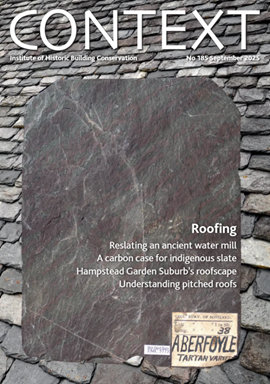
Articles range from slate to pitched roofs, and carbon impact to solar generation to roofscapes
Three reasons not to demolish Edinburgh’s Argyle House

Should 'Edinburgh's ugliest building' be saved?
IHBC’s 2025 Parliamentary Briefing...from Crafts in Crisis to Rubbish Retrofit
IHBC launches research-led ‘5 Commitments to Help Heritage Skills in Conservation’
How RDSAP 10.2 impacts EPC assessments in traditional buildings

Energy performance certificates (EPCs) tell us how energy efficient our buildings are, but the way these certificates are generated has changed.