





Decommissioning buildings
Contents |
[edit] Introduction
Decommissioning is the process of shutting down a building and/or removing it from operation or use. Decommissioning may be followed by re-commissioning, repurposing or demolition. Common types of buildings that may be decommissioned include; power stations, oil rigs, factories, warehouses, public buildings and so on.
The purpose of decommissioning a building is to protect it and its systems, to reduce ongoing costs, and to reduce hazards and other risks until the future of the building has been determined.
Decommissioning can be a complex process that requires careful planning and management to ensure it is carried out efficiently and safely. Depending on the extent and scope of the decommissioning required, it can involve:
- Disconnecting utilities to the building.
- Switching off the water supply and draining pipes.
- Considering the fire safety of the vacated building.
- Shutting down HVAC systems.
- Ensuring the roof and facades are weather-resistant.
- Preventing excess moisture and humidity by providing ventilation.
- Ensuring doors, windows and opening are secured to prevent trespassing.
- Clearing vegetation surrounding the building.
- Removing hazardous, flammable and waste materials.
- Providing temporary support to weakened or damaged elements.
- Installing a security system.
[edit] Decommissioning steps
[edit] Defining the end-state
In the first stage of decommissioning planning, the desired end-state of the building must be clearly defined. For example, whether the whole building is to be decommissioned or only part, whether plant and equipment are to be removed or left in place, and so on.
[edit] Decommissioning plan
Preparing a decommissioning plan can help to clarify the objectives of the building owner. This might set out a methodology relating to safety, what and how items will be recycled or re-used, how any hazardous substances are to be dealt with, cost-efficiency measures, and so on. A specialist consultancy team can help prepare a decommissioning plan.
[edit] Preparing a scope of work
Once the decommissioning plan has been formulated, a scope of work can be prepared which describes the exact process for achieving its objectives. The scope of work will enable the management to make informed decisions as to the level and expertise of personnel that will be required to undertake the tasks.
[edit] Identifying resources and appointing specialists
Once the tasks and activities have been detailed in the scope of work, the necessary resources that are required can be identified. The extent of the decommissioning, and its complexities will determine whether specialists are required.
[edit] Find out more
[edit] Related articles on Designing Buildings Wiki
- Building owner's manual - O and M manual.
- Demolition.
- Design for deconstruction.
- Design life.
- Dismantling.
- End of life potential.
- How to conduct a pre-demolition audit.
- Listed building.
- Maintenance.
- Pre-demolition audit.
- Pre-demolition and pre-refurbishment audits.
- Recyclable construction materials.
- Structures at the end of their design life.
- Urban decay.
- Urban exploration UE.
Featured articles and news

We're expanding our collaborative mission by launching DB Intelligence, an exclusive market research advisory panel. Built environment professionals can now get paid to share their expertise on industry trends, products and services.
Panel members receive direct financial incentives for participating in research projects like short surveys, 1-2-1 interviews and focus groups. Register today to shape the future of the construction sector.
Building Safety Wiki Interviews

Chief executive of the British Woodworking Federation.
Planning condition discharge in England and Wales

A brief exoplanation from a building compliance expert, with further links.
Overheating guidance and tools for building designers

Guidance for dealing with element of building fabric control that have increasing importance.
Shading for housing, a design guide

From the Good Homes Alliance and British Blind and Shutter Association.
UK Standard Skills Classification (SSC)

A shared framework for describing skills needs.
Social media ban consultation comes to close

CIOB urges UK Government to consider social media’s role in careers guidance in ban debate.
The latest of eight Skills England apprenticeship units

The addition of battery manufacturing welcomed by ECA with a warning about the risks of fast-tracked apprenticeship units.
Building Control Independent Panel final report
A precis of a key report led by Dame Hackitt with full recommendations and link to the government response.
Building Safety recap April, 2026
A short and longer run-through of the month, with links to further information and sources.
CIAT May 2026 briefing.

From medieval scribes to modern word art.

ECA welcomes crackdown on late payment and push for clean energy, whilst CIOB seek fixed cladding removal timeframes.
Cyber Security in the Built Environment
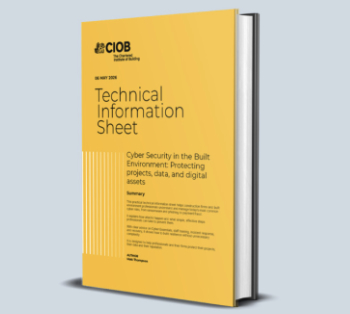
Protecting projects, data, and digital assets: A CIOB Academy TIS.
Managing competence in the built environment
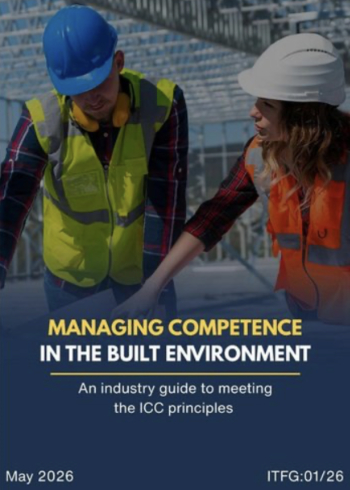
ITFG publishes new industry guide on how to meet the ICC principles.