




The National Housing Bank

In June 2025, the government announced its plans for the creation of a new National Housing Bank to help deliver more than 500,000 homes across the country. The plan, to be backed by £16 billion in financial capacity, alongside £6 billion it had already allocated, is also expected to unlock £53 billion of private investment, supporting housebuilding, creating jobs, and stimulating economic growth.
The intention from the government being that the bank, would operate as a subsidiary of Homes England, having greater autonomy to issue government guarantees and make long-term investments. It will support SMEs, fund infrastructure for complex sites, and provide loans and guarantees to help unlock housing supply, including social and affordable homes.
The aims of the National Housing Bank being to:
- Provide a wider range of debt, equity and guarantee products supporting SMEs to accelerate housebuilding and grow.
- Expand the use of lending alliances with the private sector, to increases access to finance for housebuilders.
- Support unlocking large, complex sites to increase confidence and boost housing supply through the provision of infrastructure finance and guarantees.
- Scale up partnership investments to draw more institutional funds into housing and mixed-use schemes such as Schroders Real Estate Impact Fund, the MADE Partnership with Lloyds Bank Group and Barratt Redrow and HABIKO joint venture with PIC and Muse, and PPPs with Oaktree Capital and Greycoat Real Estate.
- Work with Mayors and local leaders to develop integrated packages of financial support to deliver their housing and regeneration priorities, alongside wider land and grant funding.
- Provide the low-interest loans announced at the Spending Review to support the delivery of more social and affordable homes – recognising their importance in tackling the housing crisis.

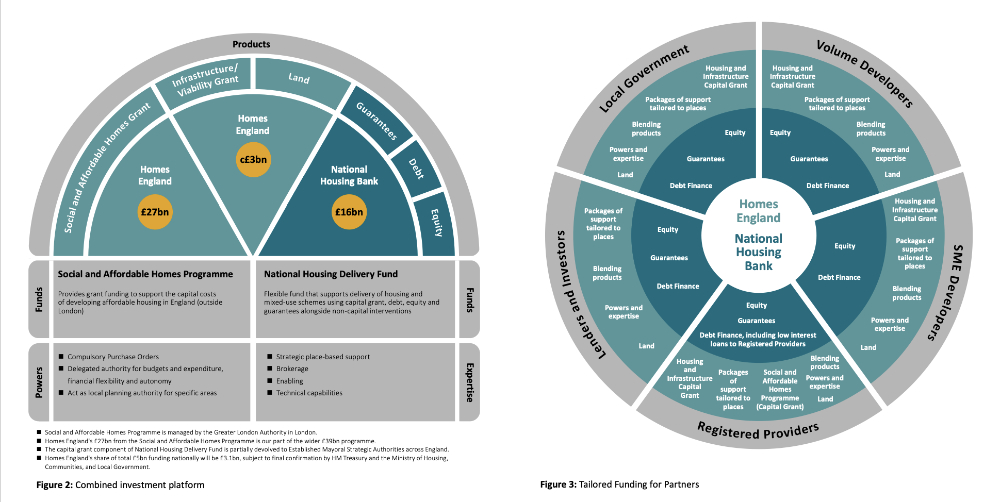
On 31 March 2026 it was announced that the newly established Homes England National Housing Bank would be officially open for business, from 1 April, 2026. Alongside the launch Homes England and the National Bank published a new Investment prospectus that sets out the agency’s full range of funding and support, the images and tables are extracted from the full prospectus document which can be found here.
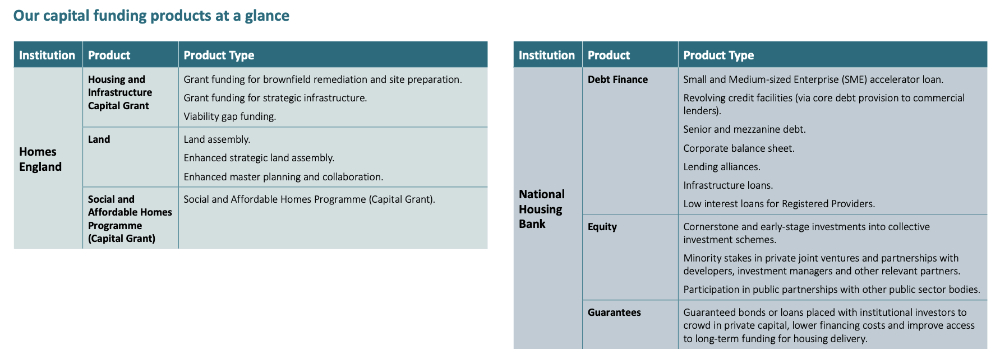
The prospectus is the Agency’s single, authoritative statement of how it invests to deliver homes and regeneration, describing in detail. With the bank at its core, the Investment Prospectus brings together for the first time Homes England’s full range of capital products, land, powers and technical expertise in one public document – making it easier for local leaders and partner organisations to understand the role the Agency and the National Housing Bank can play in delivering their pipeline of housing and mixed-use schemes.
Headquartered in Leeds, the National Housing Bank launched with the announcement "National Housing Bank and Aviva to invest £100 million to build thousands of high-quality family homes in UK towns and cities" that it had contracted a new £100 million partnership with Mansion House Compact signatory and Sterling 20 member, Aviva.
The partnership will work with Place Capital Group and has the ambition to deliver 300 homes initially with scope to develop up to 3,300 homes as the funding grows. The homes will be developed on underused brownfield sites in regional UK towns and cities, improving housing stock and creating visibly cared for neighbourhoods. The high quality, low energy rental homes will be aiming at a market segment of lower to middle income working families, providing certainty of tenure in urban areas with good commuting links and social infrastructure.
The investment is one of the first to be supported by the National Housing Bank, and has already secured the Vescock Street development in Liverpool and the Moston Lane site in Manchester. 135 homes will be built in Vescock Street, part of Liverpool’s new town ambitions, a long-term programme to improve several underdeveloped Liverpool City neighbourhoods. Approximately 150 homes will be delivered in Moston Lane, with over a third as affordable, as part of a wider development to transform the area.
Housing Secretary Steve Reed said:
"Launching England’s first ever National Housing Bank underpins a new way of doing things as we accelerate housebuilding at scale and tackle the housing crisis head on. Now open for business, the Bank will rake in billions of pounds of essential private investment to get spades in the ground for half a million new homes. This is just one of the many levers we’re pulling to make sure we reach our 1.5 million target this Parliament."
Homes England Chair Pat Ritchie CBE said:
The opening of the National Housing Bank and launch of the Investment Prospectus build on Homes England’s expertise at providing a wide range of finance to partners and places to unlock the delivery of new housing and mixed-use schemes. The National Housing Bank directly responds to calls from the housing sector, mayors and local leaders to increase the scale and flexibility of available public and private finance for housing and regeneration, to build the homes and communities our county needs. Our Investment Strategy puts place at the heart of how we invest, developing innovative tailored packages of support for the whole housing and regeneration system, bringing together grant, debt, equity, guarantees, land and expertise around local priorities.
Amy Rees CB, Chief Executive of Homes England, said:
The launch of both the National Housing Bank and Homes England’s Investment Prospectus are a watershed moment and mark an unprecedented scale of ambition and investment to deliver homes and regeneration across the country. Both institutions have up to £46 billion of capital to deploy over the next decade, including £27 billion of social and affordable housing grant, a share of £5 billion for land and infrastructure and up to £16 billion of debt, equity and guarantees.
The Investment Prospectus is explicit about the challenges facing the housing system, including affordability, viability, stalled land, constrained finance and delivery risk. Homes England and the National Housing Bank will step in where those market failures exist and help unlock delivery at pace. Our message to partners and investors is a simple one: please get in touch and talk to us. We are open for business and are committed to shaping the right solutions for a place or project.
Simon Century, Chief Executive of the National Housing Bank, said:
The National Housing Bank will back delivery at scale and act at pace, providing government-backed finance to de-risk projects and unlock delivery the market cannot change alone. Our ambition and scale as a public finance institution creates the conditions for long-term, stable investment, focusing on delivery and giving investors confidence whilst enabling more innovative, scalable delivery models. With delegated authority, we will take decisions quickly and proactively, acting as an enabler, not a barrier, to the market.
Peter Vernon, Chair of the National Housing Bank, added:
The National Housing Bank builds on Homes England’s strong track record, including long-standing investment in housing delivery and working in partnership with investors, developers and places. Building on this strong foundation and deploying substantial new firepower and flexibilities the Bank will look to build deeper and broader partnerships across the sector to accelerate early delivery as this significant day one investment clearly demonstrates.
[edit] Related articles on Designing Buildings
- A social and affordable housing renewal decade: The long term government plan for delivery.
- Affordable housing.
- Affordable rented housing.
- Buy-to-let mortgage.
- Councils and communities highlighted for delivery of common-sense housing in planning overhaul.
- Design Council Homes Taskforce launched to support the new government in creating 1.5 million homes within UK climate commitments.
- Help to buy.
- Home England.
- Housing associations.
- Killian Pretty Review.
- Laying the foundations: a housing strategy for England.
- Real estate investment trusts.
- Rent to buy.
- Right to buy.
- Social rented housing.
- The National Housing Bank; a publicly owned and backed subsidiary of Homes England
Featured articles
Check out some of the best features and news from Designing Buildings as well as key stories from around the web.

CIOB celebrates positive Ofsted report.

The Building Safety Regulator announces a call for evidence.

Government approach could undermine delivery and regeneration.
World's first mass timber data centre.

The overlooked environmental aspect of data centre development.
Introduction to radon awareness

New technical information sheet published by CIOB.

Updated supplier guide can help electrical contractors engage with NHP.

CIAT confirm the winners of the 2026 architectural technology awards.

Government launches a one stop shop for flood preparedness.

Sir Edwin Lutyens: Britain's greatest architect? Book review.

CIOB publishes free template to help assess and manage risks.
ECA's reflections on Party Conference season

Burnham wants to be confident of winning before asking for a fresh mandate.
New Chief Construction and Scientific Adviser

Sergio Cavalaro, Professor of Infrastructure Systems at Loughborough University.