





Repurposing Empty Spaces. Addressing the Housing Crisis Across England, Scotland and Wales in 2025
Contents |
[edit] New research from Habitat for Humanity Great Britain
‘Repurposing Empty Spaces: Research to Address the Housing Crisis’, is a new piece of research, exploring the current opportunities available in reutilising socially owned vacant buildings and spaces, for use as? accommodation? for those at risk of? homelessness?? across England, Wales and Scotland. It was published by Habitat for Humanity Great Britain in August 2025, following the previous report published in 2021 on a related topic.
Habitat for Humanity Great Britain writes:
…. A new piece of research, conducted by The Empty Homes Network on behalf of Habitat for Humanity Great Britain, aims… to provide an understanding of opportunities to help address the current social housing supply and demand across England, Scotland and Wales. The research has been supported by the Empty Spaces to Homes Coalition, including:?M&G plc , the Laudes Foundation, Kingfisher PLC, Blackstone and Lloyds Banking Group.?
Local authorities have more empty buildings than in 2021, and more opportunity to create social homes. The report follows from the previous 2021 report and its findings "Repurposing Empty Commercial Spaces to Help Address the Housing Crisis in the UK: Research Findings" which was conducted by The Empty Homes Network on behalf of Habitat for Humanity Great Britain. Habitat for Humanity Great Britain works with academics and sector professionals to build knowledge and understanding of the housing crisis and the most effective solutions to tackling it. It has been running its Empty Spaces to Homes campaign for some years, to find out more or donate click here or the image below.

[edit] Research Highlights (in brief)
- Commercial vacancy is rising across the UK: The estimated number of vacant local authority-owned properties rose from 6,324 to 8,242, indicating growing volumes of underused public assets, particularly in retail, office, and leisure sectors.?
- Opportunities presented by vacant spaces to create housing increases: Over 25,000 new homes could be created across the UK by converting vacant local authority-owned offices and shops, highlighting the untapped potential for local authorities to take an active lead in tackling the housing crisis.?
- Beyond local authority-owned assets, in England alone recent data suggests there are around?175,000 privately owned empty non-residential buildings which may have the potential for over 500,000 homes.
- The full 2025 research report includes a wider assessment of the state of the housing crisis in Great Britain, an analysis of the challenges and opportunities in each region, and examples of best practice.

Image of graph extract from the Habitat for Humanity report Repurposing Empty Spaces, page 6.
[edit] Policy Recommendations (in brief)
- Government, local authorities, and key agencies should create a standardised national dataset on publicly-owned vacant properties, covering details such as vacancy duration, ownership, previous use, and location.
- A national strategy should treat vacant commercial premises as a cross-cutting opportunity that aligns housing, planning, economic, and climate goals.
- England should adopt a place-led framework, as seen in Scotland and Wales, to support the reuse of vacant commercial premises for community and housing needs.
- A dedicated funding programme is needed to unlock smaller, underused commercial spaces for social and community-led housing.
- Local authorities should be empowered with stronger planning tools, funding mechanisms, and training to drive reuse projects and partnerships.
- Habitat for Humanity and partners should identify promising localities for pilot projects that convert vacant commercial premises into affordable housing.
- Habitat for Humanity should also develop an investment and delivery model with housing associations, councils, and ethical investors to share resources, risks, and costs.
[edit] Comment
Henrietta Blackmore, National Director of Habitat for Humanity said: “We know that empty buildings are only part of the answer to the housing crisis, but they should be an important part. Councils have full control over what they do with their assets, and must prioritise social homes.”
“The budgetary pressures local authorities face are not helped by constant fire-fighting with scarce resources. Vulnerable people have better outcomes when they have access to safe, good quality accommodation. Providing that sort of housing now reduces the day-to-day costs that councils face tomorrow. Fixing the broader social issues we face as a nation means first ensuring we all have somewhere to call home."
“As our report shows, there exists a large number of buildings which could help us meet that mission. The fact we have empty buildings and a housing crisis isn’t new, but it’s time for all involved to grasp new ways of thinking and doing to boost the stock of social housing. That’s what today’s report sets out; practical steps that could be taken to address the overwhelming domestic challenge of our times.”
This article is based on the news item that appears on the IHBC news and blogsite as "IHBC’s ‘Research’ Signpost: ‘Empty Spaces to Homes’…' dated 26 August 2025. Information and quotes are taken from related media items published on the Habitat for Humanity news site aswell as the report itself.
--Institute of Historic Building Conservation
[edit] Related articles on Designing Buildings
- Adverse possession.
- Architecture of Christiania.
- Empty dwelling management orders.
- Empty housing in London - documentary.
- Excluded occupier.
- Housing tenure.
- How to evict a tenant.
- IHBC articles.
- Land registry.
- Property guardianship.
- Rating (Property in Common Occupation) and Council Tax (Empty Dwellings) Bill.
- Right of entry.
- Right to access land.
- Squatting.
- Permitted development.
[edit] External links
IHBC NewsBlog
IHBC sponsors Gardens Trust event 23-4 Sept 2026
.jpeg)
'Learning from the Past, Shaping the Future’ takes place in Milton Keynes
Renovations to Frank Lloyd Wright's Fallingwater complete
.jpg)
World Heritage Preserved project opens house for tours again
Shakespeare Birthplace Trust places Hall's Croft on HAR Register
Stratford-upon-Avon home of Shakespeare's daughter is 'At Risk'
Lady Grange’s House repaired on St Kilda
.jpg)
National Trust for Scotland repairs stone cleit with link to famous island resident
Griff Rhys Jones on BBC Radio 4 Today programme
,_Green_Lane,_Derby.jpg)
The Victorian Society’s President unveiled its latest Top Ten Endangered Buildings 2026.
Need a MATE? Book your place now.

IHBC offers free webinars on applying for IHBC accreditation (Full & Associate).
UK Stained Glass Repository finds windows new homes

How are stained glass windows are rescued, stored and repurposed?
APPGEBE report sets high aims for quality
'Government must not sacrifice quality in drive to build 1.5m homes'
New measures protect Historic Shipwrecks from heritage crime

Underwater cultural heritage benefits from new HE guidance
How could the City of London skyline look in 6 years' time?

Visualisation shows approved planning applications as completed buildings
National Trust for Scotland calls for VAT cuts

Heritage neglect is encouraged by current policies
IHBC's 'Context' Issue 186 features Industrial Heritage

IHBC's members' journal reports on the challenges of conserving infrastructure
Book now for IHBC Annual School 2026
IHBC Annual School is taking place 18-20 June 2026 in Newcastle
RICHeS Research Infrastructure offers ‘Full Access Fund Call’

RICHeS offers a ‘Help’ webinar on 11 March
Latest IHBC Issue of Context features Roofing
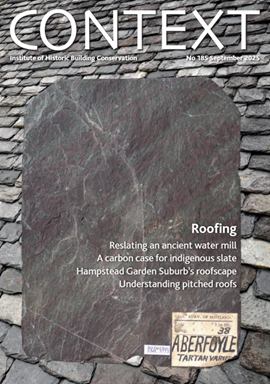
Articles range from slate to pitched roofs, and carbon impact to solar generation to roofscapes
Three reasons not to demolish Edinburgh’s Argyle House

Should 'Edinburgh's ugliest building' be saved?
IHBC’s 2025 Parliamentary Briefing...from Crafts in Crisis to Rubbish Retrofit
IHBC launches research-led ‘5 Commitments to Help Heritage Skills in Conservation’
How RDSAP 10.2 impacts EPC assessments in traditional buildings

Energy performance certificates (EPCs) tell us how energy efficient our buildings are, but the way these certificates are generated has changed.