





Non-domestic building services compliance guide
The Non-Domestic Building Services Compliance Guide provides guidance for the installation of fixed building services in new and existing non-domestic buildings to help achieve compliance with the energy efficiency requirements of the building regulations.
It is published by the government and provides more detailed information on the guidance contained in Approved Document L2A: Conservation of fuel and power in new buildings other than dwellings, and Approved Document L2B: Conservation of fuel and power in existing buildings other than dwellings
The latest version was published in 2013 and came into effect in April 2014. It is concerned with the design, installation and commissioning of:
- Conventional means of providing primary space heating, domestic hot water, mechanical ventilation, comfort cooling and interior lighting.
- Low-carbon generation of heat by heat pumps and combined heat and power systems.
It sets out recommended minimum energy efficiency standards for components of building services systems. For systems installed in new buildings, the standards are design limits. For new or replacement systems and components installed in existing buildings, the standards represent reasonable provision for complying with the building regulations.
It also provides supplementary information regarding good practice that exceeds the minimum standards, such as Microgeneration Certification Scheme standards.
The structure of the guide is:
- Section 1: Introduction and summary of energy efficiency standards.
- Section 2: Gas, oil and biomass-fuel boilers.
- Section 3: Heat pumps.
- Section 4: Gas and oil-fired warm air heaters.
- Section 5: Gas and oil-fired radiant heaters.
- Section 6: Combined heat and power and community heating.
- Section 7: Direct electric space heating.
- Section 8: Domestic hot water.
- Section 9: Comfort cooling.
- Section 10: Air distribution.
- Section 11: Pipework and ductwork insulation.
- Section 12: Lighting.
- Section 13: Heating and cooling system circulators and water pumps.
The European directives that set the framework governing fixed building services include:
- The Ecodesign Directive 2009/125/EC which provides a background for establishing the requirements for energy-related products.
- Energy Labelling Directive 2010/30/EU – This provides a system for labelling energy-related products such as lamps and washing machines.
- Renewable Energy Directive 2009/28/EC – This promotes the use of energy from renewable sources.
- Energy Efficiency Directive 2012/27/EU – This encourages energy efficiency to ensure that the EU meets the 20% energy consumption reduction comittment by 2020.
- Energy Performance of Buildings Directive 2013/31/EU – This directive sets out the minimum energy performance and the methods for calculating the performance of buildings, as well as inspections of heating and air conditioning units.
See also: Domestic building services compliance guide.
[edit] Related articles on Designing Buildings
- Air conditioning.
- Approved documents.
- Approved document L.
- Building regulations.
- Building services.
- Building services compliance with the building regulations.
- Combined heat and power.
- Cooling.
- Domestic building services compliance guide.
- Energy related products regulations.
- Heat pump.
- Heating.
- Microgeneration.
- Microgeneration certification scheme.
- Mechanical ventilation.
- Non-domestic building.
- Renewable energy.
- Types of building services.
Featured articles and news

We're expanding our collaborative mission by launching DB Intelligence, an exclusive market research advisory panel. Built environment professionals can now get paid to share their expertise on industry trends, products and services.
Panel members receive direct financial incentives for participating in research projects like short surveys, 1-2-1 interviews and focus groups. Register today to shape the future of the construction sector.
Planning condition discharge in England and Wales

A brief exoplanation from a building compliance expert, with further links.
Overheating guidance and tools for building designers

Guidance for dealing with element of building fabric control that have increasing importance.
Shading for housing, a design guide

From the Good Homes Alliance and British Blind and Shutter Association.
UK Standard Skills Classification (SSC)

A shared framework for describing skills needs.
Social media ban consultation comes to close

CIOB urges UK Government to consider social media’s role in careers guidance in ban debate.
The latest of eight Skills England apprenticeship units

The addition of battery manufacturing welcomed by ECA with a warning about the risks of fast-tracked apprenticeship units.
Building Control Independent Panel final report
A precis of a key report led by Dame Hackitt with full recommendations and link to the government response.
Building Safety recap April, 2026
A short and longer run-through of the month, with links to further information and sources.
CIAT May 2026 briefing.
From medieval scribes to modern word art.

ECA welcomes crackdown on late payment and push for clean energy, whilst CIOB seek fixed cladding removal timeframes.
Cyber Security in the Built Environment
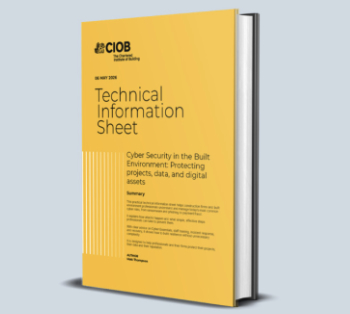
Protecting projects, data, and digital assets: A CIOB Academy TIS.
Managing competence in the built environment

ITFG publishes new industry guide on how to meet the ICC principles.
The UK's campaign to reduce noise pollution: Mythbusting, articles and topic guides.