




Kandla grey sandstone
Contents |
[edit] Introduction
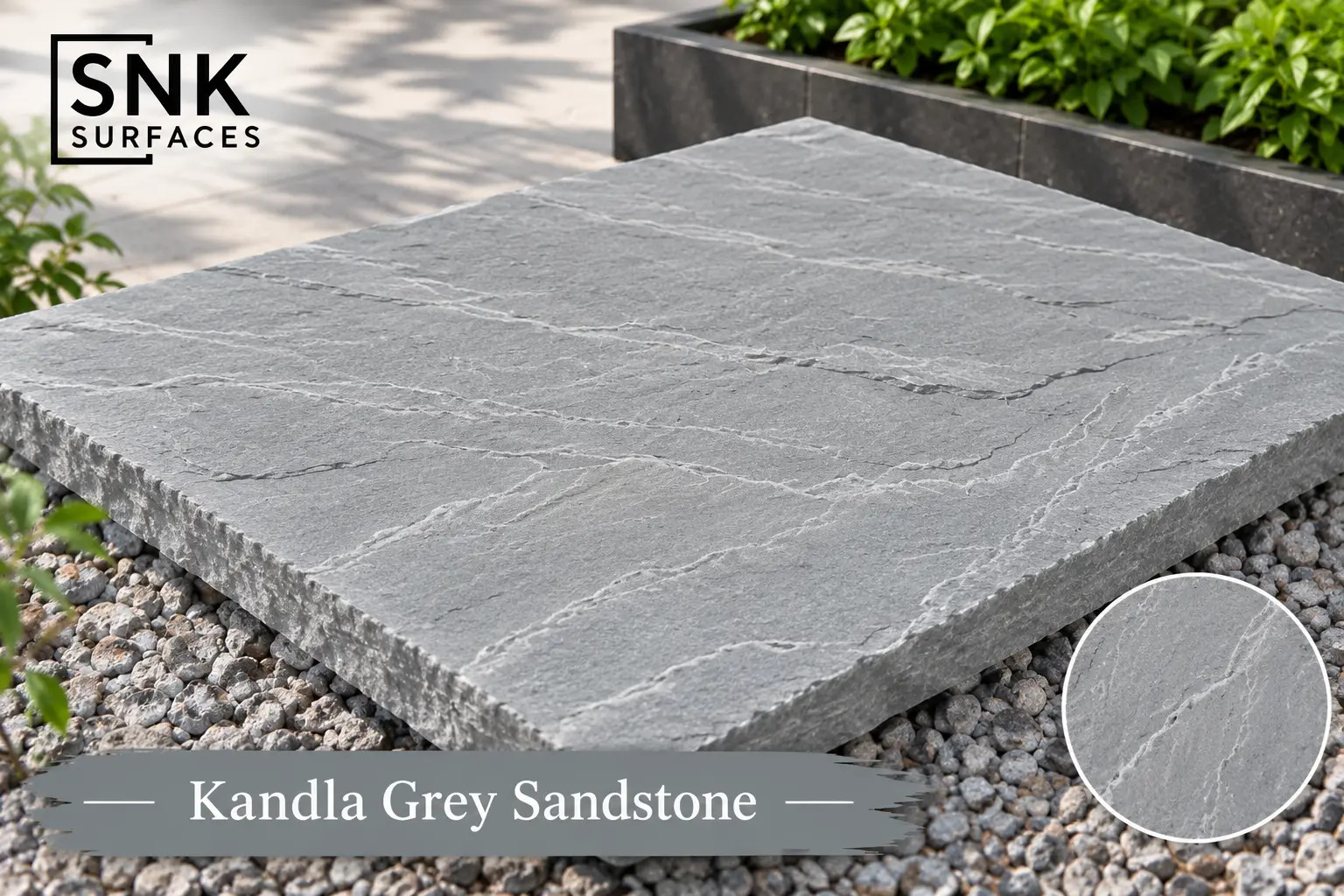
Kandla Grey sandstone is a commercially available natural sandstone commonly used for paving, landscaping and other construction applications. The name generally refers to sandstone products with cool grey and blue-grey tones, although colour, texture and mineral characteristics can vary between individual pieces and batches.
Kandla Grey sandstone is associated with sandstone quarried in Gujarat, India. Like other natural sandstones, it is a sedimentary rock formed from sand-sized mineral particles that have been deposited, compacted and cemented together. Quartz is commonly a major constituent, although the precise mineral composition and cementing materials vary between deposits.
The suitability of Kandla Grey sandstone for a particular application depends on the physical and technical properties of the specific product, its dimensions and finish, and the requirements of the proposed use. These properties should be established from appropriate technical information rather than inferred from the commercial name or appearance.
[edit] Characteristics and finishes
Kandla Grey sandstone generally has grey, blue-grey and occasionally darker or lighter tones. Natural variation is an inherent characteristic of sandstone, so individual paving units are unlikely to be identical. A representative range of samples is preferable to a single sample when specifying the material for a project.
Common finishes include naturally riven, sawn and honed surfaces. A riven finish retains some of the natural texture of the stone and can provide a textured surface suitable for external paving. Sawn and honed finishes produce flatter surfaces and can be selected where a more uniform appearance is required. The finish can affect appearance, surface texture, cleaning requirements and slip performance.
The dimensions and thickness of paving units should be selected according to the intended use and supporting construction. Common commercial sizes include 600 × 900 mm, 600 × 600 mm and 600 × 290 mm, although availability varies between suppliers and products. Larger-format units may also be available. Calibrated stone is processed to achieve more consistent thickness, which can simplify installation, but the specified dimensional tolerances should be confirmed for the particular product.
[edit] Applications and specification
Kandla Grey sandstone is commonly used for external paving, including patios, paths, terraces and other landscaping applications. It can also be used for walling, copings, building facades and natural stone cladding where the particular product is suitable and an appropriate fixing system is provided.
Stone suitable for pedestrian paving should not automatically be assumed to be suitable for vehicle traffic or structural applications. The required thickness, dimensions, bedding and supporting construction depend on the physical properties of the stone, the expected loading and the method of installation.
Natural stone cladding requires particular consideration of the weight and dimensions of the stone, the substrate and the fixing system. Thin stone used as cladding is generally supported and fixed to the structural substrate by an appropriate mechanical or proprietary system rather than being treated as structural masonry.
For external paving, relevant characteristics can include water absorption, resistance to freeze-thaw cycles, flexural strength, abrasion resistance and slip resistance. The required performance depends on the location and intended use. In exposed or frost-prone environments, the frost resistance of the particular product should be established rather than assumed from the stone's name.
[edit] Selection and purchasing
Natural variation means that a sample cannot necessarily represent every piece in a large order. For substantial projects, the expected range of colour and texture should therefore be agreed before procurement. Where appearance is important, representative samples or a control sample can help establish the acceptable range of variation.
Buyers should confirm the dimensions, thickness, finish, tolerances, quantity and relevant technical properties of the particular product. Where the stone is intended for a regulated construction application, the applicable product standards and assessment requirements should also be established.
For imported stone, procurement arrangements should take account of packaging, transport, handling, delivery times and the inspection of material on arrival. Replacement material obtained at a later date may not exactly match an earlier batch because natural stone varies between deposits and production batches.
[edit] Installation and maintenance
External sandstone paving should be installed on an appropriately designed and prepared sub-base and bedding system. The construction should provide adequate support, falls and drainage to reduce prolonged standing water. The laying method should be appropriate to the paving units, site conditions and expected loading.
Sandstone is a porous natural material and can absorb water and contaminants. Regular sweeping and appropriate cleaning can help maintain its appearance and reduce the accumulation of organic matter. Cleaning products should be suitable for the particular sandstone and finish. Strongly acidic or otherwise aggressive cleaning agents can damage some stone surfaces and should not be used unless their suitability has been established.
Sealing may be appropriate for some applications, but it is not universally required. Where a sealer is used, it should be selected for the particular stone, finish and intended use. Sealing does not compensate for inadequate drainage, unsuitable installation or inappropriate stone selection.
[edit] Related articles on Designing Buildings
Featured articles
Check out some of the best features and news from Designing Buildings as well as key stories from around the web.
Introduction to radon awareness

New technical information sheet published by CIOB.

Updated supplier guide can help electrical contractors engage with NHP.

CIAT confirm the winners of the 2026 architectural technology awards.

Government launches a one stop shop for flood preparedness.

Sir Edwin Lutyens: Britain's greatest architect? Book review.

CIOB publishes free template to help assess and manage risks.
ECA's reflections on Party Conference season

Burnham wants to be confident of winning before asking for a fresh mandate.
New Chief Construction and Scientific Adviser

Sergio Cavalaro, Professor of Infrastructure Systems at Loughborough University.
Building safety levy for England

CIAT publish estimator tool for members.

Water sector faces a growing crisis that could slow the delivery of vital infrastructure.
Undervaluing our industrial past

Heritage value changes as taste for building styles changes.
Changing expectations around competence and compliance

New information sheet from CIAT.