




Better Public Buildings: A proud legacy for the future
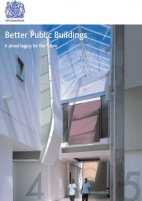
Better Public Buildings: A proud legacy for the future, was prepared by the Department for Culture, Media and Sport (DCMS), and published in October 2000. It was written by Paul Finch, a member of the Commission for Architecture and the Built Environment (CABE, now part of the Design Council), drawing on material previously prepared by members of the Better Public Buildings Group.
In the foreword, the then prime minister Tony Blair wrote, ‘It is widely believed that good design is a costly luxury. But this is simply not true. As Sir John Egan‘s report ‘Rethinking Construction’ demonstrated, best practice in integrating design and construction delivers better value for money as well as better buildings, particularly when attention is paid to the full costs of a building over its whole lifetime… That is why I have asked ministers and departments across government to work towards achieving a step change in the quality of building design in the public sector.’
The report proposes that the principles it sets out will deliver attractive, aesthetically pleasing buildings which are fit for purpose and represent good value for money.
The report suggests that good design can:
- Respect and enhance the location, the environment and the community.
- Add value and reduce whole-life costs.
- Create flexible, durable, sustainable and ecologically sound development for the community.
- Minimise waste of materials and energy, in construction and in use.
- Provide functional, efficient, adaptable spaces for home, work and recreation.
- Be attractive and healthy for users and the public.
- Contribute to construction which is quick, safe and efficient.
- Use space, materials and resources with imagination and efficiency.
- Produce buildings which are safer to construct and easier to clean and maintain.
- Revitalise neighbourhoods and cities.
- Transform derelict sites and neglected buildings, reducing pressure on the countryside.
- Uplift and bring hope to neglected communities.
- Reduce crime, illness and truancy.
- Help public services perform better.
- Deliver functional buildings and civilised places while retaining a human dimension.
- Give the client maximum value for money through the whole life of a building.
The report proposes that best value for money is likely to be obtained through the appointment of integrated project teams in which clients, designers, constructors, subcontractors and specialist suppliers work in partnership. It also highlights the role of CABE promoting quality through committees covering design review, regions, education and technology and its function as a project enabler, where a CABE representative works with a client team to help in the selection of consultants, brief writing, and advising on competitions and procurement procedures.
It suggest that the priority must be for the public sector to become a smarter client and lists a series of strategies that should either continue, or be started:
- Acknowledging the fundamental importance of design leadership as a key function within an integrated project team to provide best value for the client.
- Encouraging high expectations in respect of the design standards expected for all public realm developments.
- Working with CABE and other bodies to promote the importance of design.
- Implementing the recommendations of the Construction Task Force and Achieving Excellence programme to improve quality and value for money in construction.
- Developing key performance indicators for design quality within construction programmes.
- Promoting the civic ethos which is crucial to improved built environments nation-wide.
- Encouraging the creation of regional architecture centres to promote good design and community involvement systematically throughout the country.
- Introducing procurement arrangements that enable specialist suppliers to contribute to design development from the outset.
- Demanding buildings on time, in line with their original budget and without defects.
- Identifying the high-level post which should incorporate the role of ‘design champion’ within government departments and other public bodies.
- Insisting that measures to ensure the appointment of good designers are reviewed by the design champion.
- Promoting high-quality design on PFI projects in line with Treasury Note 7.
- Supporting local authorities who apply good architectural and urban design standards, particularly to public sector projects.
- Encouraging planning authorities to insist on appropriately high design standards for public projects.
- Allowing enough design time for projects of real quality to emerge.
- Measuring efficiency and waste in construction.
- Appointing integrated teams focussing on the whole life impact and performance of a development.
- Encouraging longer-term relationships with integrated project teams as part of long-term programmes, always subject to rigorous performance review.
- Using whole-life costing in the value-for-money assessment of buildings.
- Ensuring there is single-point client responsibility for any given project, with authority.
[edit] Find out more
[edit] Related articles on Designing Buildings Wiki
Featured articles
Check out some of the best features and news from Designing Buildings as well as key stories from around the web.

The Building Safety Regulator announces a call for evidence.

Government approach could undermine delivery and regeneration.
World's first mass timber data centre.

The overlooked environmental aspect of data centre development.
Introduction to radon awareness

New technical information sheet published by CIOB.

Updated supplier guide can help electrical contractors engage with NHP.

CIAT confirm the winners of the 2026 architectural technology awards.

Government launches a one stop shop for flood preparedness.

Sir Edwin Lutyens: Britain's greatest architect? Book review.

CIOB publishes free template to help assess and manage risks.
ECA's reflections on Party Conference season

Burnham wants to be confident of winning before asking for a fresh mandate.
New Chief Construction and Scientific Adviser

Sergio Cavalaro, Professor of Infrastructure Systems at Loughborough University.
Building safety levy for England

CIAT publish estimator tool for members.