





Whole building ventilation
Approved document F, Ventilation, suggests that ‘whole building ventilation’, or ‘general ventilation is:
‘…nominally continuous ventilation of rooms or spaces at a relatively low rate to dilute and remove pollutants and water vapour not removed by the operation of extract ventilation, purge ventilation or infiltration, as well as supplying outdoor air into the building. For an individual dwelling this is referred to as ‘whole dwelling ventilation’.’
Where:
- Extract ventilation is, ‘…. The removal of air directly from a space or spaces to the outside. Extract ventilation may be by natural means (e.g. by passive stack ventilation) or by mechanical means (e.g. by an extract fan or central system).’
- Purge ventilation is, ‘…manually controlled ventilation of rooms or spaces at a relatively high rate to rapidly dilute pollutants and/or water vapour. Purge ventilation may be provided by natural means (e.g. an openable window) or be mechanical means (e.g. a fan).’
- Infiltration is, ‘… the uncontrolled exchange of air between inside a buildings and outside through cracks, porosity and other unintentional openings in a building, caused by pressure difference effects of the wind and/or stack effect.
Whole building ventilation might be provided by background ventilators, as illustrated below.

[edit] Related articles on Designing Buildings
- Air conditioning.
- Air infiltration testing.
- Approved Document F.
- Background ventilator.
- Convection.
- Cross ventilation.
- Displacement ventilation.
- Domestic ventilation systems performance.
- Heat recovery ventilation.
- HVAC.
- Mechanical ventilation.
- Natural ventilation.
- Passive building design.
- Solar chimney.
- Stack effect.
- Ventilation.
- Ventilation and control of COVID-19 transmission.
Featured articles
Check out some of the best features and news from Designing Buildings as well as key stories from around the web.
Undervaluing our industrial past

Heritage value changes as taste for building styles changes.
Changing expectations around competence and compliance

New information sheet from CIAT.
Grenfell investigation files passed to CPS

Angela Rayner apologises on behalf of the British state.

Electrical contractors need to understand the practical implications.

The real barrier to getting more value from digital technology.

Your guide to The Construction Reset at UKCW Birmingham.

Accommodating the Victorian and Edwardian working woman. Book review.
Rethinking passive fire protection in design

PFP demands the same level of design rigour as structure or services.

38% of Gen Zs feel safe when a fire door is wedged open.
Stunning images from around the world

Shortlist for CIOB’s Art of Building photography competition.

Guidance for conversion of traditional pre-1919 stone buildings.
Industrial heritage in the Ruhr
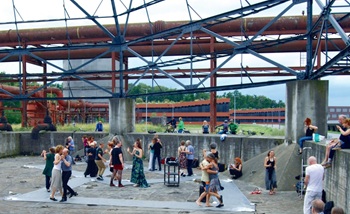
A marked difference to the fate of industrial landscapes in the UK.
Comments
[edit] To make a comment about this article, or to suggest changes, click 'Add a comment' above. Separate your comments from any existing comments by inserting a horizontal line.