






Firestopping of service penetrations, Best practice in design and installation
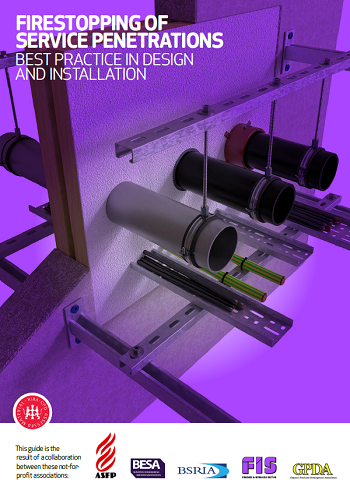
Firestopping of service penetrations, Best practice in design and installation, was published by Finishes and Interiors Sector Limited (FIS) in 2020.
It was written with support and contributions from the following trade associations:
- FIS (Finishes and Interiors Sector).
- ASFP (Association for Specialist Fire Protection).
- GPDA (Gypsum Products Development Association).
- BESA (Building Engineering Services Association).
- BSRIA (Building Services Research and Information Association).
It is intended to assist in the design, specification and installation of building services penetrations to ensure fire compartmentation is maintained.
The aim of the guide is to encourage all stakeholders in construction to consider firestopping design earlier in the process in order to avoid problems at a later stage in construction. It is not an installation manual but guidance to a good practice approach. The guide is broken down to provide information on actions that should be carried out during each of the stages one to seven as defined in the RIBA Plan of Work.
Dame Judith Hackitt DBE FRENG FICHEME FCGI said: “This document is the result of a collaboration between a number of relevant trade bodies and organisations representing the wider construction and fire safety industries, and it is an example of the collaborative working and acceptance of professional responsibility throughout the supply chain that must become a feature of the industry’s culture from now on.”
The contents of the guide are:
- Foreword 1.
- Foreword 2.
- Introduction.
- Scope.
- Preparation and briefing.
- Concept design.
- Spatial coordination.
- Technical design.
- Manufacturing and construction.
- Handover.
- Use.
- Appendix a: Regulations, standards and industry guidance.
- Appendix b: Case study.
- References.
- Acknowledgements.
You can download the guide here.
It has also been turned into a short (free) online training course designed for building engineers, designers, installer, inspectors, or insurer who want to learn more about fire stopping.
During this course, you will learn about the design process for the selection of fire stopping of service penetrations, how to apply the nine golden rules, understand the importance of early engagement, as well as the terms and definitions used and the key questions to ask to ensure a compliant installation of fire stopping.
Knowledge check questions will be asked at the end of the course. Once you have completed the course, you can download a CPD certificate.
--FIS
[edit] Related articles on Designing Buildings
Featured articles
Check out some of the best features and news from Designing Buildings as well as key stories from around the web.

Why construction can't afford to ignore the skills gap.
Building Safety Regulator, 19 August

Gill Kernick appointed Independent Chair of Residents’ Panel.
Connecting knowledge, technology and conservation
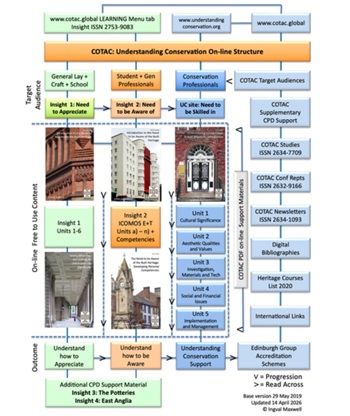
Building competence for the future of built heritage.
Building Regulations and Building Safety Act
CIOB publishes free advice for non-domestic clients.
Building Safety Newsletter from MHCLG.

An extraordinary record of steel engineering worldwide.

Households living near new pylons to save on bills.

ECA warns growth must not outpace grid capacity or skills.
The role of the client and decision making

CIOB response to built environment professions call for evidence.
Construction's sustainability reporting revolution
Tracking upfront embodied carbon with digital tools.
ECA welcomes procurement reforms

Public spending must back British jobs and skills.
Campaigning for Edinburgh: the Cockburn Association 1875-2049

The role of the civic voice in protecting character. Book review.
Comments
[edit] To make a comment about this article, click 'Add a comment' above. Separate your comments from any existing comments by inserting a horizontal line.