






How to give professional advice to friends
Sarah Elderton, Partner at BLM LLP, offers guidance on what to do when friends approach you for professional advice.

[edit] Introduction
As a professional, a simple fact of life is that at some point one of your friends is likely to ask for your advice or assistance with something that falls within your area of expertise. It happens to us all, but the real question is how should you deal with it?
You’ve known them for years and as they are looking to you to help them out in your particular area of expertise, it can often be tempting to agree to help without further thought. Unfortunately, what may seem like a good idea when you are sat round the dinner table or down the pub, can in practice be the very definition of a poisoned chalice. In fact, as an insurance broker, one of the most feared phrases we come across is “I was just doing a favour for a friend...”
[edit] But why? Surely, my friends aren’t like that...
At the outset of the majority of client relationships, you will sit down and discuss with the client the nature of the work being undertaken, the limits of services and the costs involved, i.e. the nitty gritty of the job, and this forms the basis of the requirements of the parties as well as setting out their expectations.
This relatively simple but key first step can often be over-looked when acting for a friend as you are just doing them a favour. Unfortunately, this means that any ‘agreement’ is going to be based on a number of presumptions on both sides and this lack of clarity can be one of the first ingredients in a recipe that can, if something goes wrong, end in disaster.
As a general rule, if you are considering undertaking any work for a friend, you should act as you would with any other client. While it may be a little awkward in the first instance, you should take the time to set out what work will be undertaken.
[edit] Do I need to do this if it’s just a quick bit of advice?
Whenever you provide a service to a client (be it a complete stranger or your best friend of 25 years) you are expected to have contractual terms in place and to provide the services with reasonable skill and care.
While you may think it is just a quick bit of advice that will only take 20 minutes, the moment you provide that service you are creating not only a legal working relationship but also potential liability for the advice.
In the event that a dispute does arise, and you haven’t agreed the terms and set the limitations of the services in advance, the courts would infer both the contractual terms and the services based on the conduct of the parties. In effect, this could create significantly more onerous conditions than would otherwise be the case due to the simple fact you have tried to be a little bit too helpful for a friend.
[edit] But my friend would never do that, we’ve got a great relationship...
While you may be the best of friends at the outset, this is before the practical realities of providing a service are thrown into the mix.
Unfortunately, if the services and expectations are not set out clearly, it can often be the case that your friend expects more from you than would otherwise be the case for an ordinary client.
In addition, contrary to popular belief, should problems arise during the course of the services a friend is just as likely to make a claim against you. However, given the uncertainty in the contractual position, as the terms and conditions will be inferred rather than agreed, it could leave you more exposed to a claim than may otherwise be the case.
[edit] It’s a favour; I’m not even getting paid for it...
In the majority of cases, a contract is usually considered complete when both parties provide consideration (i.e. you provide the services, they pay the fees), but the fact that it is a favour with limited or no fee does not provide an iron-clad defence.
Again, as the terms and conditions may ultimately be inferred, it is likely that a liability could still arise if your friend has acted in reliance on your advice and suffers a financial loss as a result.
[edit] What should I do if a friend asks for my advice?
If it is something general or just an opinion on a particular matter, then there is unlikely to be anything to worry about. However, if the request goes beyond a general chit-chat, our advice would be to refer your friend to another company and avoid the difficulties that could arise both professionally and personally.
If you feel you should help out and provide the services, it is important to ensure that the friend is treated as a client and the same processes and procedures are used irrespective of the existing relationship.
In brief:
- Consider whether it would be more appropriate to refer your friend to another firm, rather than accepting the risks and difficulties inherent in undertaking the work yourself.
- If you do agree to do the work, make sure that the services and the terms of engagement are clearly set out in writing, either in email format, which you ask your friend to agree to in writing, or a formal contract that you get them to sign before you undertake any work.
- Make sure that expectations are effectively managed from the outset.
For a case study of a situation that unfolded between two friends, see Giving professional advice to friends - a case study.
This article was originally published in AT Journal Spring 2017 edition.
--CIAT
[edit] Related articles on Designing Buildings Wiki
Featured articles and news

We're expanding our collaborative mission by launching DB Intelligence, an exclusive market research advisory panel. Built environment professionals can now get paid to share their expertise on industry trends, products and services.
Panel members receive direct financial incentives for participating in research projects like short surveys, 1-2-1 interviews and focus groups. Register today to shape the future of the construction sector.
Planning condition discharge in England and Wales

A brief exoplanation from a building compliance expert, with further links.
Overheating guidance and tools for building designers

Guidance for dealing with element of building fabric control that have increasing importance.
Shading for housing, a design guide

From the Good Homes Alliance and British Blind and Shutter Association.
UK Standard Skills Classification (SSC)

A shared framework for describing skills needs.
Social media ban consultation comes to close

CIOB urges UK Government to consider social media’s role in careers guidance in ban debate.
The latest of eight Skills England apprenticeship units

The addition of battery manufacturing welcomed by ECA with a warning about the risks of fast-tracked apprenticeship units.
Building Control Independent Panel final report

A precis of a key report led by Dame Hackitt with full recommendations and link to the government response.
Building Safety recap April, 2026
A short and longer run-through of the month, with links to further information and sources.

CIAT May 2026 briefing.

From medieval scribes to modern word art.

ECA welcomes crackdown on late payment and push for clean energy, whilst CIOB seek fixed cladding removal timeframes.
Cyber Security in the Built Environment

Protecting projects, data, and digital assets: A CIOB Academy TIS.
Managing competence in the built environment
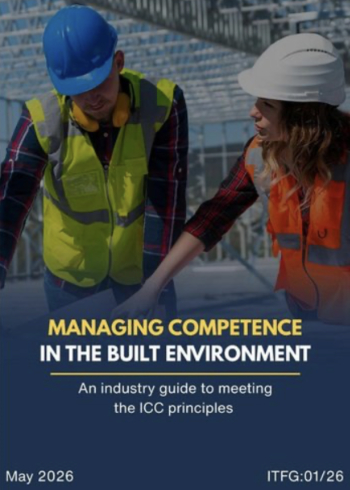
ITFG publishes new industry guide on how to meet the ICC principles.
The UK's campaign to reduce noise pollution: Mythbusting, articles and topic guides.