





Fire spread in buildings

Contents |
[edit] Introduction
Buildings need to be designed and operated so that they offer an acceptable level of fire safety and minimise the risks from heat and smoke.
Fire occurs as a result of a series of very rapid chemical reactions between a fuel and oxygen that releases heat and light. For combustion to occur, oxygen, heat and a fuel source must all be present. Flames are the visible manifestation of combustion. For more information see: Fire.
Fire spread describes the travel of fire from one area to an adjoining area. Fire spread can occur within buildings and between buildings when combustible material in one area ignites and the fire eventually spreads to an adjoining area.
The rate of fire spread within a building will depend on:
- The degree of fire separation (fire compartmentation) that exists.
- The combustibility of the materials present (some materials such as soft furnishings may burn at faster rates than others).
- The presence of air/oxygen (draughts and convection currents can fuel fires to burn more rapidly).
- The presence of active fire fighting systems to detect and suppress fires.
[edit] How a fire spreads
Fire generally spreads in six ways:
- Direct contact: materials adjacent to each other ignite through a domino-type effect;
- Radiation: when a fire is strong enough, it can emit sufficient radiated heat to ignite combustible materials that are not in direct contact with it. This process is similar to sunlight directed through a lens onto dry straw – the straw will eventually ignite.
- Conduction: heat is transferred through materials that ignite adjacent materials that are in contact. A wall may get so hot that it ignites the wallpaper on the other side.
- Convection: currents of air rise above a fire and may concentrate at an upper limit, eg beneath a ceiling. When substantial hot gas and smoke has accumulated, the temperature at the upper level rises to such an extent that it can set materials on fire, thereby causing a secondary fire and possibly a flashover (below).
- Flashover: the hot air and gases accumulated by convection may eventually start to descend to a lower level through radiation and at sufficiently high temperatures (around 500°C) that may make combustible materials start emitting gases and resulting in spontaneous ignition.
- Backdraught: a fire in a room with little oxygen will start to peter out but if a door opens or glass in a window breaks, the sudden inflow of air/oxygen can reignite the fire with explosive effect.
[edit] Fire safety
The methods of ensuring fire safety are:
- Prevention: Controlling ignition and fuel sources so that fires do not start.
- Communication: If ignition occurs, ensuring occupants are informed and any active fire systems are triggered.
- Escape: Ensuring that occupants of buildings and surrounding areas are able to move to places of safety.
- Extinguishment: Ensuring that fires can be extinguished quickly and with minimum consequential damage.
- Containment: Fires should be contained to the smallest possible area, limiting the amount of property likely to be damaged and the threat to life safety.
The spread of fire can be restricted by sub-dividing buildings into a number of discrete compartments. These fire compartments are separated from one another by compartment walls and compartment floors made of a fire-resisting construction which hinders the spread of fire.
For more information see Fire compartments.
[edit] Related articles on Designing Buildings Wiki
- Automatic fire detection and alarm systems, an introductory guide to components and systems BR 510.
- External fire spread, Supplementary guidance to BR 187 incorporating probabilistic and time-based approaches.
- Fire in buildings.
- Fire compartmentation.
- Fire detection and alarm system.
- Fire protection engineering.
- Fire safety design.
- Understanding the factors affecting flashover of a fire in modern buildings.
Featured articles and news
Cyber Security in the Built Environment

Protecting projects, data, and digital assets: A CIOB Academy TIS.
Managing competence in the built environment
ITFG publishes new industry guide on how to meet the ICC principles.

The UK's campaign to reduce noise pollution: Mythbusting, articles and topic guides.
Setting Expectations on Competence Management

Industry Competence Committee.
New Scottish and Welsh governments

CIOB stresses importance of construction after new parliament elections.
The sad story of Derby Hippodrome
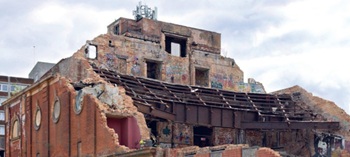
An historic building left to decay.

ECA, JIB and JTL back Fabian Society call to invest in skills for a stronger built environment workforce.

Women's Contributions to the Built Environment.
Calls for the delayed Circular Economy Strategy

Over 50 leading businesses, trade associations and professional bodies, including CIAT, and UKGBC sign open letter.
The future workforce: culture change and skill

Under the spotlight at UK Construction Week London.

A landmark moment for postmodern heritage.
A safe energy transition – ECA launches a new Charter

Practical policy actions to speed up low carbon adoption while maintaining installation safety and competency.
Frank Duffy: Researcher and Practitioner

Reflections on achievements and relevance to the wider research and practice communities.
The 2026 Compliance Landscape: Fire doors

Why 'Business as Usual' is a Liability.
Cutting construction carbon footprint by caring for soil

Is construction neglecting one of the planet’s most powerful carbon stores and one of our greatest natural climate allies.