





European Single Procurement Document ESPD
[edit] Introduction
The European Single Procurement Document (ESPD) is a self-declaratory document used by both buyers and suppliers on public-sector contracts anywhere within the European Union. It is intended to remove some of the barriers faced by suppliers (particularly small- and medium-sized enterprises (SMEs)) when tendering for goods, services or works on public-sector contracts.
The ESPD is typically issued by public-sector bodies (buyers of goods and services) to get suppliers (bidders) to respond to, or register their interest in, bidding. ESPD helps to simplify the procurement process for both sides.
Introduced in April 2016 and created under the EU 2014 Directive on Procurement, ESPD is an alternative to the more complex selection questionnaire. The self-regulatory nature of the ESPD allows suppliers to self-declare that they meet the minimum regulatory criteria or commercial capability requirements, and so allows them to progress to the next stage of the process.
In submitting an ESPD, the supplier is providing a preliminary indication that their ability, suitability and financial status meet the stated conditions of the procurement process.
This means they do not have to provide up-front documentary evidence and the assorted paperwork previously required to show they meet the public authority’s required criteria; they only have to provide such evidence when or if they are selected as the appointed contractor.
[edit] The process
The ESPD process can be summarised as follows:
- The buyer states their selection and exclusion criteria in their contract notice, including minimum standards and their policy on short-listing.
- The buyer issues the ESPD request to attract anyone interested in bidding for the contract.
- Bidders (suppliers) complete and submit their ESPD response to the buyer.
- The buyer evaluates the supplier responses for suitability against the stated criteria.
- Where bidders are found subsequently not to meet the minimum requirements, or are in breach of one of the requirements, they are excluded from the bidding process.
- ESPD is completed online, and is free.
- Although bidders have to complete an ESPD for every project, the standard ESPD form used across Europe means they can re-use a form submitted on a previous bid, as long as the information is still current.
See also: ESPD and the decline of the PQQ
As of December 2020, the ESPD has changed in England to the Single Procurement Document (SPD); in Scotland, it is SPD (Scotland).
See also: Single Procurement Document (Scotland).
[edit] Related articles on Designing Buildings Wiki
- Best value.
- Common minimum standards.
- ESPD and the decline of the PQQ.
- Fair payment practices.
- Managing the procurement process.
- Most Economically Advantageous Tender (MEAT).
- OJEU.
- Procurement route.
- Public body.
- Public contract.
- Public project definition.
- Public sector.
- Publicly subsidised project.
- Single Procurement Document (Scotland).
- SMEs and government contracts.
Featured articles and news

We're expanding our collaborative mission by launching DB Intelligence, an exclusive market research advisory panel. Built environment professionals can now get paid to share their expertise on industry trends, products and services.
Panel members receive direct financial incentives for participating in research projects like short surveys, 1-2-1 interviews and focus groups. Register today to shape the future of the construction sector.
Planning condition discharge in England and Wales

A brief exoplanation from a building compliance expert, with further links.
Overheating guidance and tools for building designers

Guidance for dealing with element of building fabric control that have increasing importance.
Shading for housing, a design guide

From the Good Homes Alliance and British Blind and Shutter Association.
UK Standard Skills Classification (SSC)

A shared framework for describing skills needs.
Social media ban consultation comes to close

CIOB urges UK Government to consider social media’s role in careers guidance in ban debate.
The latest of eight Skills England apprenticeship units

The addition of battery manufacturing welcomed by ECA with a warning about the risks of fast-tracked apprenticeship units.
Building Control Independent Panel final report
A precis of a key report led by Dame Hackitt with full recommendations and link to the government response.
Building Safety recap April, 2026
A short and longer run-through of the month, with links to further information and sources.

CIAT May 2026 briefing.

From medieval scribes to modern word art.

ECA welcomes crackdown on late payment and push for clean energy, whilst CIOB seek fixed cladding removal timeframes.
Cyber Security in the Built Environment
Protecting projects, data, and digital assets: A CIOB Academy TIS.
Managing competence in the built environment
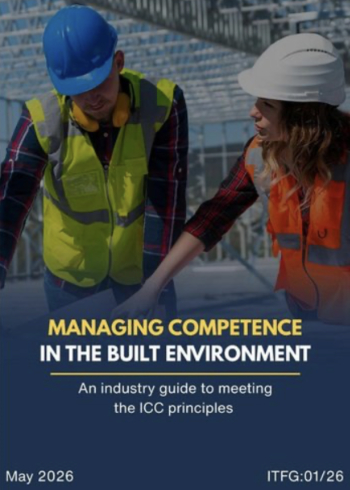
ITFG publishes new industry guide on how to meet the ICC principles.
The UK's campaign to reduce noise pollution: Mythbusting, articles and topic guides.