





CIC Risk Management Briefings
The CIC Risk Management Briefings are a series of free guidance documents produced by the CIC Liability Panel. The briefings examine current areas of concern in relation to liability and are released to keep industry informed of current issues that can have impact on them.
The Liability Panel was set up by CIC to consider liability, legal and insurance issues. The panel drafts and publishes standard form contract documentation for consultants as well as publishing the freely available Risk Management Briefings. A full suite of CIC Risk Management Briefings can be downloaded for free by clicking on the image below.
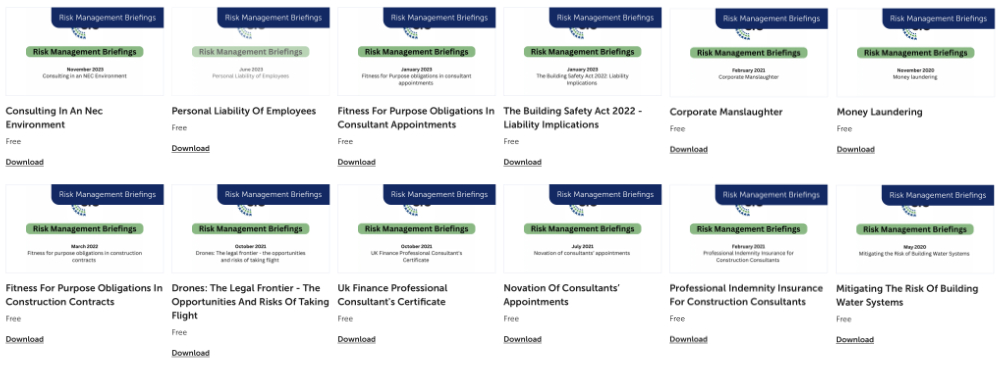
Construction Industry Council (CIC) have written a number of new briefings this year covering the building Safety Act to Consultant appointments, NEC environments to personal liability of Employees, shown below.
The new Risk Management Briefing "Personal Liability of Employees", details professional indemnity insurance (PII), when employees may be covered (and when not) how it impacts employers and employees, what employers should do and how employees can protect themselves.
Nasir Khan, Chair of the Liability Panel said: "Employers and employees need to be aware of the risks that can create personal liability in various ways. The CIC Liability Panel's risk management briefing on Personal Liability of Employees provides professional consultant to exercise a standard of care to carefully review and understand the terms of their contracts, maintain professional standards, and consider obtaining appropriate insurance coverage to mitigate potential personal liability risks."
|
|
|
|
This article is based on one that appears on the CIAT news and blog site as "CIC guidance on employee personal liability risks", dated December 14 2023.
--CIAT
[edit] Related articles on Designing Buildings
- As Low As Reasonably Practicable (ALARP).
- Avoiding disaster in existing buildings and infrastructure.
- Building Back Better: Resilience.
- Building services and health risk resilient buildings.
- CMA and IRM publish 2020 competition law risk guide.
- Code of practice for project management.
- Code of practice for programme management.
- Constraints.
- Contingency plan.
- Crisis communications.
- Design risk management.
- Facility security risk management plan.
- Game theory.
- How to use the Enterprise Risk Management guide.
- Incident reporting system.
- Interface risk in construction.
- Monte Carlo simulation.
- Non-technical risk.
- Project manager.
- Project risk.
- Reflections on 2021.
- Resource allocation in design and construction.
- Risk appetite.
- Risk assessment.
- Risk assessment: a quality perspective.
- Risk assessment for construction.
- Risk feedback.
- Risk in building design and construction.
- Risk management.
- Risk mapping.
- Risk register.
- Risk tolerance.
- Stakeholders.
- Systems approach.
- Third party dependencies.
- Types of risk in construction projects.
- What is a hazard?
Featured articles
Check out some of the best features and news from Designing Buildings as well as key stories from around the web.

CIOB celebrates positive Ofsted report.

The Building Safety Regulator announces a call for evidence.

Government approach could undermine delivery and regeneration.
World's first mass timber data centre.

The overlooked environmental aspect of data centre development.
Introduction to radon awareness

New technical information sheet published by CIOB.

Updated supplier guide can help electrical contractors engage with NHP.

CIAT confirm the winners of the 2026 architectural technology awards.

Government launches a one stop shop for flood preparedness.

Sir Edwin Lutyens: Britain's greatest architect? Book review.

CIOB publishes free template to help assess and manage risks.
ECA's reflections on Party Conference season

Burnham wants to be confident of winning before asking for a fresh mandate.
New Chief Construction and Scientific Adviser

Sergio Cavalaro, Professor of Infrastructure Systems at Loughborough University.