





Achieving net zero in social housing
|
Contents |
[edit] Introduction
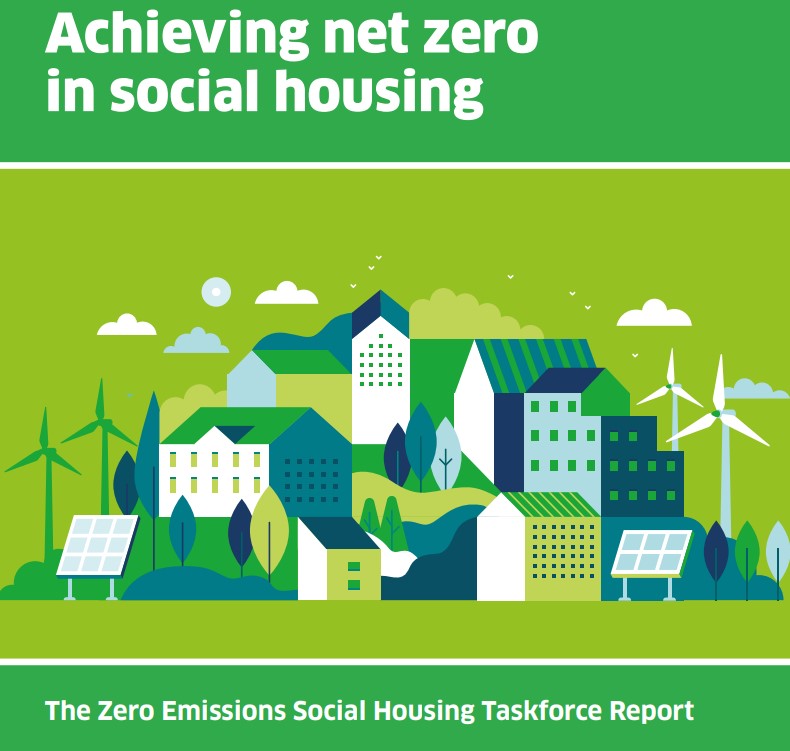
On 31 August 2021, the Scottish Government published Achieving net zero in social housing. This report from the Zero Emissions Social Housing Taskforce (ZEST) included recommendations for what will be required to achieve zero emission housing whilst ensuring support for tenants in reducing their energy bills and achieving carbon savings.
[edit] Eight recommendations
ZEST includes eight recommendations:
- The Scottish Government and social landlords should develop a collective commitment to a just transition in the social housing sector with clear metrics and sufficient budgetary investment to ensure this is successfully realised.
- The Scottish Government should promote a fabric first approach as an essential first step towards decarbonisation, prioritising investment accordingly, and ensure that the promotion of a fabric first approach is reflected appropriately in its review of the Energy Efficiency Standard for Social Housing (EESSH2).
- The Scottish Government should work with social landlords to ensure capital investment for social housing is adequate, structured and designed in line with the needs of the sector, and supports the social housing sector’s aim for a fabric first approach.
- Social landlords and the Scottish Government must work together to plan ahead with certainty, including to work with new partners to access and maximise funding opportunities.
- Social landlords and the Scottish Government should commit to working together in partnership to understand the current condition and investment needs of the existing social housing stock and develop appropriate collaborative solutions.
- Social landlords and both local and national governments should work in partnership to ensure individuals and communities are fully engaged and supported in the net zero transition.
- All partners must work together to ensure there is sufficient workforce capacity in Scotland to deliver high quality retrofit works in the social housing sector.
- Social housing providers should continue to evaluate their wider impacts and ongoing contribution to tackling the climate emergency, through systematic monitoring and measurement.
[edit] Overall net zero housing strategy in Scotland
Achieving net zero in social housing is a follow up to the Scottish Government’s housing standard (published In March 2021) that proposed a legal requirement that all homes must meet the same quality standards. The plan is a component of Housing to 2040, the Government’s 20 year vision for how Scotland’s homes and communities should look and feel in the year 2040.
The ZEST report sits alongside the Scottish Government’s Draft Heat in Buildings Strategy (published in February 2021) as part of the country’s commitment to adapt and retrofit existing homes to improve their energy efficiency and decarbonise their heating. The recommendations in the report highlight the housing sector’s contribution to reducing climate change emissions while decarbonising one million homes by 2030, addressing fuel poverty, keeping rents affordable and promoting equality.
[edit] Related articles on Designing Buildings Wiki
- Fabric first.
- Fabric first investigation into net zero for existing buildings.
- Heat Networks (Scotland) Bill.
- Low carbon building standards strategy for Scotland.
- Net zero carbon 2050.
- Scottish housing standard.
- Scottish planning policy.
- Scotland publishes plans to reach net zero targets with Heat in Buildings Strategy.
- Social housing.
- Zero carbon homes.
[edit] External resources
Featured articles and news

We're expanding our collaborative mission by launching DB Intelligence, an exclusive market research advisory panel. Built environment professionals can now get paid to share their expertise on industry trends, products and services.
Panel members receive direct financial incentives for participating in research projects like short surveys, 1-2-1 interviews and focus groups. Register today to shape the future of the construction sector.
Planning condition discharge in England and Wales

A brief exoplanation from a building compliance expert, with further links.
Overheating guidance and tools for building designers

Guidance for dealing with element of building fabric control that have increasing importance.
Shading for housing, a design guide

From the Good Homes Alliance and British Blind and Shutter Association.
UK Standard Skills Classification (SSC)

A shared framework for describing skills needs.
Social media ban consultation comes to close

CIOB urges UK Government to consider social media’s role in careers guidance in ban debate.
The latest of eight Skills England apprenticeship units

The addition of battery manufacturing welcomed by ECA with a warning about the risks of fast-tracked apprenticeship units.
Building Control Independent Panel final report

A precis of a key report led by Dame Hackitt with full recommendations and link to the government response.
Building Safety recap April, 2026

A short and longer run-through of the month, with links to further information and sources.
CIAT May 2026 briefing.

From medieval scribes to modern word art.

ECA welcomes crackdown on late payment and push for clean energy, whilst CIOB seek fixed cladding removal timeframes.
Cyber Security in the Built Environment

Protecting projects, data, and digital assets: A CIOB Academy TIS.
Managing competence in the built environment

ITFG publishes new industry guide on how to meet the ICC principles.

The UK's campaign to reduce noise pollution: Mythbusting, articles and topic guides.