





Strategic Forum for Construction
The 1994 Latham report led to the creation of the Construction Industry Board (CIB) to oversee reform of the construction industry, this was replaced in 2001 by the Strategic Forum for Construction, chaired by Sir John Egan. Established initially as a government-funded body it was changed to an independent industry group in 2002.

It described itself as ‘…the only construction forum that seeks to represent the whole of the construction community... The Forum’s activities are both proactive and reactive but at all times seek to work in partnership across the industry to achieve long term improvements.'
It's vision was ‘…for the UK construction industry to achieve maximum value for all clients, end users and stakeholders and to exceed their expectations through the consistent delivery of world-class products and projects.’
It promoted six key areas:
- Procurement and integration.
- Commitment to people.
- Client leadership.
- Sustainability.
- Design quality.
- Health and safety.
In 2002, the Strategic Forum published Accelerating change, a report on its first year of activity. It proposed that:
- By the end of 2004, 20% of construction projects should be undertaken by integrated project teams and integrated supply teams.
- By the end of 2004, 20% of client activity should embrace the principles of the construction clients' charter.
- By the end of 2007 both these figures should rise to 50%.
- That the industry would recruit and retain 300,000 qualified people by the end of 2006.
- That there would be a 50% increase in applications to built environment higher and further education courses by 2007.
The Strategic Forum tasked itself, amongst other things to:
- Ensure a 'Toolkit' was developed to help assemble integrated teams.
- Produce models for payment mechanisms and key performance indicators for payment.
- Develop a code of good working practices.
- Make the business case for Investors in People (IIP).
In 2008, the Strategic Forum published ‘The Strategy for Sustainable Construction’, a joint industry and government strategy based on a recognition of the need to deliver radical change in the sustainability of the construction industry.
It then became relatively inactive. In 2012 / 2013, there was an unsuccessful attempt to relaunch the Strategic Forum as the industry’s “single voice” in government, however the UK Contractors Group (UKCG) withdrew and the Forum foundered.
In July 2015, Construction Manager Magazine reported that the Strategic Forum would return. This followed an announcement in July that the membership of the Construction Leadership Council (CLC) would be reduced from 30 to 12 and the role of Chief Construction Adviser would be scrapped. See Restructuring the Construction Leadership Council for more information.
Alastair Reisner, chief executive of the Civil Engineering Contractors Association, told Construction Manager: “I think that will be the way things move forward, there will be a discussion by Strategic Forum members on what we do next… There’s support for the Forum playing a fuller role in delivering improvement and reform to the industry – a lot of that had been devolved to the Construction Leadership Council. So the Strategic Forum might be a bit more visible than it has been in the past.”
The Strategic Forum relaunched in 2016. Its members are:
- Build UK
- Construction Alliance (a grouping of major construction trade organisations working together within the remit of the Strategic Forum for Construction)
- Construction Clients Group
- Construction Industry Council
- Construction Products Association
- Specialist Engineering Contractors Group
It has said that it will focus on '...targeting delivery of four cross-industry work streams covering payment, pre-qualification, procurement models, and industry Commitments.
In February 2016, it published The Strategic Forum Guidance for Employing Young People providing guidance about how under 18's should be managed in the industry.
[edit] Related articles on Designing Buildings
- Accelerating change.
- Construction client's charter.
- Construction Industry Board.
- Construction industry institutes and associations.
- Construction industry reports.
- Construction Leadership Council.
- Demonstration project.
- Egan Report.
- Integrated project teams.
- Integrated supply teams.
- Latham Report.
- Restructuring the Construction Leadership Council.
- Rethinking Construction 2002: Achievements, Next Steps, Getting Involved.
- UK Contractors Group.
Featured articles and news

We're expanding our collaborative mission by launching DB Intelligence, an exclusive market research advisory panel. Built environment professionals can now get paid to share their expertise on industry trends, products and services.
Panel members receive direct financial incentives for participating in research projects like short surveys, 1-2-1 interviews and focus groups. Register today to shape the future of the construction sector.
Building Safety Wiki Interviews

Chief executive of the British Woodworking Federation.
Planning condition discharge in England and Wales

A brief exoplanation from a building compliance expert, with further links.
Overheating guidance and tools for building designers

Guidance for dealing with element of building fabric control that have increasing importance.
Shading for housing, a design guide

From the Good Homes Alliance and British Blind and Shutter Association.
UK Standard Skills Classification (SSC)

A shared framework for describing skills needs.
Social media ban consultation comes to close

CIOB urges UK Government to consider social media’s role in careers guidance in ban debate.
The latest of eight Skills England apprenticeship units

The addition of battery manufacturing welcomed by ECA with a warning about the risks of fast-tracked apprenticeship units.
Building Control Independent Panel final report
A precis of a key report led by Dame Hackitt with full recommendations and link to the government response.
Building Safety recap April, 2026
A short and longer run-through of the month, with links to further information and sources.

CIAT May 2026 briefing.

From medieval scribes to modern word art.

ECA welcomes crackdown on late payment and push for clean energy, whilst CIOB seek fixed cladding removal timeframes.
Cyber Security in the Built Environment
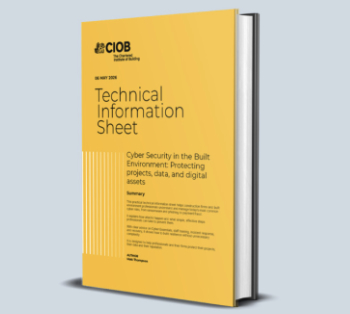
Protecting projects, data, and digital assets: A CIOB Academy TIS.
Managing competence in the built environment
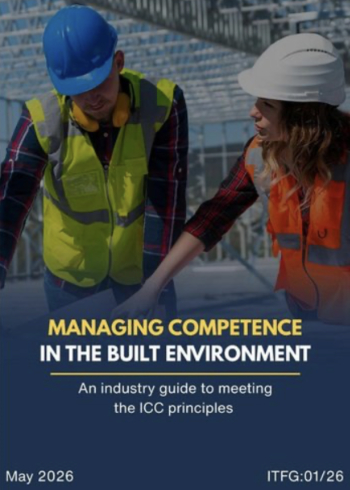
ITFG publishes new industry guide on how to meet the ICC principles.
Comments