





Sistering floor joists
A common problem in older buildings is that floors sag or feel ‘springy’ (that is they 'bounce' when walked on). This can be because the joists are undersized (particularly where older buildings are converted for modern uses where they may be subject to higher loads than was originally intended), or they have been weakened by decay or by having holes or notches cut through them incorrectly. The structural repair of damaged floor joists is known as ‘sistering’.
Floor joists can become damaged due to contact with water which may lead to rot setting in or infestation from termites, woodworm, and so on. These underlying problems should be rectified first before sistering, or the damage will recur.
The typical choice for sistering material is framing timer or engineered timber products such as plywood.
The first step to take is to remove any obstructions, such as electrical cables, pipes, and so on. If this is too difficult the new joists can be notched, although this may mean that are not as strong. The new joists are set alongside the existing ones. Joist material should be chosen that matches the height of what is already installed, as well as being, as closely as possible, the same span.
If necessary, a hydraulic jack and post can be used to jack up the joists until they are level. It is sometimes recommended that jacks are only raised by around 1/8 inch per day to avoid cracking in the walls and floors.
Adhesive should be applied along the length of a joist to strengthen the bond between the existing and its sister, as well as to prevent squeaking. Quick clamps are used to hold the sistered joist in place, and nails driven through the sister and into the existing joist. Shifting and settling can work to loosen and separate the boards over time, therefore, the nails should be used with lag or carriage bolts to lock them together.
The quick clamps can then be released. This process should then be repeated for each joist that needs strengthening or straightening.
[edit] Related articles on Designing Buildings Wiki
Featured articles and news

We're expanding our collaborative mission by launching DB Intelligence, an exclusive market research advisory panel. Built environment professionals can now get paid to share their expertise on industry trends, products and services.
Panel members receive direct financial incentives for participating in research projects like short surveys, 1-2-1 interviews and focus groups. Register today to shape the future of the construction sector.
Planning condition discharge in England and Wales

A brief exoplanation from a building compliance expert, with further links.
Overheating guidance and tools for building designers

Guidance for dealing with element of building fabric control that have increasing importance.
Shading for housing, a design guide

From the Good Homes Alliance and British Blind and Shutter Association.
UK Standard Skills Classification (SSC)
A shared framework for describing skills needs.
Social media ban consultation comes to close

CIOB urges UK Government to consider social media’s role in careers guidance in ban debate.
The latest of eight Skills England apprenticeship units

The addition of battery manufacturing welcomed by ECA with a warning about the risks of fast-tracked apprenticeship units.
Building Control Independent Panel final report
A precis of a key report led by Dame Hackitt with full recommendations and link to the government response.
Building Safety recap April, 2026
A short and longer run-through of the month, with links to further information and sources.
CIAT May 2026 briefing.

From medieval scribes to modern word art.

ECA welcomes crackdown on late payment and push for clean energy, whilst CIOB seek fixed cladding removal timeframes.
Cyber Security in the Built Environment
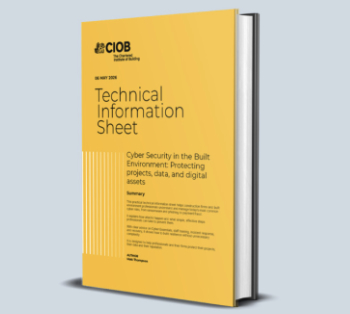
Protecting projects, data, and digital assets: A CIOB Academy TIS.
Managing competence in the built environment
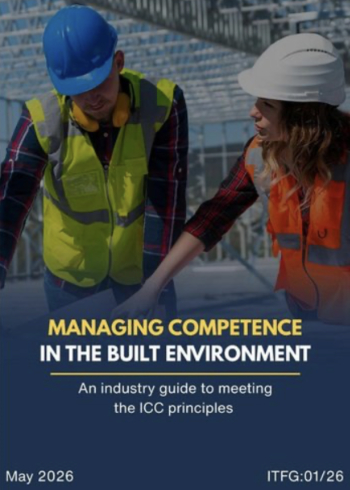
ITFG publishes new industry guide on how to meet the ICC principles.
The UK's campaign to reduce noise pollution: Mythbusting, articles and topic guides.