






Reducing thermal bridging at junctions when designing and installing solid wall insulation FB 61
BRE (Building Research Establishment) is an independent, research-based consultancy, testing and training organisation, operating in the built environment and associated industries.
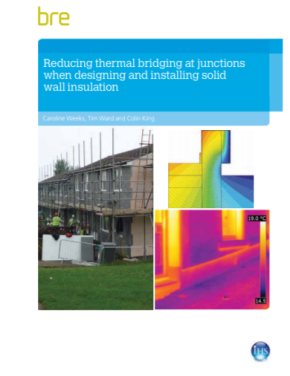
Reducing thermal bridging at junctions when designing and installing solid wall insulation (FB 61) was written by Caroline Weeks, Tim Ward and Colin King and published by BRE on 19 December 2013.
Improving the energy efficiency of the existing building stock is one of the biggest challenges facing the UK. In particular, traditional solid wall homes are more difficult and more costly to improve than more modern, cavity wall constructions.
Current practice during refurbishment does little or nothing to minimise the effects of thermal bridging or inconsistencies in the thermal performance of the building envelope.
This guide sets out clear principles and methods that should be considered during the design and installation of solid wall insulation to reduce thermal bridging effects, and to minimise carbon dioxide emissions and the risk of condensation. The effect of installing external and internal wall insulation in typical solid wall homes has been modelled for junctions with windows, eaves, floors and party walls. Potential problems are considered, and examples are given from recent refurbishment projects in which BRE has been involved.
This report will be useful for public and private clients looking to improve the performance of their properties and for architects and other designers, specifiers and installers.
Its contents are:
- Executive summary.
- Introduction.
- Background-Risks associated with thermal bridging.
- Detailing of external wall insulation.
- Detailing of internal wall insulation.
- Comparing the overall thermal performance of external and internal insulation.
- References.
[edit] Related articles on Designing Buildings Wiki
Featured articles and news

We're expanding our collaborative mission by launching DB Intelligence, an exclusive market research advisory panel. Built environment professionals can now get paid to share their expertise on industry trends, products and services.
Panel members receive direct financial incentives for participating in research projects like short surveys, 1-2-1 interviews and focus groups. Register today to shape the future of the construction sector.
Building Control Independent Panel final report
A precis of a key report led by Dame Hackitt with full recommendations and link to the government response.
Guide to ISO 19650 for Architecture Firms (2026)
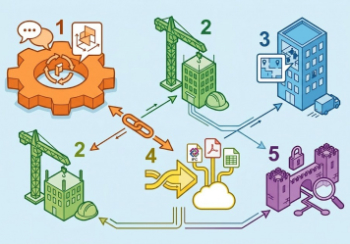
A user gives their low down.

A UK training and membership provider for mould remediation professionals.
Building Safety recap April, 2026
A short and longer run-through of the month, with links to further information and sources.
CIAT May 2026 briefing.
Independent NSI and BAFE study exploring how organisations are changing the way they buy fire safety services.
From medieval scribes to modern word art.
ECA welcomes crackdown on late payment and push for clean energy, whilst CIOB seek fixed cladding removal timeframes.
Cyber Security in the Built Environment
Protecting projects, data, and digital assets: A CIOB Academy TIS.
Managing competence in the built environment
ITFG publishes new industry guide on how to meet the ICC principles.
The UK's campaign to reduce noise pollution: Mythbusting, articles and topic guides.