





Identifying non-traditional houses in the UK 1918-75
BRE (Building Research Establishment) is an independent, research-based consultancy, testing and training organisation, operating in the built environment and associated industries.
Non-traditional houses: Identifying non-traditional houses in the UK 1918-75 - DIGITAL EDITION (AP 294) was written by Harry Harrison, Stephen Mullin, Barry Reeves and Alan Stevens and was published by BRE on 14 December 2012.
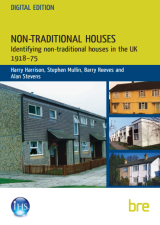
AP 294 was first published in 2004. The 2012 edition introduced a fully-searchable pdf format on CD ROM, giving housing professionals, building surveyors, engineers and architects access to a 1000-page reference library detailing 450 non-traditional house types.
House types are classified in AP 294 as:
- Metal framed.
- Precast concrete.
- In-situ concrete.
- Timber framed.
The comprehensive and highly-illustrated resource, brings together a wealth of information and advice from the leading experts. Each house type is accompanied by an isometric drawing giving a clear explanation of construction details. Additional notes are provided for surveyors for those housing systems investigated by BRE, and more detailed information is given for some house types in structural condition reports available at http://www.brebookshop.com/details.jsp?id=327968
Extensive background information is included on the CD ROM, as well as a search tool that identifies houses by; type, local authority area, construction class, and identifying characteristics. It also includes six government reports on prefabrication and system building from the Burt Committee in the 1940s, the Moir Committee in 1920, corrosion of steel in steel houses (1951), and prefabrication (1965).
The contents include:
- Foreword.
- The Editors.
- Preface.
- Introduction.
- Acronyms.
- How to use this book.
- Designated defective houses.
- References.
- Further reading.
- List of house types.
- Appendices.
The CD ROM includes:
- Non-traditional houses: Identifying non-traditional houses in the UK 1918-75 (digital edition).
- Search engine.
- BRE and government reports (pdf files).
[edit] Find out more.
[edit] Related articles on Designing Buildings Wiki
- Apartment.
- Architectural styles.
- BRE articles on Designing Buildings Wiki.
- BRE Buzz articles on Designing Buildings Wiki.
- BRE Buzz.
- Building Research Establishment.
- Bungalow.
- Dwelling
- English housing stock age.
- Household.
- Manse.
- Penthouse.
- Residential definition.
- Types of building.
- Types of dwelling
- Use class.
Featured articles
Check out some of the best features and news from Designing Buildings as well as key stories from around the web.

Government approach could undermine delivery and regeneration.
World's first mass timber data centre.

The overlooked environmental aspect of data centre development.
Introduction to radon awareness

New technical information sheet published by CIOB.

Updated supplier guide can help electrical contractors engage with NHP.

CIAT confirm the winners of the 2026 architectural technology awards.

Government launches a one stop shop for flood preparedness.

Sir Edwin Lutyens: Britain's greatest architect? Book review.

CIOB publishes free template to help assess and manage risks.
ECA's reflections on Party Conference season

Burnham wants to be confident of winning before asking for a fresh mandate.
New Chief Construction and Scientific Adviser

Sergio Cavalaro, Professor of Infrastructure Systems at Loughborough University.
Building safety levy for England

CIAT publish estimator tool for members.

Water sector faces a growing crisis that could slow the delivery of vital infrastructure.