





Road joints
Contents |
[edit] Introduction
Joints are formed in concrete slabs as part of the process of constructing rigid paving for roads. Joints are discontinuities in the pavement slab that are necessary to allow for expansion, contraction and warping. Rigid paving consists of a reinforced or unreinforced insitu concrete slab laid over a thin granular base course. The rigidity and strength of the pavement enables the loads and stresses to be distributed over a wide area of the subgrade.
Joints are spaced depending on a range of factors:
- The amount of reinforcement used.
- The proposed traffic intensity.
- The slab thickness.
- The frictional restraint of the subgrade.
- The temperature at which the concrete is laid.
Joints comprise a filler which separates the slabs, and a sealing compound which is used to fill the top 25 mm of the joint to prevent the entry of water and grit. Suitable jointing materials include impregnated fibre board, cork, sheet bitumen, and rubber. The joint sealing compound must have good adhesion to concrete, extensibility without fracture, resistance to flow in hot weather, and durability.
A system of dowel bars in introduced between slabs to prevent slab movement and ensure load-transfer. Dowel bars are positioned at mid-depth of the slab at centres of 300 mm. The diameter of the bar usually ranges from 20-30 mm but varies with the slab thickness. A plastic sleeve 100 mm-long is inserted on one end of the dowel to allow free movement of the slab. The sleeve should contain a pad of compressible material at the end.
[edit] Types of road joints
There are a number of different types of joints:
[edit] Expansion joint
These are provided along the transverse direction to allow the expansion and contraction of a concrete slab due to temperature and subgrade moisture variation. They are intended to prevent potentially damaging forces accumulating within the slab itself or surrounding structures. Maximum spacing of expansion joints range from 25-27 m in jointed reinforced concrete slabs, and from 40 m (for slabs <230 mm thick) to 60 m (for slabs >230 mm thick) in unreinforced concrete.
[edit] Contraction joint
These are also known as ‘shrinkage’ joints and are provided along the transverse direction to allow for contraction or shrinkage of the slab during the curing process. Maximum spacing of contraction joints ranges from 12-24 m in reinforced slabs, and from 4-5 m in unreinforced slabs.
[edit] Construction joint
Construction joints are provided whenever the construction work stops temporarily. They can be either along the transverse or longitudinal direction.
[edit] Warping joint
Warping joints are provided along the longitudinal direction to prevent warping of the concrete slab due to temperature and subgrade moisture variation.
[edit] Related articles on Designing Buildings
- Bituminous mixing and laying plant.
- Code of Practice for Ironwork Systems Installation and Refurbishment.
- Highway drainage.
- Joint v connection.
- Kerbs.
- Overview of the road development process.
- Pavement.
- Road construction.
- Runway construction.
- Settlement.
- Types of road and street.
[edit] External references
- ‘Introduction to civil engineering construction’ (3rd ed.), HOLMES, R., The College of Estate Management (1995)
Featured articles and news

We're expanding our collaborative mission by launching DB Intelligence, an exclusive market research advisory panel. Built environment professionals can now get paid to share their expertise on industry trends, products and services.
Panel members receive direct financial incentives for participating in research projects like short surveys, 1-2-1 interviews and focus groups. Register today to shape the future of the construction sector.
Planning condition discharge in England and Wales

A brief exoplanation from a building compliance expert, with further links.
Overheating guidance and tools for building designers

Guidance for dealing with element of building fabric control that have increasing importance.
Shading for housing, a design guide

From the Good Homes Alliance and British Blind and Shutter Association.
UK Standard Skills Classification (SSC)

A shared framework for describing skills needs.
Social media ban consultation comes to close

CIOB urges UK Government to consider social media’s role in careers guidance in ban debate.
The latest of eight Skills England apprenticeship units

The addition of battery manufacturing welcomed by ECA with a warning about the risks of fast-tracked apprenticeship units.
Building Control Independent Panel final report

A precis of a key report led by Dame Hackitt with full recommendations and link to the government response.
Building Safety recap April, 2026

A short and longer run-through of the month, with links to further information and sources.

CIAT May 2026 briefing.

From medieval scribes to modern word art.

ECA welcomes crackdown on late payment and push for clean energy, whilst CIOB seek fixed cladding removal timeframes.
Cyber Security in the Built Environment
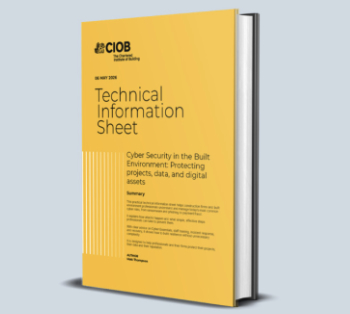
Protecting projects, data, and digital assets: A CIOB Academy TIS.
Managing competence in the built environment

ITFG publishes new industry guide on how to meet the ICC principles.
The UK's campaign to reduce noise pollution: Mythbusting, articles and topic guides.