





Rescue and Reuse: communities, heritage and architecture

Rescue and Reuse: communities, heritage and architecture, Merlin Waterson, edited by Ian Morrison, RIBA Publishing, 2019, 166 pages, two black and white and 106 colour illustrations, hardback.
What do these buildings have in common: working-class houses, mansions, town halls, markets, chapels, castles, stables, shipyards, boathouses, barns, and cinemas? They, and many others, are rescued historic buildings that were facing the bulldozers or were left in a sad state of slow deterioration, which merely delayed the arrival of the bulldozers. Some buildings have lost their original functions. Others did not meet modern standards and regulations. Local authorities were unable to keep them because of the drastic cuts of funding. The private sector did not find them attractive for investment.
Rescue and Reuse is a heart-warming catalogue of success stories of community-led safeguarding and rehabilitation projects for historic buildings up and down the country. Communities refused to let go of historic buildings that gave a sense of place to their localities. Different types of buildings in various localities have been saved and were given new lives, thanks to vigilant local communities, visionary individuals, efficient building preservation trusts, resourceful architects, cooperative local authorities, and the funding from local and national bodies such as the Architectural Heritage Fund and Historic England.
The book consists of 10 chapters, according to the functions that were given to historic buildings after their restoration. Each chapter starts with a general discussion of the function in question, followed by case studies of prize-winning projects. This grouping is useful as it highlights the challenges and opportunities that are particular to a certain function. For example, the third chapter discusses rehabilitating historic buildings as private homes, which limits access to public and charitable funds because it does not permit public access.
On the other hand, bank loans and private sector funding could be an alternative if the newly created residences were in demand, and thus financially feasible. This could work with ‘revolving funding’ by using the proceeds of property sales in revitalisation projects for further properties. The last chapter makes the case for introducing conservation into the curriculum of architectural education. It also makes the point that government funding should be made available as it is the only possible way to save some categories of historic buildings. The text is easy to read, with plenty of photographs and no specialised jargon or technical details.
Rescue and Reuse demonstrates the feasibility of saving and reusing historic buildings, not only from an economic point of view, but more importantly, for their role in preserving a sense of community and the identity of place. It demonstrates that radical localism can secure sustainable conservation and revitalisation for the built heritage. The book is a great resource for local communities, decision makers, businesses and others who may be looking for inspiration, encouragement and ideas for giving historic buildings new roles for the future.
This article originally appeared as ‘At risk no longer’ in Context 166, published by the Institute of Historic Building Conservation (IHBC) in November 2020. It was written by Hossam Mahdy, international freelance consultant on the conservation of built heritage.
--Institute of Historic Building Conservation
Related articles on Designing Buildings Wiki
- Bletchley Park restoration.
- Conservation.
- Heritage.
- IHBC articles.
- Institute of Historic Building Conservation.
- Mews.
- Restoration v repair.
- Restoring Charles Drake's concrete house.
- Restoring Clitheroe Pinnacle.
- The creative re-use of historic prisons.
- The repair and restoration of Manchester Town Hall.
IHBC NewsBlog
IHBC sponsors Gardens Trust event 23-4 Sept 2026
.jpeg)
'Learning from the Past, Shaping the Future’ takes place in Milton Keynes
Renovations to Frank Lloyd Wright's Fallingwater complete
.jpg)
World Heritage Preserved project opens house for tours again
Shakespeare Birthplace Trust places Hall's Croft on HAR Register
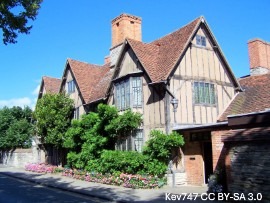
Stratford-upon-Avon home of Shakespeare's daughter is 'At Risk'
Lady Grange’s House repaired on St Kilda
.jpg)
National Trust for Scotland repairs stone cleit with link to famous island resident
Griff Rhys Jones on BBC Radio 4 Today programme
,_Green_Lane,_Derby.jpg)
The Victorian Society’s President unveiled its latest Top Ten Endangered Buildings 2026.
Need a MATE? Book your place now.

IHBC offers free webinars on applying for IHBC accreditation (Full & Associate).
UK Stained Glass Repository finds windows new homes

How are stained glass windows are rescued, stored and repurposed?
APPGEBE report sets high aims for quality
'Government must not sacrifice quality in drive to build 1.5m homes'
New measures protect Historic Shipwrecks from heritage crime

Underwater cultural heritage benefits from new HE guidance
How could the City of London skyline look in 6 years' time?

Visualisation shows approved planning applications as completed buildings
National Trust for Scotland calls for VAT cuts

Heritage neglect is encouraged by current policies
IHBC's 'Context' Issue 186 features Industrial Heritage
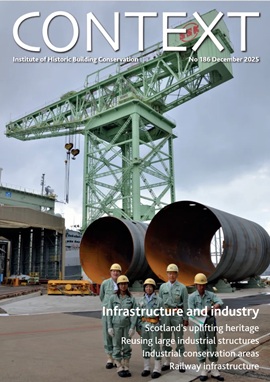
IHBC's members' journal reports on the challenges of conserving infrastructure
Book now for IHBC Annual School 2026
IHBC Annual School is taking place 18-20 June 2026 in Newcastle
RICHeS Research Infrastructure offers ‘Full Access Fund Call’
RICHeS offers a ‘Help’ webinar on 11 March
Latest IHBC Issue of Context features Roofing
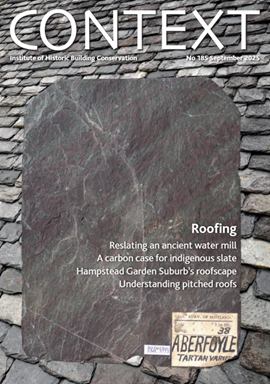
Articles range from slate to pitched roofs, and carbon impact to solar generation to roofscapes
Three reasons not to demolish Edinburgh’s Argyle House

Should 'Edinburgh's ugliest building' be saved?
IHBC’s 2025 Parliamentary Briefing...from Crafts in Crisis to Rubbish Retrofit
IHBC launches research-led ‘5 Commitments to Help Heritage Skills in Conservation’
How RDSAP 10.2 impacts EPC assessments in traditional buildings

Energy performance certificates (EPCs) tell us how energy efficient our buildings are, but the way these certificates are generated has changed.