





Professional practice
The term 'professional practice' refers to the conduct and work of someone from a particular profession.
Professions are occupations that require a prolonged period of education and training. They are often overseen by professional bodies who may accredit educational establishments and qualified professionals. Qualification may be recognised by the designation 'member of...', 'certified', 'chartered member', 'fellow', and so on. For example, a professional member of the Chartered Institute of Architectural Technologists may use the letters MCIAT after their name (member of).
Professional bodies may set standards of ethics, performance, competence, insurance, training and so on that must be met to remain within the profession. These are typically set out in a code of conduct.
Some professional designations are protected by law. For example, the term ‘architect’ is protected by the Architects Act 1997 which established the Architects Registration Board (ARB). Only qualified individuals that are registered with the ARB can offer their services as architects. However, rather peculiarly, the public tend to recognise the designation RIBA, denoting an architect who is also a member of the Royal Institute of British Architects. This is not a legal requirement.
Professions will have specific practices and standards that they value, but in construction there are some general principles common to most professionals:
- Act with integrity.
- Adopt an ethical approach.
- Provide a high standard of service.
- Only undertake work for which there is appropriate competence.
- Have appropriate insurance.
- Ensure that terms of appointment are clear.
- Act in a way that promotes trust in the profession.
- Do not bring the profession into disrepute.
- Do not discriminate against parties on any grounds.
- Demonstrate a commitment to continuing professional development.
- Offer a dispute resolution service.
Contracts may include terms requiring that the contracted party exercise 'reasonable skill and care', and in interpreting this, the courts may take into account the professional standard that might be expected. That is, a party advertising services as a professional architect would be expected to demonstrate the level of skill and care of a competent architect.
An architect offering services in a specialist field might be expected to demonstrate a higher level of skill and care, of a competent specialist. The more skilled a person, the more the care that can be expected of them. For more information see: Reasonable skill and care.
See also: Professional conduct.
[edit] Related articles on Designing Buildings Wiki
- Architect.
- BEIS Reforming Regulation Initiative.
- Best practice.
- Chartered institute.
- Chartered surveyor.
- CIAT.
- Corporate social responsibility in construction.
- CPD.
- Discipline.
- Ethics in construction.
- Fair payment practices.
- International Ethics Standards Coalition.
- Practice.
- Practice management.
- Professional.
- Professional body.
- Professional conduct.
- RIBA.
- Reasonable skill and care.
- The architectural profession.
- Types of construction organisation.
- What is a Chartered Practice?
Featured articles and news

We're expanding our collaborative mission by launching DB Intelligence, an exclusive market research advisory panel. Built environment professionals can now get paid to share their expertise on industry trends, products and services.
Panel members receive direct financial incentives for participating in research projects like short surveys, 1-2-1 interviews and focus groups. Register today to shape the future of the construction sector.
Planning condition discharge in England and Wales

A brief exoplanation from a building compliance expert, with further links.
Overheating guidance and tools for building designers

Guidance for dealing with element of building fabric control that have increasing importance.
Shading for housing, a design guide

From the Good Homes Alliance and British Blind and Shutter Association.
UK Standard Skills Classification (SSC)

A shared framework for describing skills needs.
Social media ban consultation comes to close

CIOB urges UK Government to consider social media’s role in careers guidance in ban debate.
The latest of eight Skills England apprenticeship units

The addition of battery manufacturing welcomed by ECA with a warning about the risks of fast-tracked apprenticeship units.
Building Control Independent Panel final report
A precis of a key report led by Dame Hackitt with full recommendations and link to the government response.
Building Safety recap April, 2026
A short and longer run-through of the month, with links to further information and sources.
CIAT May 2026 briefing.

From medieval scribes to modern word art.

ECA welcomes crackdown on late payment and push for clean energy, whilst CIOB seek fixed cladding removal timeframes.
Cyber Security in the Built Environment
Protecting projects, data, and digital assets: A CIOB Academy TIS.
Managing competence in the built environment
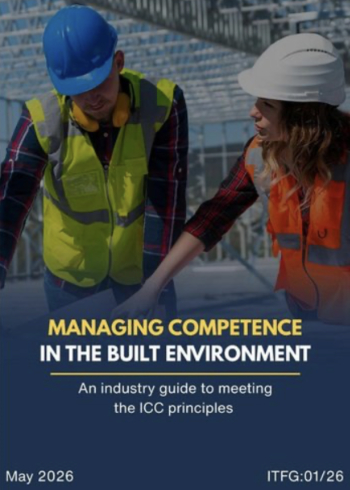
ITFG publishes new industry guide on how to meet the ICC principles.
The UK's campaign to reduce noise pollution: Mythbusting, articles and topic guides.