





Master builder

|
[edit] Introduction
The term ‘master builder’ has been in use since the early 17th century but the profession itself has existed since humans started to build shelters.
Traditionally, the term referred to a person who undertook many or all of the professions that were required to build a house or other small structure. Master builders would have the knowledge and/or skills of an architect, structural engineer, carpenter, roofer and other trades needed to construct a building.
[edit] Historical usage of the term ‘master builder’
Since master builders have existed since people began building, they were active before the various skills were separated into architect, structural engineer, surveyor etc and the growth of the respective professions. Master builders were multi-skilled craftspeople who were either competent to physically carry out the works themselves or else were knowledgeable enough to instruct and direct other trades to complete the work.
In medieval England (5th – 15th century), the cruck frame was a crude way to construct a house, using large curved timbers that would form the roof and walls. The carpenter as master builder would often be responsible for the structural integrity of the building and direct the other crafts such as walling and rendering the structure to make it watertight.
The cathedrals of the Gothic age (11th – 15th centuries) were designed by master builders (sometimes called 'master masons') who had architectural and structural knowledge that had been gained first as apprentices then from experience. They could design the architecture and knew what its structural requirements and limitations were. It may be because one person was responsible for the design that the architecture and structure of Gothic cathedrals is harmonious and inseparable.
These multi-skilled craftspeople whose knowledge was often founded on either their mistakes or the mistakes of others (usually structural collapses of some description), tended to be 'anonymous': they might lead a peripatetic life, travelling from one city to the next, designing and directing the construction of a cathedral, enjoying great patronage and prestige, then moving on to the next project elsewhere.
In Victorian England, some master builders may have been responsible for the design and construction of buildings, whether a house, school or church, but others may also have been guided by plans prepared by architects. In such cases, the master builder would usually have been responsible for everything apart from the design.
Later in the early-mid 20th century, the term master builder was sometimes applied to an architect who possessed a theoretical knowledge of engineering and the fundamentals of building construction.
Today, the term ‘master builder’ is still in use by builders with an all-encompassing knowledge of building design and construction which they can apply to the construction of buildings, whether that is undertaking the work themselves or directing trades (who may be in their direct employment) to complete the work.
The UK-based Federation of Master Builders is a trade association that was established in 1941 to protect the interests of small- and medium-sized (SME) construction firms. It offers a range of services to help members grow and improve their businesses.
[edit] Related articles on Designing Buildings
- Architect.
- British Property Federation BPF.
- Builder.
- Building Site to Boardroom (BS2B).
- Construction contractor.
- Construction industry institutes and associations.
- Engineer.
- Federation of Master Builders.
- Flint.
- FMB - Programme for Government.
- Interview with FMB.
- Masonry chimney.
- Types of construction organisations.
Featured articles and news

We're expanding our collaborative mission by launching DB Intelligence, an exclusive market research advisory panel. Built environment professionals can now get paid to share their expertise on industry trends, products and services.
Panel members receive direct financial incentives for participating in research projects like short surveys, 1-2-1 interviews and focus groups. Register today to shape the future of the construction sector.
Planning condition discharge in England and Wales

A brief exoplanation from a building compliance expert, with further links.
Overheating guidance and tools for building designers

Guidance for dealing with element of building fabric control that have increasing importance.
Shading for housing, a design guide

From the Good Homes Alliance and British Blind and Shutter Association.
UK Standard Skills Classification (SSC)

A shared framework for describing skills needs.
Social media ban consultation comes to close

CIOB urges UK Government to consider social media’s role in careers guidance in ban debate.
The latest of eight Skills England apprenticeship units

The addition of battery manufacturing welcomed by ECA with a warning about the risks of fast-tracked apprenticeship units.
Building Control Independent Panel final report
A precis of a key report led by Dame Hackitt with full recommendations and link to the government response.
Building Safety recap April, 2026
A short and longer run-through of the month, with links to further information and sources.
CIAT May 2026 briefing.

From medieval scribes to modern word art.

ECA welcomes crackdown on late payment and push for clean energy, whilst CIOB seek fixed cladding removal timeframes.
Cyber Security in the Built Environment
Protecting projects, data, and digital assets: A CIOB Academy TIS.
Managing competence in the built environment
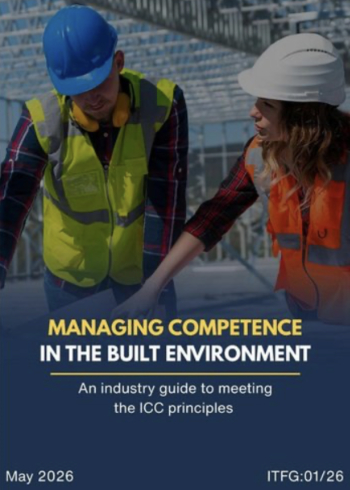
ITFG publishes new industry guide on how to meet the ICC principles.

The UK's campaign to reduce noise pollution: Mythbusting, articles and topic guides.