





Housing health and safety rating system
The Housing Health and Safety Rating System (HHSRS) was introduced in England and Wales by the Housing Act 2004. It replaced the pass or fail Housing Fitness Standard in April 2006 because of concerns that it did not properly distinguish between defects and health and safety hazards.
The HHSRS is a risk-based assessment system used by environmental health officers (EHOs) to assess the likelihood and severity of 29 categories of potential health and safety hazards in residential housing (including fire). It can be used in private or social rented housing as well as owner-occupied housing, and is intended to help local authorities identify and protect against potential risks to health and safety resulting from deficiencies in dwellings.
Local authorities have a statutory duty to keep housing conditions in their area under review, and to inspect properties if they consider it appropriate to do so.
An HHSRS score is calculated following an inspection (as prescribed by the Housing Health and Safety Rating System (England) Regulations 2005), and the government has issued statutory Enforcement Guidance explaining the actions local authorities can take and the factors they should consider when deciding which action is the most appropriate.
If the EHO finds a serious hazard (one scoring A – C, called a Category 1 hazard in the Act) the local authority is under a duty to take action. If an EHO finds a less serious hazard (one scoring D – J, called a Category 2 hazard in the Act) the local authority only need take action if they think it is necessary. Enforcement is intended to make the property safer for occupants and potential future occupants and may include the local authority carrying out any necessary remedial work themselves and reclaiming the costs if necessary.
There has been some criticism that since the introduction of the HHSRS there have been no minimum property standards for rented housing in England, and have been failed attempts to introduce new legislation to require that residential rented accommodation is maintained in a state fit for human habitation.
[edit] Welsh Housing Quality Standard 2023
The Welsh Housing Quality Standard 2023, published by the Welsh Government in October 2023, states:
The Housing health and safety rating system (HHSRS) was introduced by the Housing Act 2004 and HHSRS (Wales) Regulations 2006. The system is a health-based risk assessment tool for the evaluation of housing conditions. The HHSRS has not changed since its introduction in April 2006. The system operates by evaluating potential risk of harm to an actual or potential occupier from their living environment and is a means of rating the seriousness of any hazard/s identified. A hazard is any risk of harm to the health and safety of an occupier that arises from a deficiency. Deficiencies can contribute to any one or more of the 29 different hazards subject to an HHSRS assessment.
A hazard rating is expressed though a numerical score which falls within a hazard, there are 10 bands. Scores in Bands A to C are Category 1 hazards, imposing a duty on enforcing local housing authorities to take appropriate action under Part 1 of the 2004 Act. Scores in Bands D to J are Category 2 hazards, a local housing authority has a power but not a duty to act against any significant hazard in the case of Category 2 hazards.
Category 1 Hazards are whole house judgements and deficiencies leading to the assessment of a Category 1 Hazard may impact on more than one WHQS element. Deficiencies in any element (listed in Part 7 of the standard below) that contribute to an HHSRS Category 1 Hazard would automatically result in a fail for that element and thereby the dwelling failing the Standard. The Housing Health and Safety Rating System Guidance Operational Guidance can be obtained from the Welsh Government website and is free to download https://gov.wales/housing-health-and-safety-rating-system-guidance.
[edit] Related articles on Designing Buildings
- Housing.
- Housing Act 2004.
- Housing Design SPG.
- Affordable housing.
- Changing lifestyles.
- Draft London Housing Strategy.
- Housing standards review.
- Inclusive design.
[edit] External references
- Housing Act 2004.
- Housing Health and Safety Rating System (England) Regulations 2005.
- Housing Health and Safety Rating System Enforcement Guidelines, Part 1: Housing Conditions.
- Housing health and safety rating system: guidance for landlords and property-related professionals.
- Homes (Fitness for Human Habitation) Bill.
- Library briefing paper 7328: Housing fitness in the private rented sector.
Featured articles and news

We're expanding our collaborative mission by launching DB Intelligence, an exclusive market research advisory panel. Built environment professionals can now get paid to share their expertise on industry trends, products and services.
Panel members receive direct financial incentives for participating in research projects like short surveys, 1-2-1 interviews and focus groups. Register today to shape the future of the construction sector.
Planning condition discharge in England and Wales

A brief exoplanation from a building compliance expert, with further links.
Overheating guidance and tools for building designers

Guidance for dealing with element of building fabric control that have increasing importance.
Shading for housing, a design guide

From the Good Homes Alliance and British Blind and Shutter Association.
UK Standard Skills Classification (SSC)

A shared framework for describing skills needs.
Social media ban consultation comes to close

CIOB urges UK Government to consider social media’s role in careers guidance in ban debate.
The latest of eight Skills England apprenticeship units

The addition of battery manufacturing welcomed by ECA with a warning about the risks of fast-tracked apprenticeship units.
Building Control Independent Panel final report
A precis of a key report led by Dame Hackitt with full recommendations and link to the government response.
Guide to ISO 19650 for Architecture Firms (2026)
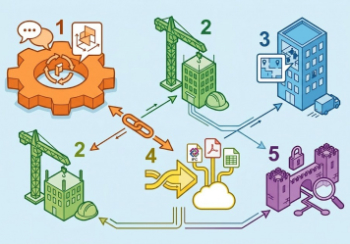
A user gives their low down.

A UK training and membership provider for mould remediation professionals.
Building Safety recap April, 2026
A short and longer run-through of the month, with links to further information and sources.
CIAT May 2026 briefing.

Independent NSI and BAFE study exploring how organisations are changing the way they buy fire safety services.

From medieval scribes to modern word art.

ECA welcomes crackdown on late payment and push for clean energy, whilst CIOB seek fixed cladding removal timeframes.
Cyber Security in the Built Environment
Protecting projects, data, and digital assets: A CIOB Academy TIS.
Managing competence in the built environment

ITFG publishes new industry guide on how to meet the ICC principles.
The UK's campaign to reduce noise pollution: Mythbusting, articles and topic guides.