





A Guide for Selecting Flat Entrance Doorsets
|
| In March 2019, in an unprecedented collaboration within the fire and security industry, three not-for-profit organisations with expertise in fire and security doorsets combined their knowledge to offer guidance in a newly-published document on flat entrance doorsets. |
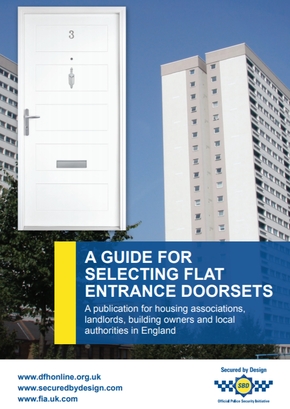
The joint publication: A Guide for Selecting Flat Entrance Doorsets; A publication for housing associations, landlords, building owners and local authorities in England, relates to new doorsets and is the product of DHF (Door & Hardware Federation), Secured by Design (SBD) and the Fire Industry Association (FIA).
The publication brings together the best collaborative advice available from the industry in one straightforward document to highlight the fundamental issues of fire safety and security for those selecting fire doorsets.
Importantly, the publication makes the point that there is no conflict between fire and security, with Building Regulations Approved Document B (fire) and Approved Document Q (security) carrying equal weight. It explains why only factory produced doorsets can meet both ADB and ADQ.
Specifiers can have confidence in using the publication as an authoritative source of information as they are guided through the complexities of an extremely important area of the Building Regulations to help them make informed choices.
The publication comes in the wake of the 2017 Grenfell Tower tragedy and in response to the Ministry of Housing Communities and Local Governments’ (MHCLG) Implementation Plan – ‘Building a Safer Future’, released at the end of December 2018.
This new guidance document recommends that all fire doorsets are factory-prepared (as opposed to prepared on-site) and audited by a third-party. It is suggested these recommendations will offer greater assurance on door performance and protect occupants, control the spread of fire and enable safer, easier escape in the event of an incident.
DHF’s CEO, Bob Perry said: “It seemed a natural partnership to come together and offer guidance on what to look for in a flat entrance doorset, how this relates to the latest advice supplied by Government (MHCLG) and why third-party certification of fire and security doorset manufacture, installation and maintenance is a critical part of the protection against fire ingress and unlawful entry. Third party certification of manufacture, installation, maintenance and inspection of fire, smoke and security doors is something DHF has lobbied for tirelessly, as well as issues surrounding poorly or ill-fitting door closers. These form a vital part of fire safety.”
FIA’s CEO, Ian Moore, said: “This underlines the Fire Industry Association’s objective to improve and perfect fire protection work and builds on MHCLG guidance within the Government’s building safety programme. It is worth noting that although this document is specific to England and Wales, it is also useful information for Northern Ireland and Scotland.”
Chief Operating Officer of Secured by Design, Jon Cole, said: “Third party certification, by suitably qualified bodies, has certainly delivered consistency and quality within the security sector. This is why we have campaigned for flat entrance doorsets to have dual certification, meeting all the relevant requirements for security and fire resistance in a single combined design specification. We believe that certification remains the best and only way to assure that effective quality products are delivered to market, providing additional assurance of performance .”
You can download the document at: https://www.securedbydesign.com/images/downloads/DOORSET_BROCHURE_200319.pdf
This article originally appeared as DHF, Secured by Design and the Fire Industry Association release joint publication on fire safety, published by CIAT on 21 Mar 2019.
--CIAT
[edit] Related articles on Designing Buildings Wiki
Featured articles
Check out some of the best features and news from Designing Buildings as well as key stories from around the web.

Government approach could undermine delivery and regeneration.
World's first mass timber data centre.

The overlooked environmental aspect of data centre development.
Introduction to radon awareness

New technical information sheet published by CIOB.

Updated supplier guide can help electrical contractors engage with NHP.

CIAT confirm the winners of the 2026 architectural technology awards.

Government launches a one stop shop for flood preparedness.

Sir Edwin Lutyens: Britain's greatest architect? Book review.

CIOB publishes free template to help assess and manage risks.
ECA's reflections on Party Conference season

Burnham wants to be confident of winning before asking for a fresh mandate.
New Chief Construction and Scientific Adviser

Sergio Cavalaro, Professor of Infrastructure Systems at Loughborough University.
Building safety levy for England

CIAT publish estimator tool for members.

Water sector faces a growing crisis that could slow the delivery of vital infrastructure.