





The Personal Protective Equipment at Work Regulations 1992
The Personal Protective Equipment at Work Regulations 1992 came into force on 1st January 1993. They set out the requirements for equipment intended to protect the wearer from health and safety risks.
The regulations define personal protective equipment (PPE) as ‘…all equipment (including clothing affording protection against the weather) which is intended to be worn or held by a person at work and which protects him against one or more risks to his health or safety, and any addition or accessory designed to meet that objective.’
Employers are required to provide PPE for employees who may be exposed to a risk to their health or safety except where that risk has been adequately controlled by other means. Self-employed people are required to provide themselves with PPE.
PPE shall:
- Be appropriate for the risks involved and the conditions where exposure to the risk may occur.
- Take account of ergonomic requirements and the state of health of the person or persons who may wear it.
- Be capable of fitting the wearer correctly.
- Be effective to prevent or adequately control the risk.
- Comply with statutory requirements on design or manufacture.
- Be compatible with other PPE.
The regulations that require PPE is assessed before use and maintained and stored properly and that wearers are provided with instructions on safe and correct use.
Employees are required to report to their employer any loss of or obvious defect in personal protective equipment.
The contents of the regulations are:
- Introductory Text
- Citation and commencement
- Disapplication of these Regulations
- Provision of personal protective equipment
- Compatibility of personal protective equipment
- Assessment of personal protective equipment
- Maintenance and replacement of personal protective equipment
- Accommodation for personal protective equipment
- Information, instruction and training
- Use of personal protective equipment
- Reporting loss or defect
- Exemption certificates
- Extension outside Great Britain
- Modifications, repeal and revocations directive
- Schedule 1: Relevant Community
- Schedule 2: Modifications
- Schedule 3: Revocations
[edit] Related articles on Designing Buildings
- Asbestos.
- Building regulations.
- CDM.
- Cold stress.
- Control of Substances Hazardous to Health (COSHH).
- Crane regulations.
- Environmental health.
- Fee for intervention.
- Getting personal about protective equipment.
- Health and safety.
- Health and safety consultant.
- Health and Safety Executive.
- Health and safety file.
- Health and safety inspector.
- Health and safety offences, corporate manslaughter and food safety and hygiene offences definitive guideline.
- Health and safety policy.
- Hi-vis clothing.
- Management of Health and Safety at Work Regulations 1999.
- Method statement.
- Non-freezing cold injury NFCI.
- Notification to HSE.
- Personal protective equipment.
- Pre-construction information.
- Principal contractor.
- Purchasing personal protective equipment.
- Reporting accidents and injuries on construction sites.
- Work at height regulations.
Featured articles and news

We're expanding our collaborative mission by launching DB Intelligence, an exclusive market research advisory panel. Built environment professionals can now get paid to share their expertise on industry trends, products and services.
Panel members receive direct financial incentives for participating in research projects like short surveys, 1-2-1 interviews and focus groups. Register today to shape the future of the construction sector.
Planning condition discharge in England and Wales

A brief exoplanation from a building compliance expert, with further links.
Overheating guidance and tools for building designers

Guidance for dealing with element of building fabric control that have increasing importance.
Shading for housing, a design guide

From the Good Homes Alliance and British Blind and Shutter Association.
UK Standard Skills Classification (SSC)

A shared framework for describing skills needs.
Social media ban consultation comes to close

CIOB urges UK Government to consider social media’s role in careers guidance in ban debate.
The latest of eight Skills England apprenticeship units

The addition of battery manufacturing welcomed by ECA with a warning about the risks of fast-tracked apprenticeship units.
Building Control Independent Panel final report
A precis of a key report led by Dame Hackitt with full recommendations and link to the government response.
Building Safety recap April, 2026
A short and longer run-through of the month, with links to further information and sources.

CIAT May 2026 briefing.
From medieval scribes to modern word art.

ECA welcomes crackdown on late payment and push for clean energy, whilst CIOB seek fixed cladding removal timeframes.
Cyber Security in the Built Environment
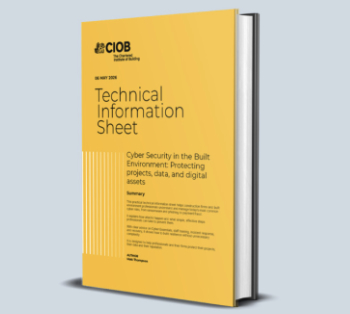
Protecting projects, data, and digital assets: A CIOB Academy TIS.
Managing competence in the built environment
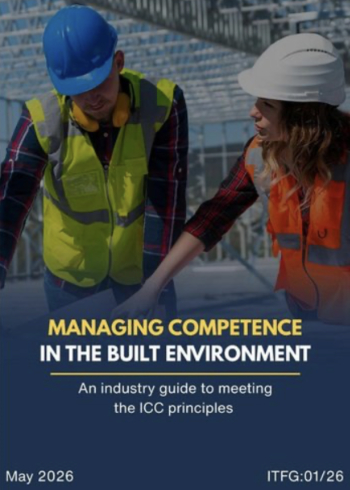
ITFG publishes new industry guide on how to meet the ICC principles.
The UK's campaign to reduce noise pollution: Mythbusting, articles and topic guides.