





Tensegrity structural systems

Tensegrity is a structural design principle that applies to a structure which can be stabilised entirely by internal pre-stress. This pre-stress is created by a discontinuous set of compression elements being opposed and balanced by a continuous tensile force.
In essence, a net of continuous tension cables or tendons (the tensioned elements), hold in place, and are themesleves held in place by, a series of discontinous bars or struts (the compressed elements).
The pioneering architect Buckminster Fuller coined the term tensegrity in the 1960s, as a combination of ‘tensional integrity’. However, the American sculptor Kenneth Snelson has long-claimed that Fuller took credit for his original idea of ‘floating compression’. Snelson defines tensegrity as follows:
| ‘Tensegrity describes a closed structural system composed of a set of three or more elongate compression struts within a network of tension tendons, the combined parts (are) mutually supportive in such a way that the struts do not touch one another, but press outwardly against nodal points in the tension network to form a firm, triangulated, prestressed, tension and compression unit.’ |
This combination of balanced elements produces an exceptionally rigid structure made up of members that do not experience bending moments. Members are loaded only in pure compression or pure tension, and will fail only if cables yield or rods buckle.
A famous example of a tensegrity structure was the Skylon, exhibited at the Festival of Britain in 1951 [see top image]. The tower was held in position by six cables, three of which were at the bottom and determined its location, while the other three were at the top and maintained its verticality.
One of the first uses of tensegrity in architecture was Spodek, an entertainment venue in Poland, designed by architects Maciej Gintowt and Maciej Krasiski in the 1960s. The roof was an inclined surface, the circumference of which was held up by a system of cables.
[edit] Related articles on Designing Buildings
Featured articles
Check out some of the best features and news from Designing Buildings as well as key stories from around the web.
New and updated CLC building safety guidance.
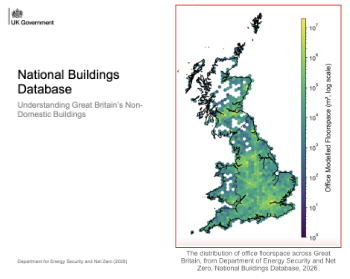
New UK National Buildings Database.
Building Safety Wiki Interviews

Chief executive of the British Woodworking Federation.
Planning condition discharge in England and Wales

A brief explanation from a building compliance expert, with further links.
Overheating guidance and tools for building designers

Guidance for dealing with element of building fabric control that have increasing importance.
Shading for housing, a design guide

From the Good Homes Alliance and British Blind and Shutter Association.
UK Standard Skills Classification (SSC)

A shared framework for describing skills needs.
Social media ban consultation comes to close

CIOB urges UK Government to consider social media’s role in careers guidance in ban debate.
The latest of eight Skills England apprenticeship units

The addition of battery manufacturing welcomed by ECA with a warning about the risks of fast-tracked apprenticeship units.
Building Control Independent Panel final report

A precis of a key report led by Dame Hackitt with full recommendations and link to the government response.
Building Safety recap April, 2026

A short and longer run-through of the month, with links to further information and sources.