





Statutory declaration excluding security of tenure
Most tenants of commercial premises with a lease of more than 6 months have security of tenure. This means they have the right to continue to occupy the premises after the lease has come to a natural end on similar terms to the original lease.
This protection is given by the Landlord & Tenant Act 1954 and can be important for commercial tenants, for example; if they have installed a lot of equipment, If the location is vital to their operation, if business continuity is important and so on.
To regain possession, the landlord must serve notice under the Act setting out the grounds for opposing renewal of the lease, for example if the tenant has not carried out repair and maintenance obligations.
However, the landlord and the tenant can agree to exclude, or ‘contract out’, the right to security of tenure, giving the landlord automatic possession at the end of the lease. This might be agreed, for example, if the landlord intends to refurbish or redevelop the premises, or to occupy it themselves, or they may simply want flexibility at the end of the lease.
To contract out security of tenure, the landlord must issue a Landlord’s Notice to Exclude Security of Tenure and in response to this the tenant completes a Declaration confirming that they understand and accept they are entering into a lease with no security of tenure. The notice and the declaration must follow a prescribed format.
If the landlord's notice is served at least 14 days before the lease is entered into, then a simple declaration can be used. If the landlord's notice is served less than 14 days before the lease is entered into then a statutory declaration is required, signed before a solicitor.
The lease must then refer to the notice, the declaration and the agreement to exclude security of tenure.
Leases that exclude security of tenure may have a lower rent.
[edit] Related articles on Designing Buildings Wiki
- Betterment.
- Break clauses in leases.
- Build to Suit.
- Dilapidations.
- Ground rent.
- Lease Negotiations - Tenants Checklist.
- Leasehold.
- Rent-free period.
- Rent in administration.
- Rent review.
- Reversion.
- Sample retail lease.
- Schedule of dilapidations.
- Security of tenure for commercial leases.
- Service charge.
- Supersession.
- Vacant possession.
[edit] External references
Featured articles and news

We're expanding our collaborative mission by launching DB Intelligence, an exclusive market research advisory panel. Built environment professionals can now get paid to share their expertise on industry trends, products and services.
Panel members receive direct financial incentives for participating in research projects like short surveys, 1-2-1 interviews and focus groups. Register today to shape the future of the construction sector.
Building Safety Wiki Interviews

Chief executive of the British Woodworking Federation.
Planning condition discharge in England and Wales

A brief exoplanation from a building compliance expert, with further links.
Overheating guidance and tools for building designers

Guidance for dealing with element of building fabric control that have increasing importance.
Shading for housing, a design guide

From the Good Homes Alliance and British Blind and Shutter Association.
UK Standard Skills Classification (SSC)

A shared framework for describing skills needs.
Social media ban consultation comes to close

CIOB urges UK Government to consider social media’s role in careers guidance in ban debate.
The latest of eight Skills England apprenticeship units

The addition of battery manufacturing welcomed by ECA with a warning about the risks of fast-tracked apprenticeship units.
Building Control Independent Panel final report
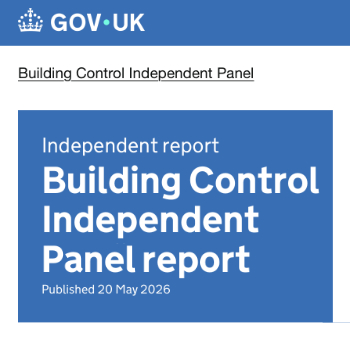
A precis of a key report led by Dame Hackitt with full recommendations and link to the government response.
Building Safety recap April, 2026
A short and longer run-through of the month, with links to further information and sources.

CIAT May 2026 briefing.

From medieval scribes to modern word art.

ECA welcomes crackdown on late payment and push for clean energy, whilst CIOB seek fixed cladding removal timeframes.
Cyber Security in the Built Environment
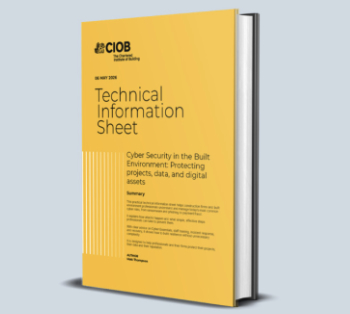
Protecting projects, data, and digital assets: A CIOB Academy TIS.
Managing competence in the built environment

ITFG publishes new industry guide on how to meet the ICC principles.