




RIDDOR and the provisional statistics for 2023 / 2024

Contents |
[edit] The RIDDOR requirements
The Reporting of Injuries, Diseases and Dangerous Occurrences Regulations 2013 (RIDDOR) introduced a legal requirement for responsible persons (employers, the self-employed and individuals in control of work premises) to notify and keep records of specified workplace incidents. This includes certain workplace accidents, occupational diseases and certain ‘dangerous occurrences’ (including near miss accidents). In addition, registered gas fitters are required to report poor and dangerous gas installations.
A ‘responsible person’ must notify the relevant enforcing authority (Health and Safety Executive (HSE), local authorities and the Office for Rail Regulation (ORR)) about deaths, injuries, occupational diseases and dangerous occurrences. The information gathered is used to assist in identifying where and how risks arose and to prevent re-occurrence.
Accurate records of any RIDDOR incidents must be maintained to assist in ensuring that health and safety is managed appropriately. In addition to RIDDOR incidents, any incident resulting in a worker being away from work or incapacitated for more than three consecutive days must be recorded. The records must include details regarding the incident or disease, personal details of the individual(s) involved, time and place of the event and the date and method of reporting. Records must be kept for at least three years from the date on which they were made.
Records must be submitted by the responsible person via an online reporting system from the RIDDOR report page on the HSE website. The appropriate form should be completed which will be submitted to the database and a copy emailed as a record for the responsible person. Fatalities and major injuries can be reported by phone to the HSE. A report must be received within 10 days of the incident or within 15 days for accidents resulting in the over seven-day incapacitation of a worker.
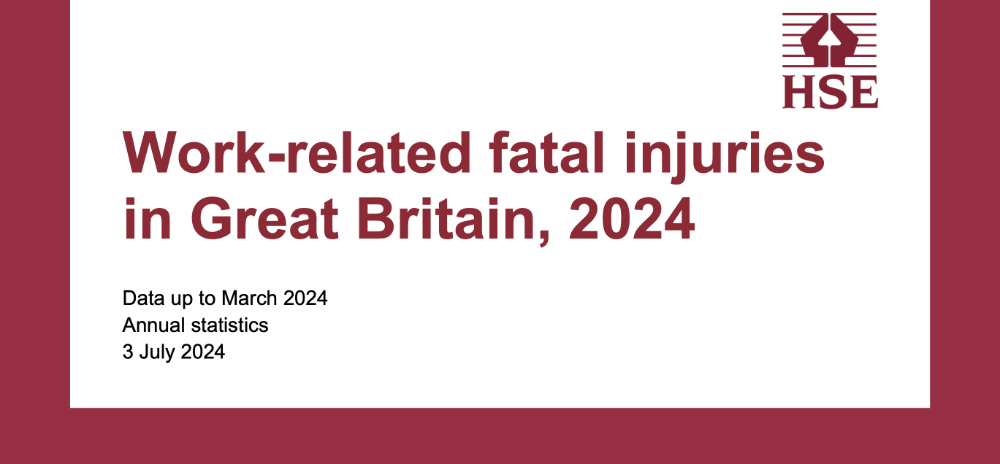
[edit] RIDDOR provisional statistics for 2023/2024
The Reporting of Injuries, Diseases and Dangerous Occurrences Regulations (RIDDOR) figures for 2023/24 are published annually first as provisional statistics that will be finalised in July 2025.
In 2023/24 provisional figures show that 138 workers were killed in work-related accidents (RIDDOR) and that 87 members of the public were killed in work-related accidents during the same period. This excludes deaths due to work-related accidents to ‘patients and service users’ in the healthcare and adult social care sectors in England reportable under RIDDOR.
Over 50% of the total number of 138 workers killed in work-related accidents in 2023/2024 were attributed to the construction sector, and of that total exactly 50% of these fatal accidents were recorded as fall from height. During the period 2013/2014 to 2023/2024 the highest number of work related deaths occurred in 2018 with 149 deaths, whilst the lowest figures were in 2019 with 113 deaths (noting that the pandemic likely impacted figures).
HSE state that 'Despite long term reductions in the number of workers killed by work activities, each year such cases continue, with 138 such deaths in 2023/24. This number compares with 236 twenty years ago (2003/04) and 495 in 1981 (prior to 1981 only fatal injury numbers to employees were reported to enforcing authorities)....the 138 worker deaths in 2023/24 represents an increase of 2 from the previous year. In statistical terms the number of fatalities in 2023/24 is broadly in line with the pre-pandemic level (annual average of 142 deaths per year 2016/17-2018/19).
[edit] Further information and guidance from HSE
HSE provides a wide range of RIDDOR related resources and explanations covering; reportable incidents, types of incidents that must be reported and exemptions, how to make a RIDDOR report, reporting online or by telephone, the types of records that need to be kept aswell as a resources section. For further information see article Reporting accidents and injuries on construction sites RIDDOR or visit the HSE website page here as well as a downloadable pdf.
[edit] Related articles on Designing Buildings
- Accident book.
- Accident report.
- As Low As Reasonably Practicable (ALARP).
- Asbestos.
- CDM.
- Collaborative Reporting for Safer Structures UK.
- Construction dust.
- Control of Noise at Work Regulations 2005.
- Deleterious materials.
- Demolition.
- Emergency plan.
- First aider.
- Health and safety.
- Health and Safety Executive.
- Heat stress.
- Incident reporting system.
- Injuries on construction sites.
- Inspections focus on occupational lung disease.
- Method statement.
- Near miss.
- Occupational health.
- Occupational Safety and Health Administration OSHA.
- Personal protective equipment.
- Reporting accidents and injuries on construction sites RIDDOR.
- Risk assessment.
- Safety.
- Safety helmet colours.
- What is CLOCS?
- Workplace noise exposure estimator.
[edit] External links
Featured articles
Check out some of the best features and news from Designing Buildings as well as key stories from around the web.
World's first mass timber data centre.

The overlooked environmental aspect of data centre development.
Introduction to radon awareness

New technical information sheet published by CIOB.

Updated supplier guide can help electrical contractors engage with NHP.

CIAT confirm the winners of the 2026 architectural technology awards.

Government launches a one stop shop for flood preparedness.

Sir Edwin Lutyens: Britain's greatest architect? Book review.

CIOB publishes free template to help assess and manage risks.
ECA's reflections on Party Conference season

Burnham wants to be confident of winning before asking for a fresh mandate.
New Chief Construction and Scientific Adviser

Sergio Cavalaro, Professor of Infrastructure Systems at Loughborough University.
Building safety levy for England

CIAT publish estimator tool for members.

Water sector faces a growing crisis that could slow the delivery of vital infrastructure.
Undervaluing our industrial past

Heritage value changes as taste for building styles changes.