





Genius loci
The term ‘genius loci’ originates from Roman mythology and refers to the protective spirit of a place. In antiquity, the genius loci was often depicted in religious iconography as a figure holding bowls or a snake. This is similar to Asian architecture, where spirits of places are often honoured in outdoor spirit houses, as well as indoor and outdoor shrines.
In contemporary usage, it can refer to a place’s distinctive atmosphere.
Often quoted in discussions about ‘spirit of places’, the 18th century English poet Alexander Pope advised landscape designers to ‘consult the genius of place in all’. This has been interpreted as emphasising the importance of attending to the distinctiveness of landscapes as well as local natural systems and environmental processes.
The concept of the genius loci was expanded upon and secularised as part of the philosophical branch of ‘architectural phenomenology’. This was an intellectual movement which began in the 1950s, and focused on the study of architecture as it appears in the human experience.
This was in sharp contrast to the anti-historicism of postwar modernism and would go on to influence post-modernism, especially with regard to contemporary design learning experiential lessons from historical buildings.
In his 2001 essay ‘Can spirit of place be a guide to ethical building?’, Isis Brooks identified a range of ideas that have been associated with spirit of place, including:
- Energy fields (a point of intense energy).
- Authenticity.
- Local distinctiveness.
- Narrative, with layers of history.
- Empowerment of ordinary people.
- Essence or interiority.
- Character and individuality.
- Ecosystem.
- Pantheism.
- Panpsychism (the idea that all things, including inanimate ones, have consciousness).
- Health of a place or emergent property.
Brooks suggested that a solution to this ambiguity with regard to the genius loci is to accept that spirit of place has its own legitimacy as a means of preventing homogenised design, rather than simply reflecting human feelings about places.
[edit] Related articles on Designing Buildings Wiki
- Antiquities.
- Architectonics.
- Context.
- Design principles.
- Living in the hyperreal Post-Modern city.
- Location.
- Modernist architecture.
- Monument and context.
- Phenomenology.
- Place.
- Placemaking.
- Public space.
- Setting.
- Townscape.
- Truth to materials.
- Wellbeing.
- Vernacular architecture.
- Zeitgeist.
[edit] External resources
- Placeness - Spirit of place
Featured articles and news

We're expanding our collaborative mission by launching DB Intelligence, an exclusive market research advisory panel. Built environment professionals can now get paid to share their expertise on industry trends, products and services.
Panel members receive direct financial incentives for participating in research projects like short surveys, 1-2-1 interviews and focus groups. Register today to shape the future of the construction sector.
Planning condition discharge in England and Wales

A brief exoplanation from a building compliance expert, with further links.
Overheating guidance and tools for building designers

Guidance for dealing with element of building fabric control that have increasing importance.
Shading for housing, a design guide

From the Good Homes Alliance and British Blind and Shutter Association.
UK Standard Skills Classification (SSC)

A shared framework for describing skills needs.
Social media ban consultation comes to close

CIOB urges UK Government to consider social media’s role in careers guidance in ban debate.
The latest of eight Skills England apprenticeship units

The addition of battery manufacturing welcomed by ECA with a warning about the risks of fast-tracked apprenticeship units.
Building Control Independent Panel final report
A precis of a key report led by Dame Hackitt with full recommendations and link to the government response.
Building Safety recap April, 2026
A short and longer run-through of the month, with links to further information and sources.
CIAT May 2026 briefing.
From medieval scribes to modern word art.

ECA welcomes crackdown on late payment and push for clean energy, whilst CIOB seek fixed cladding removal timeframes.
Cyber Security in the Built Environment
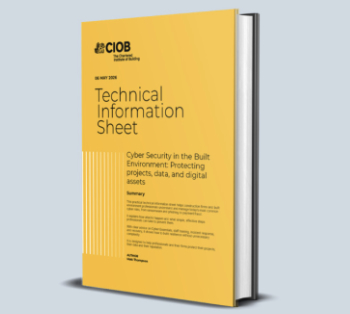
Protecting projects, data, and digital assets: A CIOB Academy TIS.
Managing competence in the built environment
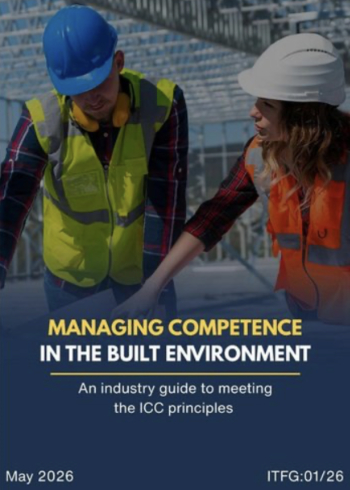
ITFG publishes new industry guide on how to meet the ICC principles.
The UK's campaign to reduce noise pollution: Mythbusting, articles and topic guides.