





Pulley
|
This photograph shows a rope and pulley (or block and tackle) system. |

Contents |
[edit] Introduction
A pulley is a type of wheel system is used with an axle to support the movement of some type of load.
[edit] History
The earliest recorded existence of pulley systems appeared in Ancient Egypt, Mesopotamia and Greece where block and tackle configurations were commonly used to move heavy objects.
During the Renaissance, this system was included by scientists in their list of six simple machines. According to Galileo Galilei, the simple machines “do not create energy, only transform it.” In addition to the pulley, these machines included:
- Lever
- Wheel and axle
- Inclined plane
- Wedge
- Screw
The six simple machines often served as the basis for more complex machines.
[edit] Types of pulleys
There are several types of pulley:
- Fixed. A fixed pulley has an axle mounted in bearings attached to a supporting structure.
- Movable. A movable pulley is made up of an axle in a movable block. A single movable pulley can lift more than a single fixed pulley.
- Compound. This combination of fixed and movable pulleys is also known as rope and pulley or block and tackle. When a fixed pulley is combined with a movable pulley or another fixed pulley, it can achieve more ambitious mechanical goals.
[edit] Rope and pulley
When used in combination with a frame or shell (sometimes referred to as a block), the freely rotating movable pulley (or set of pulleys) may be referred to as a sheave. The pulley or sheave may have indentations or grooves around its circumference to accommodate a drive element (sometimes referred to as a tackle) in the form of a continuous cable, belt, rope or chain. The tackle transmits tension to move a load.
This combination of rope and pulley can be part of a simple system that is used to lift items or change the direction of their motion. With the aid of a block and tackle system, it is possible to lift heavy loads by the application of a relatively small amount of force.
There are different types of rope and pulley configurations. The variations are based on the tackle configuration. Increasing the number of pulleys and falls of tackle increases the load that can be moved. Pulleys can be incorporated into common items such as curtains and sliding doors or lifting equipment such as fire ladders or power–driven industrial trucks and so on.
[edit] LOLER and rope and pulley systems
The Lifting Operations and Lifting Equipment Regulations (LOLER) place legal duties and responsibilities on those who own, operate or have control over lifting equipment. Rope and pulley systems are one type of lifting equipment covered by the regulations.
LOLER was created under the Health and Safety at Work etc. Act 1974, and came into force in 1998, replacing several preceding pieces of legislation which had previously regulated the use of lifting equipment. LOLER defines lifting equipment as ‘work equipment for lifting or lowering loads and includes its attachments used for anchoring, fixing or supporting it.’
The regulations require:
- That lifting equipment is strong and stable enough for safe use.
- Equipment is marked to indicate safe working loads.
- Equipment is positioned and installed so as to minimise risks.
- A competent person plans, organises and performs the safe use of the equipment.
- Equipment is subject to ongoing thorough examination and inspection.
LOLER may not apply where a lift is not used by people at work (such as a lift in a shop used by customers). However, Section 3 of the Health and Safety at Work Act imposes general responsibilities for the safety of users.
LOLER requires that lifts are thoroughly examined by a competent person at least every six months or, in the case of goods-only lifts, every 12 months. Insurance companies will generally request that a third party independent inspector carries out the inspections. The minimum requirements are:
- Every six months for lifting equipment used for lifting/lowering persons.
- Every six months for lifting accessories.
- Every 12 months for all other lifting equipment not falling into either of the categories above.
[edit] Belt and pulley
Another use of the pulley is the belt and pulley system. This system uses a pulley in conjunction with a belt drive to direct power from one place to another. The belt and pulley system can also control the speed of the motion.
|
This photograph shows a belt and pulley system. |

This configuration consists of two or more pulleys used in conjunction with a belt. The necessary contact pressure between the belt and pulleys is ensured by appropriate tightening of the belt. This may be achieved by means of a tensioning roller or another pulley.
[edit] Related articles on Designing Buildings Wiki
Featured articles
Check out some of the best features and news from Designing Buildings as well as key stories from around the web.

The real barrier to getting more value from digital technology.

Your guide to The Construction Reset at UKCW Birmingham.

Accommodating the Victorian and Edwardian working woman. Book review.
Rethinking passive fire protection in design

PFP demands the same level of design rigour as structure or services.

38% of Gen Zs feel safe when a fire door is wedged open.
Stunning images from around the world

Shortlist for CIOB’s Art of Building photography competition.

Guidance for conversion of traditional pre-1919 stone buildings.
Industrial heritage in the Ruhr
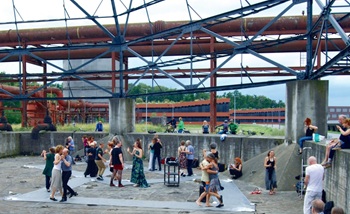
A marked difference to the fate of industrial landscapes in the UK.

Communities will be able to build their own clean energy.
Why diversity and inclusion matters for SMEs

CIOB’s D&I Charter shows how practical changes can support long-term growth.
Cut electricity bills to power growth

Coalition sends joint letter to the Chancellor.

Gasholders: a history in pictures. Book review.