





Types of washers

Contents |
[edit] Introduction
A washer is a thin disc-shaped plate, typically with a hole through the centre, that is used in conjunction with a threaded fastener (such as a screw or bolt) to:
Washers are most commonly made from metal or plastic, although rubber and fibre versions are also available.
Although they can vary widely, in general, washers have an outer diameter that is approximately twice the inner diameter.
There are three main categories of washer:
[edit] Plain washers
Also known as a flat washer, this type of washer is a flat annulus or ring which is used to spread the load of a screwed fastening and prevent damage to the surface being fixed.
Types of plain washer include:
- Penny washer (or Fender washer): A flat washer with a larger outer diameter proportional to the central hole, meaning it can distribute loads more widely.
- Spherical washer: Consists of one radiused surface which, when used with a mating nut, allows for several degrees of misalignment between parts.
- C-washer: Can be slid in and out of position on a bolt or shaft.
- Countersunk washer: When secured, this type of washer creates a flush surface.
[edit] Spring washers
This type of washer has axial flexibility which helps prevent fastening or loosening as a result of vibrations or shock.
Types of spring washer include:
- Belleville washer: Has a slight conical shape which helps maintain tension in assemblies where there is thermal expansion and contraction.
- Curved disc spring: Is only curved in one direction and so is used to support relatively light loads with a wide deflection range.
- Wave washer: Has a ‘wave’ in the axial direction which makes it suitable for use as a cushion spring or spacer.
- Split washer: Has a ring that is split at one point and bent into a helical shape creating more friction and rotation resistance.
[edit] Locking washer
This type of washer is often interchangeable with spring washers and prevents fastening or loosening rotation.
Types of locking washer include:
- Helical spring: Increases the pre-load on the fastener while tightening. This provides protection against loosening.
- Toothed lock washer: Has serrations around its edge that can extend inward or outward to bite into the surface material and provide maximum torsional resistance.
- Tab washer: Has a side tab that can be bent into place against a nut, preventing rotation.
[edit] Related articles on Designing Buildings Wiki
Featured articles and news
Change of use legislation breaths new life into buildings

A run down on Class MA of the General Permitted Development Order.
Solar generation in the historic environment

Success requires understanding each site in detail.
Level 6 Design, Construction and Management BSc

CIOB launches first-ever degree programme to develop the next generation of construction leaders.

Open for business as of April, with its 2026 prospectus and new pipeline of housing schemes.
The operational value of workforce health

Keeping projects moving. Incorporating unplanned absence and the importance of health, in operations.
A carbon case for indigenous slate

UK slate can offer clear embodied carbon advantages.
Costs and insolvencies mount for SMEs, despite growth

Construction sector under insolvency and wage bill pressure in part linked to National Insurance, says report.
The place for vitrified clay pipes in modern infrastructure
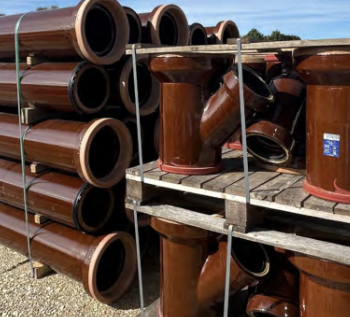
Why vitrified clay pipes are reclaiming their role in built projects.

Research by construction PR consultancy LMC published.
Roles and responsibilities of domestic clients

ACA Safety in Construction guide for domestic clients.
Fire door compliance in UK commercial buildings

Architect and manufacturer gives their low down.
The new towns and strategic environmental assessments

12 locations of the New Towns Taskforce reduced to 7 within the new towns draft programme and open consultation.

Buildings that changed the future of architecture. Book review.