





White v Jones
The principle of Hedley Byrne & Co Ltd v Heller & Partners Ltd was revisited by the House of Lords in the case of White v Jones, a judgment delivered shortly after Henderson and Others v Merrett Syndicates Ltd and Others.
The facts of White v Jones concerned a claim in negligence against a testator's solicitors by intended beneficiaries, the testator's daughters, for the solicitors' failure to draw up a will to be executed by the testator bequeathing gifts of money to the daughters. The court held that the solicitors were liable in tort for the economic loss suffered by the intended beneficiaries because:
- The assumption of responsibility by a solicitor towards their client should be extended in law to an intended beneficiary who was reasonably foreseeably deprived of their intended legacy as a result of the solicitor's negligence in circumstances in which there was no confidential or fiduciary relationship and neither the testator nor their estate had a remedy against the solicitor, since otherwise an injustice would occur because of a lacuna in the law ...
- Adopting the incremental approach by analogy with established categories of relationships giving rise to a duty of care, the principle of assumption of responsibility should be extended to a solicitor who accepted instructions to draw up a will so that he was held to be in a special relationship with those intended to benefit under it, in consequence of which he owed a duty to the intended beneficiary to act with due expedition and care in relating to carrying out those instructions.
Lord Goff felt that the broad principle of assumption of responsibility did not apply to the testator's solicitor and an intended beneficiary, although it could apply to the solicitor and the testator. His reasoning was that in the absence of special circumstances, there will have been no reliance by the intended beneficiary on the exercise by the solicitor of due care and skill; the intended beneficiary may not even have been aware that the solicitor was engaged on such a task or that his position might be affected.
Some commentators believe that Lord Goff s position in White v Jones is more conservative than the views he expressed in Henderson and Others v Merrett Syndicates Ltd and Others. In any event Lord Goff appears in White v Jones to be deciding the case on its own particular facts, and retreating from the broad principle stated in Henderson.
Similarly Lord Browne-Wilkinson was also seen to 'draw some lines in the sand'. He stated:
‘The law of England does not impose any general duty of care to avoid negligent mis-statements or to avoid causing pure economic loss even if economic damage to the plaintiff was foreseeable. However, such a duty of care will arise if there is a special relationship between the parties. Although the categories of cases in which such a special relationship can be held to exist are not closed, as yet only two categories have been identified, viz (1) where there is a fiduciary relationship and (2) where the defendant has voluntarily answered a question or tenders skilled advice or services in circumstances where he knows or ought to know that an identified plaintiff will rely on his answers or advice. In both these categories the special relationship is created by the defendant voluntarily assuming to act in the matter by involving himself in the plaintiffs affairs or by choosing to speak ... such relationship can arise even though the defendant has acted in the plaintiffs affairs pursuant to a contract with a third party.’
Lord Browne-Wilkinson did not consider that there was a special relationship within the definition of the two categories; however to avoid the situation of there being no remedy in law when justice demanded there be one - the 'legal black hole' mentioned in the GUS Property Management Ltd v Littlewoods Mail Order Stores Ltd - he was content to establish an incremental extension to the categories of special relationship to include the facts of White v Jones.
Lord Mustill delivered a powerful dissenting judgment. He posed the following question:
'If A promises B to perform a service for B which B intends, and A knows, will confer a benefit on C if it is performed, does A owe to C in tort a duty to perform that service?'
To answer this question, Lord Mustill, like Lord Goff in Henderson, felt it necessary to determine the principle underlying the decision in Hedley Byrne. He detected four themes in the speeches of their Lordships in Hedley Byrne: mutuality, special relationship, reliance and undertaking of responsibility. He concluded that, in essence, Hedley Byrne was concerned with the undertaking of legal responsibility for careful and diligent performance in the context of a mutual relationship. This was to be contrasted with the principle derived from Donoghue v Stevenson where the relationship was imposed externally from the position in which they found themselves. In Hedley Byrne the 'liability arose internally from the relationship in which the parties had together chosen to place themselves', i.e. there was mutuality. Lord Mustill concluded, in answer to the question he had posed, 'that to hold that a duty existed, even prima facie, in such a situation, would be to go far beyond anything so far contemplated by the law of negligence'.
Lord Mustill had said very little in Henderson. Could it be that he was having second thoughts as to the potential breadth of principle inherent in Lord Goff's judgment?
The development of the law of negligence is continued in Gable House Estates Ltd v The Halpern Partnership and Another.
[edit] Find out more
[edit] Related articles on Designing Buildings Wiki
Featured articles and news
Costs and insolvencies mount for SMEs, despite growth

Construction sector under insolvency and wage bill pressure in part linked to National Insurance, says report.
The place for vitrified clay pipes in modern infrastructure

Why vitrified clay pipes are reclaiming their role in built projects.

Research by construction PR consultancy LMC published.
Roles and responsibilities of domestic clients

ACA Safety in Construction guide for domestic clients.
Fire door compliance in UK commercial buildings

Architect and manufacturer gives their low down.
Plumbing and heating for sustainability in new properties

Technical Engineer runs through changes in regulations, innovations in materials, and product systems.
Awareness of the Carbon Border Adjustment Mechanism
What CBAM is and what to do about it.
The new towns and strategic environmental assessments

12 locations of the New Towns Taskforce reduced to 7 within the new towns draft programme and open consultation.

Buildings that changed the future of architecture. Book review.
The Sustainability Pathfinder© Handbook
Built environment agency launches free Pathfinder© tool to help businesses progress sustainability strategies.
Government outcome to the late payment consultation, ECA reacts.
IHBC 2025 Gus Astley Student Award winners

Work on the role of hewing in UK historic conservation a win for Jack Parker of Oxford Brookes University.
Future Homes Building Standards and plug-in solar
Parts F and L amendments, the availability of solar panels and industry responses.
How later living housing can help solve the housing crisis

Unlocking homes, unlocking lives.
Preparing safety case reports for HRBs under the BSA
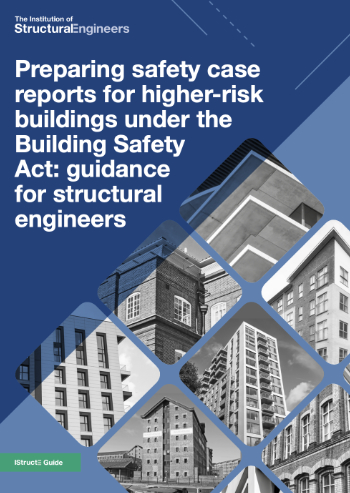
A new practical guide to preparing structural inputs for safety cases and safety case reports published by IStructE.
Male construction workers and prostate cancer

CIOB and Prostate Cancer UK encourage awareness of prostate cancer risks, and what to do about it.