





The destruction of the English country house
The V&A exhibition The Destruction of the Country House, 1875–1975, which led to the founding of SAVE and the revision of the listing rules, is remembered 50 years on.

|
| Highclere Castle, Hampshire, aka Downton Abbey, (Photo: Haley Blackmore, Wikimedia). |
The poor country house! In times of plenty it has been rebuilt and its estates sold off to make way for new developments. Aston Hall (1618) in Birmingham stands incongruously surrounded by the city’s later development, just as London has engulfed many other houses, such as Boston Manor House (1622), Charlton House (1607) and Eastbury Manor House (1570). They survive (like rescue dogs), finding new lives long after they were private homes. Elsewhere, in lean years, abandonment, decay and lack of upkeep brought dilapidation and ruin to other sites, often reducing the former buildings to piles of rubble.
No corner of the UK is without memories of such losses. Fires have struck down even the once most prosperous sites such as Cowdray in Sussex, reduced to a masonry shell overnight in 1793. It had been ‘pardoned’ from demolition by parliament at the end of the English Civil War (an early example of listing?). After war, fire is the next apocalyptic threat to menace old buildings.
When the families that had owned these mansions ran into the various later troubles that can afflict even the greatest of fortunes – as at Stowe House and Park, finally given up after years of struggle during Victorian years to open as a school in 1923 – more misadventure could follow. It is true that boarding schools, hospitals and hotels sometimes stepped in to take on the abandoned sites and put them to new uses. Here mixed results could ensue but at least the old buildings lived on to fight another day, with their gardens and parks used as football pitches or golf courses.
Given the setbacks, it comes as a perfect surprise that we actually do have so many great houses left. Sometimes their treasures are still intact inside or even amplified by accumulating leftovers as family properties elsewhere were cast off. Woburn Abbey took into its care art collections from other Bedford ducal houses and thus acquired, for example, the Canaletto pictures of Venice, a unique set housed (or rehoused) for display in a spectacular single room fitted up for this purpose. Most of our greatest houses tell similar stories, in which the loss of other houses has led to the enrichment of collections in surviving properties elsewhere. Even in the ‘worst’ of times, houses such as Parham, Sussex, or Haddon Hall, Derbyshire, were saved in the 1920s to be filled with antiques with wonderful effect by their devoted new owners and restorers. In many other cases, such as Danny House, Sussex, an ‘empty’ house was saved because its extensive grounds were too valuable to lose and residential conversion was permitted in a listed setting.
With thoughts like these in mind, one day in 1974 I got off a No 49 bus at South Kensington to see the Victoria and Albert Museum’s exhibition The Destruction of the Country House, 1875–1975. I needed to be convinced that it was actually ‘destruction’ that I was about to view. The losses due to world wars and the depression years that followed, as endured by great families, were well known to me, as vividly evoked in Waugh’s post-war novel Brideshead Revisited.
Evoking the crisis years of decline, 1912–26, the television drama series Downton Abbey still lay well in the future, being first screened in 2010. Downton Abbey is really Highclere Castle, just as Brideshead is really Castle Howard in the television version. Costume dramas on the screen, fashionable after 1975, may be other by-products of the V&A exhibition. The use of real buildings as settings for the action was rather rare for television or film locations until that time.
By making use of multi-media displays, and with taped sounds of buildings crashing down, The Destruction of the Country House was a shock to my eyes and ears. Nothing like it was known before, outside of cinemas, least of all in the staid exhibition halls of the V&A. The exhibition was a historical account with a message: wake up, the heritage is being trashed, soon nothing will be left! The pictures of houses already lost or of empty buildings in the process of falling down or being knocked down were deliberately displayed to displease the viewer. Violence and loss without mend were implicit in every image.
Reeling from the shock, I left the V&A without giving even a glance at any of its usual art displays. The exhibition’s after-effect is much documented. The catalogue now sells second-hand for about £100. Where is mine? Long lost, I am afraid. What followed was the founding of SAVE, the revising of the listing rules to include more Victorian and 20th-century heritage, and a considerable boom in attendances at country houses open to the public. Ten years after the V&A exhibition, The Treasure Houses of Britain: 500 years of private patronage and art collecting opened at the National Gallery of Art, Washington DC, with a splendid catalogue by Gervase Jackson-Stops. That show and its catalogue provided reassuring evidence of what had survived, at least inside the houses.
In the new atmosphere that the V&A exhibition helped to create, more attention was paid to the country houses of the 19th century. These were still being undervalued in 1974, often regarded as freaks in their design, too big or too ugly, and they stood at great risk. Mentmore Towers reached a crisis point in the late 1970s, for example, and this mid-Victorian great mansion has once more declined into being at risk.
In the aftermath of the show, with Mentmore much in the news, I arranged a group visit there for friends, with me at the wheel of a minibus. I transformed this pursuit into a part-time paid occupation for about two decades, taking my passengers to many sites from Castle Howard in Yorkshire to Kingston Lacy in Dorset. I realised that heritage was not merely a subject for enjoyment, historical research and accumulating knowledge, but that it could instead be a vital pursuit with practical outcomes.
This article originally appeared in the Institute of Historic Building Conservation’s (IHBC’s) Context 183, published in March 2025. It was written by Graham Tite, an independent heritage advisor.
--Institute of Historic Building Conservation
Related articles on Designing Buildings Conservation.
IHBC NewsBlog
IHBC sponsors Gardens Trust event 23-4 Sept 2026
.jpeg)
'Learning from the Past, Shaping the Future’ takes place in Milton Keynes
Renovations to Frank Lloyd Wright's Fallingwater complete
.jpg)
World Heritage Preserved project opens house for tours again
Shakespeare Birthplace Trust places Hall's Croft on HAR Register
Stratford-upon-Avon home of Shakespeare's daughter is 'At Risk'
Lady Grange’s House repaired on St Kilda
.jpg)
National Trust for Scotland repairs stone cleit with link to famous island resident
Griff Rhys Jones on BBC Radio 4 Today programme
,_Green_Lane,_Derby.jpg)
The Victorian Society’s President unveiled its latest Top Ten Endangered Buildings 2026.
Need a MATE? Book your place now.

IHBC offers free webinars on applying for IHBC accreditation (Full & Associate).
UK Stained Glass Repository finds windows new homes
How are stained glass windows are rescued, stored and repurposed?
APPGEBE report sets high aims for quality
'Government must not sacrifice quality in drive to build 1.5m homes'
New measures protect Historic Shipwrecks from heritage crime

Underwater cultural heritage benefits from new HE guidance
How could the City of London skyline look in 6 years' time?

Visualisation shows approved planning applications as completed buildings
National Trust for Scotland calls for VAT cuts
Heritage neglect is encouraged by current policies
IHBC's 'Context' Issue 186 features Industrial Heritage
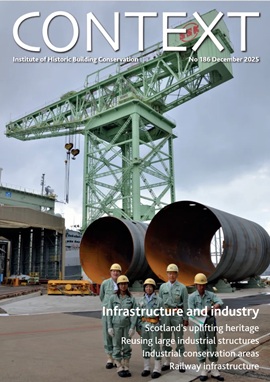
IHBC's members' journal reports on the challenges of conserving infrastructure
Book now for IHBC Annual School 2026

IHBC Annual School is taking place 18-20 June 2026 in Newcastle
RICHeS Research Infrastructure offers ‘Full Access Fund Call’
RICHeS offers a ‘Help’ webinar on 11 March
Latest IHBC Issue of Context features Roofing
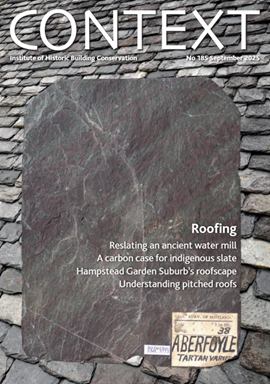
Articles range from slate to pitched roofs, and carbon impact to solar generation to roofscapes
Three reasons not to demolish Edinburgh’s Argyle House

Should 'Edinburgh's ugliest building' be saved?
IHBC’s 2025 Parliamentary Briefing...from Crafts in Crisis to Rubbish Retrofit
IHBC launches research-led ‘5 Commitments to Help Heritage Skills in Conservation’
How RDSAP 10.2 impacts EPC assessments in traditional buildings

Energy performance certificates (EPCs) tell us how energy efficient our buildings are, but the way these certificates are generated has changed.