




Pilot programme for National Model Design Code NMDC
Contents |
[edit] Introduction
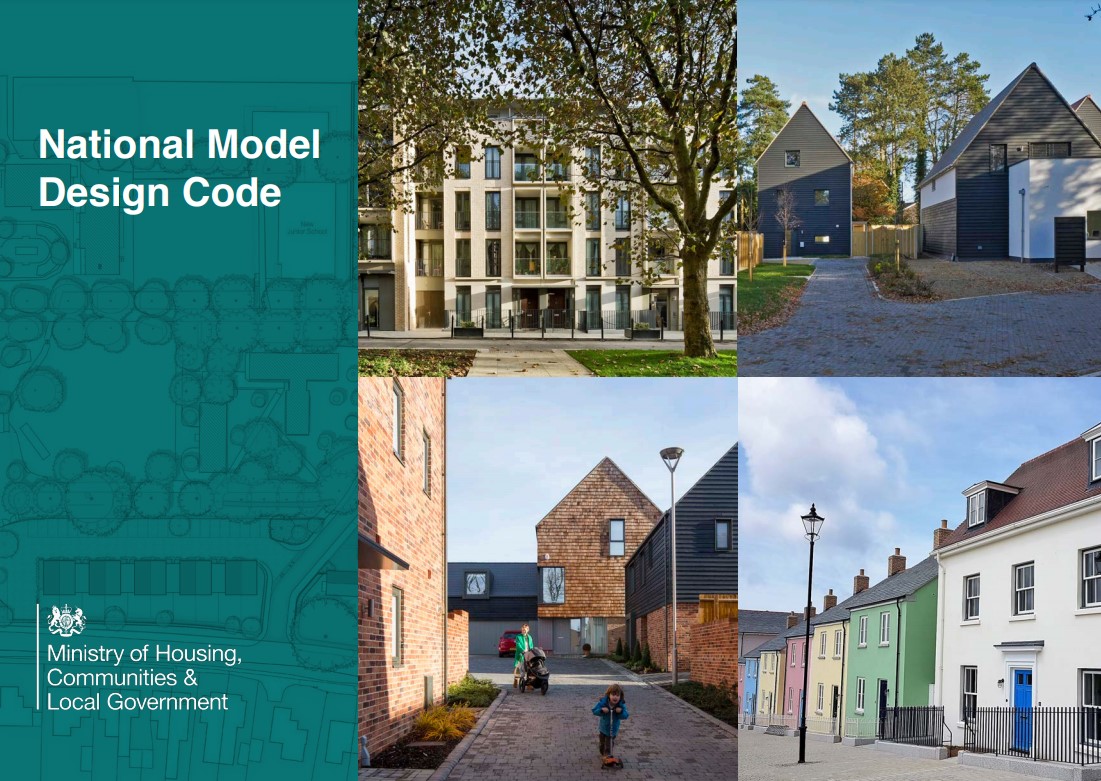
On 21 May 2021, the Ministry of Housing, Communities and Local Government (MHCG) announced that the National Model Design Code (NMDC) was being tested in 14 areas across England. The strategic theme of the NMDC - to prioritise beauty and place making within communities - is being considered by the Government as part of the changes to the National Planning Policy Framework (NPPF).
[edit] Beautiful and suitable
The purpose of the NMDC is to provide detailed guidance on the production of local design codes, guides and policies that lead to successful projects that are beautiful, well designed and locally led. The measures mean the word “beauty” will be prioritised in planning rules for the first time since the system was created in 1947 – going back to a previous time when there was a greater emphasis on whether a building was considered attractive to local people.
The NMDC provides local planning authorities with a toolkit of design principles to incorporate into new developments. In addition to providing methods to capture and reflect the views of the local community through the process, these measures include considerations such as street character, building types and façades. It also sets out environmental, heritage and wellbeing factors.
Some of the specific parameters of the NMDC include:
- Setting out the expectation that local authorities produce their own design codes and guides that define the principles that are reflected in new development in their areas.
- Asking for new streets to be tree-lined.
- Improving biodiversity and access to nature through design.
- Putting an emphasis on approving good design and refusing poor quality schemes.
[edit] Selecting the pilot participants
Following a consultation period, more than 70 Expression of Interest submissions were received to test the NMDC, with representation from every region of England. The final 14 applicants were shortlisted to ensure a geographical spread and a range of development types, including an urban conservation area with industrial heritage, town centres, new neighbourhoods, rural settlements and urban regeneration sites. Each pilot receives a £50,000 grant to carry out the project.
The 14 successful pilot applicants were:
| Local authority | Region |
| Colchester Borough Council, Tendring District Council and Essex County Council | East |
| Guildford Borough Council | South East |
| Herefordshire Council | West Midlands |
| Leeds City Council | Yorkshire & Humber |
| Mid Devon Council | South West |
| Newcastle City Council | North East |
| Dacorum Borough Council | East |
| Portsmouth City Council | South East |
| Sefton Council | North West |
| Southwark Council | London |
| Hyndburn Borough Council | North West |
| North West Leicestershire District Council | East Midlands |
| Nuneaton and Bedworth Borough Council | West Midlands |
| Buckinghamshire Council | South East |
[edit] The pilot programme
During the testing phase, the programme will provide participating councils with guidance to shape new developments in a way which reflects what their communities want. These councils will be asked to apply the NMDC in their areas as part of the Government’s Build Back Better initiative.
The objective of the pilot is to test the practical aspects of the NMDC in different types of developments, locations and regions across England, with the output being a local design code. Once the code has been formulated, the councils are expected to apply their updated building codes to future projects. The hope is that projects planned under these guidelines will be aesthetically agreeable and suitable for the local character.
The NMDC is part of a wider strategy outlined in the 2020 report Living with beauty: report of the Building Better, Building Beautiful Commission. The report proposed a development and planning framework with three principal goals – to ask for beauty, refuse ugliness and promote stewardship.
[edit] Related articles on Designing Buildings Wiki
- Building Beautiful Places plan.
- Building Better, Building Beautiful Commission.
- Building Better, Building Beautiful Commission interim report.
- Future Homes Standard.
- National design guide.
- National Model Design Code.
- National planning policy framework NPPF.
- Neighbourhood planning.
[edit] External resources
Featured articles
Check out some of the best features and news from Designing Buildings as well as key stories from around the web.
Introduction to radon awareness

New technical information sheet published by CIOB.

Updated supplier guide can help electrical contractors engage with NHP.

CIAT confirm the winners of the 2026 architectural technology awards.

Government launches a one stop shop for flood preparedness.

Sir Edwin Lutyens: Britain's greatest architect? Book review.

CIOB publishes free template to help assess and manage risks.
ECA's reflections on Party Conference season

Burnham wants to be confident of winning before asking for a fresh mandate.
New Chief Construction and Scientific Adviser

Sergio Cavalaro, Professor of Infrastructure Systems at Loughborough University.
Building safety levy for England

CIAT publish estimator tool for members.

Water sector faces a growing crisis that could slow the delivery of vital infrastructure.
Undervaluing our industrial past

Heritage value changes as taste for building styles changes.
Changing expectations around competence and compliance

New information sheet from CIAT.