






National Retrofit Hub unveils Guide to Digital Building Logbooks
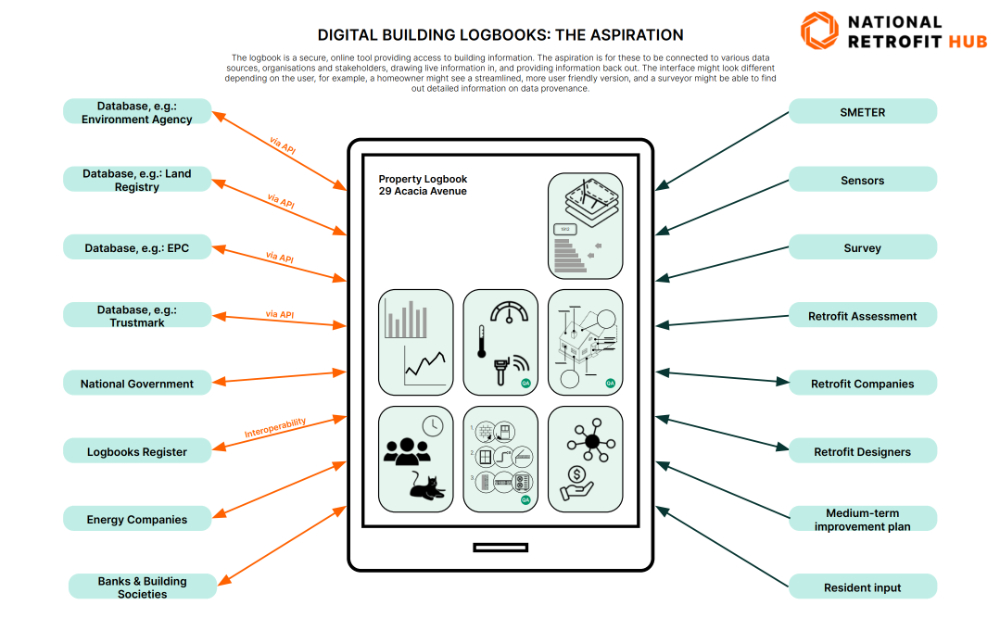
The National Retrofit Hub (NRH) introduces a valuable new resource: "DIGITAL BUILDING LOGBOOKS AND RETROFIT: AN INTRODUCTION”, a guide aimed at supporting retrofit initiatives nationwide. Digital Building Logbooks are currently used in the legal and conveyancing sector and have the potential to be expanded to include detailed information and retrofit plans for every home, helping to overcome multiple barriers to scaling up retrofit delivery.

"Digital Building Logbooks represent a transformative solution to streamline access to vital building data," states Rachael Owens, NRH Co-Director. "By storing retrofit assessments, plans, and performance data, these logbooks could empower stakeholders with comprehensive insights, enabling better resident engagement and informed decision-making."

In tandem with this guide, the NRH has released a matrix showcasing the current landscape of building data across the UK. This matrix, compiled by NRH Working Group 1 Technical Lead Louis Daillencourt, offers insights into data ownership, accessibility, and usage, inviting stakeholders to explore collaborative opportunities and address existing data gaps. The original work in this data matrix project was funded by ClimateXChange (CXC), and the Scottish Government. “We hope this research will be useful to anyone in the industry hoping to better understand which actors host what building and energy data”, said Louis Daillencourt. “We welcome further contributions from organisations hosting or modelling building data to keep enriching this document for the benefit of all in the industry”.
The NRH's initiative responds to the urgent need for standardised data schemas and enhanced accessibility to building information. By collaborating with industry stakeholders, the NRH aims to bring about standardised data schemas for new logbook sections identified, fostering innovation and collaboration in the retrofit domain.

"Digital building logbooks have the potential to revolutionise resident engagement in retrofit initiatives and provide accurate outcomes data to support finance," adds Rachael.
The NRH's efforts build upon the groundwork laid by organisations such as the Green Finance Institute (GFI), ClimateXChange (CXC), and the Residential Logbook Association (RLBA). Through consultation with stakeholders such as London Councils, B4NZ, and the RICS, the NRH has compiled key insights and identified the next steps to propel the adoption of Digital Building Logbooks nationwide.
"We are extremely pleased to see the launch of the NRH Logbooks Explainer document," remarks Nigel Walley, Chair of the Residential Logbooks Association (RLBA). "This report clarifies the interaction between Logbooks, Renovation Plans, and other data products, paving the way for widespread adoption across the property industry."
Moving forward, the NRH is committed to identifying stakeholders to inform data schemas, addressing ethical and ownership implications, and proposing solutions to manage data provenance and trust.
For more information and to download the Digital Building Logbooks guide and view the building data matrix, visit the NRH website.
This article was issued via Press Release as 'National Retrofit Hub Unveils Guide to Digital Building Logbooks' from the National Retrofit Hub, dated May 8, 2024.
[edit] Related articles on Designing Buildings
Featured articles
Check out some of the best features and news from Designing Buildings as well as key stories from around the web.

Sir Edwin Lutyens: Britain's greatest architect? Book review.

CIOB publishes free template to help assess and manage risks.
ECA's reflections on Party Conference season

Burnham wants to be confident of winning before asking for a fresh mandate.
New Chief Construction and Scientific Adviser

Sergio Cavalaro, Professor of Infrastructure Systems at Loughborough University.
Building safety levy for England

CIAT publish estimator tool for members.

Water sector faces a growing crisis that could slow the delivery of vital infrastructure.
Undervaluing our industrial past

Heritage value changes as taste for building styles changes.
Changing expectations around competence and compliance

New information sheet from CIAT.
Grenfell investigation files passed to CPS

Angela Rayner apologises on behalf of the British state.

Electrical contractors need to understand the practical implications.

The real barrier to getting more value from digital technology.

Your guide to The Construction Reset at UKCW Birmingham.