





Mitigation hierarchy
Competence frameworks for the built environment – Core criteria for sustainability competence - Code of practice , Version 3, published by the Edge for the Construction Industry Council in February 2025, defines the mitigation hierarchy as a: ‘hierarchical sequence of actions to anticipate and avoid impacts on biodiversity or ecosystem services; and, where avoidance is not possible, minimise; where impacts occur, restore; and finally where significant residual impacts remain, offset. NOTE 1 Its application requires taking each step in turn, focusing on all possibilities before moving on to the next step. NOTE 2 The term “compensation” is sometimes used interchangeably with “offset”.’
The Environmental Audit Committee. Environmental sustainability and housing growth: Sixth Report of Session 2024–26 HC 439 describes it thus "seeks to minimise the impacts a development has on biodiversity. The mitigation hierarchy has four levels that should be applied in order of priority:
- Avoidance: Preventing or reducing negative impacts on biodiversity.
- Minimisation: Reducing the severity or extent of impacts that cannot be avoided.
- Restoration: Restoring degraded biodiversity or enhancing existing biodiversity.
- Offsetting: Creating new biodiversity or improving the condition of biodiversity elsewhere; this should be used as a last resort."
See also: Biodiversity mitigation hierarchy.
[edit] Related articles on Designing Buildings
- Areas of outstanding natural beauty.
- Biodiversity mitigation hierarchy.
- Biodiversity Net Gain BNG
- Biodiversity net gain (BNG) regulations and implementation; Government response.
- Biodiversity Net Gain: statutory must-haves, plus the delivery model that de-risks planning.
- Biodiversity net gain, tools, tips and terms for small sites.
- Biodiversity net gain and terminology explained.
- Built environment.
- Carbon.
- Competence.
- Conservation area.
- Designated sites.
- Environmental Development Plans EDP.
- Environmental Principles Policy Statement EPPS.
- Forests.
- Green belt.
- Guidance on tree specification, BNG and more.
- How nature can be used to improve wellbeing.
- Local Nature Reserve.
- Local Nature Recovery Strategy LNRS.
- National nature reserve.
- National Parks.
- National Planning Practice Guidance.
- Natural England.
- Nature Restoration Fund NRF.
- Nature Recovery Network NRN.
- NPPF consultation briefing notes on terms.
- NPPF inquiry.
- NPPF.
- Nutrient Neutrality NN.
- NPPF.
- Outline planning permission.
- Planning and Infrastructure Bill PIB
- Planning legislation.
- Planning permission.
- Protected species.
- Resilience.
- Sustainability.
- Site of Nature Conservation Interest (SNCI).
- Sites of special scientific interest.
- What is the biodiversity metric?
- Wildlife corridor.
- Wildlife Trusts.
Featured articles and news

We're expanding our collaborative mission by launching DB Intelligence, an exclusive market research advisory panel. Built environment professionals can now get paid to share their expertise on industry trends, products and services.
Panel members receive direct financial incentives for participating in research projects like short surveys, 1-2-1 interviews and focus groups. Register today to shape the future of the construction sector.
Building Safety Wiki Interviews

Chief executive of the British Woodworking Federation.
Planning condition discharge in England and Wales

A brief exoplanation from a building compliance expert, with further links.
Overheating guidance and tools for building designers

Guidance for dealing with element of building fabric control that have increasing importance.
Shading for housing, a design guide

From the Good Homes Alliance and British Blind and Shutter Association.
UK Standard Skills Classification (SSC)

A shared framework for describing skills needs.
Social media ban consultation comes to close

CIOB urges UK Government to consider social media’s role in careers guidance in ban debate.
The latest of eight Skills England apprenticeship units

The addition of battery manufacturing welcomed by ECA with a warning about the risks of fast-tracked apprenticeship units.
Building Control Independent Panel final report
A precis of a key report led by Dame Hackitt with full recommendations and link to the government response.
Building Safety recap April, 2026
A short and longer run-through of the month, with links to further information and sources.
CIAT May 2026 briefing.

From medieval scribes to modern word art.

ECA welcomes crackdown on late payment and push for clean energy, whilst CIOB seek fixed cladding removal timeframes.
Cyber Security in the Built Environment
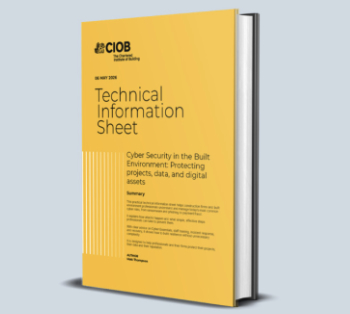
Protecting projects, data, and digital assets: A CIOB Academy TIS.
Managing competence in the built environment
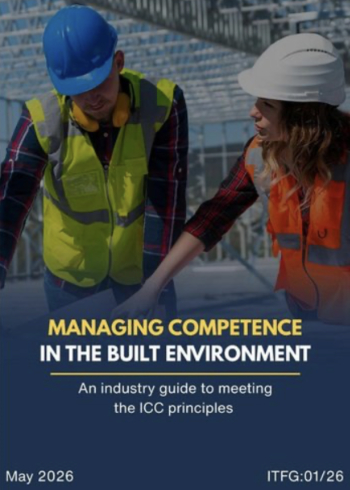
ITFG publishes new industry guide on how to meet the ICC principles.